• TalkBass has been independent since 1998. Add your voice.
    Create a free account to reply to discussions, view embedded media, and browse with fewer display ads.
    Join freeLog in
    Want zero display ads or expanded classifieds tools? Compare plans.

Output Jacks - Different for Active Basses? Patch Cord issues?

So, I recently had some issues with a new bass that I thought was the onboard preamp. It was intermittently not working in active mode. After some troubleshooting and support with the Company’s technical support, it was discovered that output jack was not making the correct contact depending on which patch cord I was using. The ends were slightly different lengths (odd, because there’re both Neutrik ends) with the slightly shorter one sitting on the black ring portion of the connector (contact point between the output jack and the patch cord).


The intermittent part of my issue was which cord I was choosing to put between my bass and the pedalboard and which I was putting between my pedalboard and the amp. It was a 50/50 chance!


It got me thinking, maybe I should just change the jack so that it is not a problem. But I was looking at what is available and saw “stereo” ones listed for active basses.


Do you really need a stereo jack to work with active basses? Have any of you encountered this? How did you correct the problem (without replacing all your patch cords)?

Here is a picture of the bad connection:
Sandberg_VM5_Input_Jack_(Bad_Connection).jpeg


Here is a picture of the good connection:
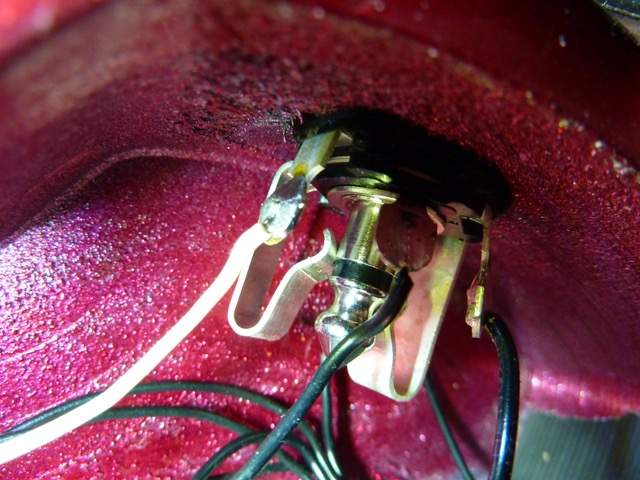
Sandberg_VM5_Input_Jack_(Good_Connection).jpeg


And here is the slight difference in length on the patch cord ends:
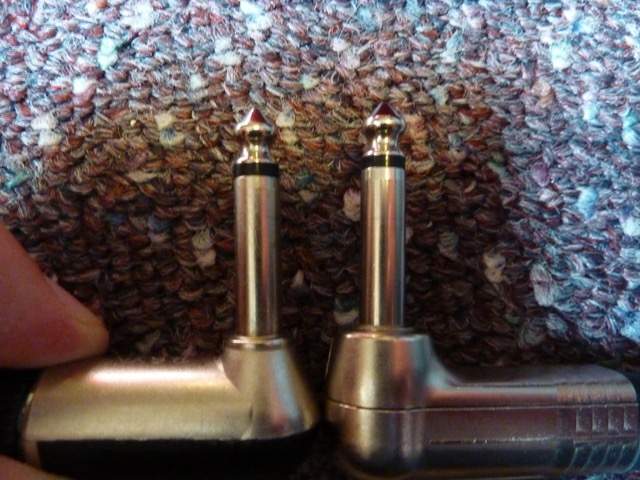
Patch_Cord_Neutrik_Jack_Lengths.jpeg


The other option is to bend the existing output jack so that it sits higher on the patch cord end.

 
I had a similar problem, but it was on the outside of the jack, or on the bass itself. The edge of the jack was not on the same level as the edge of the bass wood and the angled plugs could not penetrate fully. The jack was very deep in the wood. Works with straight plugs. I bought cables with angled plugs and with a bigger "neck" before the part that inserts into the jack. Everything's solved. Some jacks can be threaded more and thus stick more out of the wood solving the problem. I didn't realize if this is the same problem you have, but it's similar. Lucky with that.

IMG_1895.JPG
 
Active basses do virtually all use stereo output jacks, so that the battery power is only on when there is a mono cord inserted in the plug. This works because the stereo jack "ring" connector ends up lying against the sleeve (ground) portion of the plug - it is wired so that inserting a plug in the jack completes the battery circuit, connecting to ground through the plug.
 
I had a similar problem, but it was on the outside of the jack, or on the bass itself. The edge of the jack was not on the same level as the edge of the bass wood and the angled plugs could not penetrate fully. The jack was very deep in the wood. Works with straight plugs. I bought cables with angled plugs and with a bigger "neck" before the part that inserts into the jack. Everything's solved. Some jacks can be threaded more and thus stick more out of the wood solving the problem. I didn't realize if this is the same problem you have, but it's similar. Lucky with that.

View attachment 5019822
Many recessed sockets do not accept a right-angled connector well - the "L" of the connector prevents the plug from seating fully into the socket. Some right-angle cords will seat fully, but many don't. With some recessed sockets it is possible to remount the jack in the socket so that it protrudes further on the outside of the socket and that may be enough to accept an otherwise unusable lead cord.
 
Last edited:
Many recessed sockets do not accept a right-angled connector well - the "L" of the connector prevents the plug from seating fully into the socket. Some right-angle cords will seat fully, but many don't. With some recessed sockets it is possible to remount the jack in the socket so that it protrudes further on the outside of the socket and that may be enough to accept an otherwise unusable lead cord.

This ^

You've got an electrosocket jack holder, which is great, those things don't loosen up and give you issues that a football or square jack plate does. But as pointed out they don't like 90° jacks. Switch to a straight end and chances are you won't have the issue anymore.
 
Further to my last post...

The usual mount of a jack into a recessed socket is shown in this pic:

upload_2023-4-3_9-40-17.png


In many such cases there is a nut between the jack body and the socket (red arrow). If you remove that nut the jack can be screwed in further to the socket , allowing it to protrude further on the outside. This may be enough to allow the use of a right-angle cord.

upload_2023-4-3_9-42-15.png
 
Further to my last post...

The usual mount of a jack into a recessed socket is shown in this pic:

View attachment 5020025

In many such cases there is a nut between the jack body and the socket (red arrow). If you remove that nut the jack can be screwed in further to the socket , allowing it to protrude further on the outside. This may be enough to allow the use of a right-angle cord.

View attachment 5020026


I did this just a few weeks ago, works great...

Was having trouble with both Neutrik and Switchcraft RA plugs into an Electrosocket until I gave them enough jack to fully seat.
 
  • Like
Reactions: 96tbird
I did this just a few weeks ago, works great...

Was having trouble with both Neutrik and Switchcraft RA plugs into an Electrosocket until I gave them enough jack to fully seat.
To be fair, Electrosockets were designed to be used with straight-ended cords. And (don't quote me on this) I think they were originally designed as an improvement on the recessed jacks commonly installed on Telecasters. So many of them worked loose and were a pain to repair.
 
To be fair, Electrosockets were designed to be used with straight-ended cords. And (don't quote me on this) I think they were originally designed as an improvement on the recessed jacks commonly installed on Telecasters. So many of them worked loose and were a pain to repair.

Electrosockets seem to work fine with RA plugs for me as long as I use the longer jacks and ditch the extra nuts & washers.

The 4 screw plastic side jack holders seem a bit flimsy.

I like to loop the cable thru the strap and the RA plug will sit flat and out of the way.
 
  • Like
Reactions: 96tbird
Electrosockets seem to work fine with RA plugs for me as long as I use the longer jacks and ditch the extra nuts & washers.

The 4 screw plastic side jack holders seem a bit flimsy.

I like to loop the cable thru the strap and the RA plug will sit flat and out of the way.
Exactly my experience. I installed an Electrosocket and had to remove the nut and washers to make my Neutrik RA work. It’s great now.

back to the OP, don’t bend the Jack! Replace it with a Switchcraft stereo Jack and life will return to normal.
 
  • Like
Reactions: claudel and bholder
Yeah bending the jack contact arms is an easy quick fix, but usually won't last, they'll just bend back. And every time they bend, it weakens the metal at the bend point. A good quality jack is worth spending a bit extra for.
 
This ^

You've got an electrosocket jack holder, which is great, those things don't loosen up and give you issues that a football or square jack plate does. But as pointed out they don't like 90° jacks. Switch to a straight end and chances are you won't have the issue anymore.

My preference would be to use a 90 degree patch cord end as is it a side mount jack and the cord files over the strap well that way.
 
  • Like
Reactions: Reedt2000
My preference would be to use a 90 degree patch cord end as is it a side mount jack and the cord files over the strap well that way.
I get it, but I've never liked right angle jacks, too often the contacts are WAY close to the shielding because of the 90° turn so they can be more likely to short out.

It's all good though, to each their own :)
 
Further to my last post...

The usual mount of a jack into a recessed socket is shown in this pic:

View attachment 5020025

In many such cases there is a nut between the jack body and the socket (red arrow). If you remove that nut the jack can be screwed in further to the socket , allowing it to protrude further on the outside. This may be enough to allow the use of a right-angle cord.

View attachment 5020026

Yes, I have that bowl type in the first photo. I am not seeing a washer to adjust or remove though. Do you have to unsolder it to get access to it? I did unscrew the bowl and moved it a bit.

Oh wait, they're all the same jack. It looks like a bowl on the inside and straight on the inside...
 
Last edited:

Latest posts