• TalkBass has been independent since 1998. Add your voice.
    Create a free account to reply to discussions, view embedded media, and browse with fewer display ads.
    Join freeLog in
    Want zero display ads or expanded classifieds tools? Compare plans.

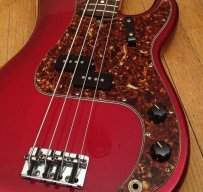
P Bass Pickup Height

I've looked at a few threads regarding pickup height but I was hoping people could chime in and clarify this for certain.

In Fender's Bass Guitar Setup Guide, it is stated that the bass side should measure 2.8mm and the treble side should measure 2mm. Bill Lawrence says 1 nickle touching the string to pickup on the high E and 2 nickles touching the string to pickup on the low E. Many others say just use your ear.

I interpret these instructions for a P bass to mean that I make the distance on the E string 2.8mm, A string 2mm and D string 2.8mm and G string 2mm. The problem with this is that I get a really loud A string with my Lakland. That being said, my P 46 Pickup seems to be very happy with this method.

When I do it the opposite way and make the E and A 2.8mm and the D and G 2mm, the D and G come off way louder than the E and A.

I have trouble doing it with my ears because I find it sounds good at home and is then all wonky at practice.

Does anyone have a tried and tested method for adjusting pickup height on a P bass?
 
spend 15 minutes at practice through the real rig with a screwdriver, tweaking until all 4 strings have equal volume.

that should mean G and D closer, A and E further away, with the inside ends steepled up a bit to follow string radius.

how close overall depends on you. i say close as you can get without the strings smacking into the pickup, and without it getting too boomy.
 
how close overall depends on you. i say close as you can get without the strings smacking into the pickup, and without it getting too boomy.

Depends on what tone you are after. The closer you get to the strings the more the signal will distort. And the more strange overtones will be introduced by the effects of the magnetic pull on the strings.

But if you like that kind of thing, go for it. Certainly not for me.
 
well, that would be the "too boomy" i was referring to.

"as close as you can get where it still sounds clear" might have been a better way to put it.
 
well, that would be the "too boomy" i was referring to.

"as close as you can get where it still sounds clear" might have been a better way to put it.

Wasn't trying to be picky, but I've dealt with lots of cases where the pickups were so close that the magnetic pull was causing bad overtones and "chorus" effects in the upper registers. In that case they don't sound clear - so I do prefer your edited version.
 
I adjust by ear. Adjsuting both individual pole peices and each pup half individually. No reason to go by some books measurements. Normally for P pup basses Ive had the pole peices are raised a little higher on the E&A string side compared to the D&G string half. With pup slant being mainly with curve of fretboard Most P pups basses Ive owned have been with neck and bridge P pup set. Bridge pup set frequently has ended up with the bass side slightly higher for bridge pup and treble side slightly higher for neck half.
 
  • Like
Reactions: byacey
When measuring for distance between pickup and string bottom, the rule is placed on top of the pole piece. In the case of dual poles, the rule can be rotated 90 degrees to span both pole pieces. Fine tune by ear if necessary.
 
i tend to set my p pups more linear with the closest to the string at the g and furthest at the e string. The way i play that seems to me to b the most even volume from each string. but i also tend to raise the e string to even with the a string even though the radius is not that way. except on older necks with a more rounded radius
 
Wasn't trying to be picky, but I've dealt with lots of cases where the pickups were so close that the magnetic pull was causing bad overtones and "chorus" effects in the upper registers. In that case they don't sound clear - so I do prefer your edited version.
Strange how people can play such basses without hitting the pickups with the strings, especially the E string supporting the thumb when striking other strings...
 

Latest posts