
Enjoy the benefits of a premium membership!
Upgrade Account
-
TalkBass has been independent since 1998. Add your voice.
Create a free account to reply to discussions, view embedded media, and browse with fewer display ads.
Join free Log in
Want zero display ads or expanded classifieds tools? Compare plans.
You are using an out of date browser. It may not display this or other websites correctly.
You should upgrade or use an alternative browser.
You should upgrade or use an alternative browser.
P-bass pot help - 500k
- Thread starter pocketgroove
- Start date
More options
Who Replied?

that works too; you get more brightness than both being 250k, but you can roll the tone back just a little and be right at true "vintage" spec.CTS pots 500k audio for the tone pot, and 250k linear for the volume...
(this works for the tone, but turning down a 500k volume does not make it the same as a 250k.)
not sure how easy 250k linear CTS pots are to find, but 300k linears are plentiful, and close enough.
as for the knobs, if they don't fit i vote just getting some that do.
I sure would like to know a few things.
1. Is this an American P?
2. Solid shaft-style knobs?
3. The knobs won't fit because the hole in the knob is too small or did you get one of the long-threaded hex-nut pots?
I agree with walterw. Get the pots MADE for a Fender (CTS) and get some new knobs in the style you prefer.
1. Is this an American P?
2. Solid shaft-style knobs?
3. The knobs won't fit because the hole in the knob is too small or did you get one of the long-threaded hex-nut pots?
I agree with walterw. Get the pots MADE for a Fender (CTS) and get some new knobs in the style you prefer.
I wasn't familiar enough to know if there were different size control holes for Mexican, Korean, Affinity, etc. Guess that's true. He may as well go ALL AMERICAN and be done with it.
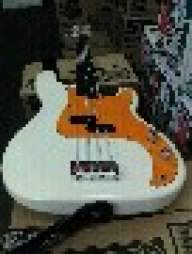
Well, thanks for the help everyone. I don't really have access to many tools, but I took some finishing files I had and enlarged the pickguard holes, as well as the inside of the knobs. Now everything fits and is in place! I'm happy to be able to use the nice CTS pots, and through a little trick, I was even able to make it so that the pots and jack actually thread into the pickguard, which helps keep them in place.

I don't mean to threadjack or derail, but while we're on the subject of pots - would putting brighter pots (500K or 1 Meg) help combat the effects of cable capacitance? In other words, would I in theory be able to run, say, a 30 foot cable and have the same tonal properties of a 20 footer?
Just curious...
Just curious...
The resistance of the pickup plus the volume pot and tone pot/cap form a low pass filter, to keep it simple. Yeah, it would somewhat but I wouldn't look for a miracle with a 30 ft. cable. I'd use a low capacitance variety such as a Lava cable. There are others. There's a thread on here somewhere comparing capacitance per foot of some brands. You might be able to pull it off with one of those, but again, don't expect a high impedance system to give you low impedance high frequency response. It might even help if you disconnect the tone cap completely if you HAVE to have a 30 ft. cable.

The resistance of the pickup plus the volume pot and tone pot/cap form a low pass filter, to keep it simple. Yeah, it would somewhat but I wouldn't look for a miracle with a 30 ft. cable. I'd use a low capacitance variety such as a Lava cable. There are others. There's a thread on here somewhere comparing capacitance per foot of some brands. You might be able to pull it off with one of those, but again, don't expect a high impedance system to give you low impedance high frequency response. It might even help if you disconnect the tone cap completely if you HAVE to have a 30 ft. cable.
You say that like the cap is always in the circuit and active even when the tone knob is fully turned to either side of it's sweep.
Is it actually doing anything when it's there but the tone knob is nowhere in between the two extremes?
I edited my word there - to nowhere.
Yes. If it's soldered in where it belongs, it's always in circuit. The volume control and the tone control are actually paralleled, so resistance will go down according to the parallel combination of the two pots when the tone is all the way up.
In other words, with the tone pot wide open (no cut) there will be 500k volume >500k tone > cap > ground. With the tone pot all the way down (max treble cut) there will be 500k volume > cap > ground.
I think I have that right. I'm too tired to proofread.
In other words, with the tone pot wide open (no cut) there will be 500k volume >500k tone > cap > ground. With the tone pot all the way down (max treble cut) there will be 500k volume > cap > ground.
I think I have that right. I'm too tired to proofread.
I don't mean to threadjack or derail, but while we're on the subject of pots - would putting brighter pots (500K or 1 Meg) help combat the effects of cable capacitance? In other words, would I in theory be able to run, say, a 30 foot cable and have the same tonal properties of a 20 footer?
Just curious...
Higher value pots will increase the brightness in a certain way. Longer cables will
decrease the brightness in a certain, but different way. So higher value pots won't
exactly compensate for a longer cable, but it will compensate to some extent.
But this is only true if the volume pot is kept at "10". If you turn back the volume pot,
things will be worse. You will not only lose high frequencies from the longer cable,
but you will also lose additional high frequencies from the added series resistance
of the attenuated volume pot setting. The advantages of higher volume pot values
are only there at max setting. Turning the volume back will defeat the purpose.
A better solution is a treble bleed cap. That will preserve the high frequencies (more
or less) at lower volume settings.
For the tone pot, the higher value will also add to the brightness. But there will be no
extra losses when turning down the tone pot. You will just get the various tone effects
at different positions of the knob setting. All the effects of the tone control will be more
in the lower settings, with less effect near "10".


