• TalkBass has been independent since 1998. Add your voice.
    Create a free account to reply to discussions, view embedded media, and browse with fewer display ads.
    Join freeLog in
    Want zero display ads or expanded classifieds tools? Compare plans.

P-Bass too bassy. Strings or pickups?

Thanks everyone for your input.

I tried switching the e-string for a take-off roundwound I had as a spare from my other bass. It added a bit more bite to the sound but didn't reduce the bass aspect of the sound.

As I had to go to my luthier, I discussed it with him and according to him, it's a matter of the wood being new and not having had the chance to open up yet.

Now, let me clarify that I didn't dislike the sound. It's superb. I was just surprised to have to turn the bass all the way down compared to my SR5.

Going back to my luthier, he assured me that everything is stock vintage and that the body parts are of superb wood. (alder body, rosewood board). I also checked him remove the neck to adjust the rod and it couldn't be sitting tighter in the pocket.

He added that of all the real vintage P-Bass he saw in his shop, aside from the sound being less opened, it was very impressive sounding, comment I also had by the leader of a project I work for, and that all in all it's a good "problem" to have cause usually it's the other way around where people want more bass in their P's.

So yep, I will give it a lot of play time love and care and will EQ accordingly.
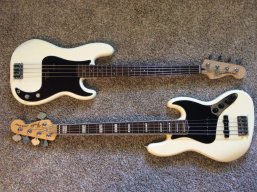
 
As I had to go to my luthier, I discussed it with him and according to him, it's a matter of the wood being new and not having had the chance to open up yet.

:eyebrow: That smells like BS. With acoustic guitars when the wood hasn't opened up yet,they sound thin and brittle because they're so tight and stiff,as they age they loosen up and become more bassy and full because the wood is able to move more freely...

Just think about treble and bass frequency curves. Bass is wide,very loose with broad archs,and treble is tight and sharp. That makes no sense.
 
:eyebrow: That smells like BS. With acoustic guitars when the wood hasn't opened up yet,they sound thin and brittle because they're so tight and stiff,as they age they loosen up and become more bassy and full because the wood is able to move more freely...

Just think about treble and bass frequency curves. Bass is wide,very loose with broad archs,and treble is tight and sharp. That makes no sense.

Open up might not be the right choice of words to sum it up.

Basically he said that since the wood is new, it hasn't lost it's humidity the same way as a real '62 would and that since it hasn't had the chance to resonate during all these years, the wood's fibers are tighter, more compact.
 
I can't believe people are recommending roundwound strings to reduce "bassiness". I use Daddario Chromes and never have a problem with it being too bassy, lots of brightness when I open up the tone knob. Check your EQ?

Yeah, I don't get this either. It's like people are saying that since flats have less high-end zing than rounds, that rounds must have less low-end output than flats? Huh? :confused:

It's all about the eq settings and how they interact with the room.
 
I'm also wondering if some of this is due to you not having become familiar with a P-Bass. That P pup is a different animal bro.

That's a strong possibility also. It's the first other bass than my SR5 that I run through my Micro-VR kit since I got it.

The thing though is I had the chance to compare mine with a real '64 from a friend of mine, in an old Traynor kit and his had less bass (not a lot) and more mid. Mind you, his has D'Addario roundwounds on.

Like I said, the sound is still superb, I just found it unusual to have to turn the bass knob all the way down. And I understand that the room might have had something to do with it.
 
It's not the strings and it's not the wood being "not opened up", whatever the hell that is supposed to mean. Anyone who tells you either of those things is also going to try to sell you a bridge in Louisiana.

Fine,

So you take a body made of alder, match it with a neck, put on some period correct pots, pickups, bridge etc... then string on some flats and find yourself with an end result bassier and less midier than you expected.

What are you left to do???

Like I said.... the sound is not awful. In fact, the guys on last night's gig complimented me on the sound. I'm just not used to have to turn the bass all the way down on my Ampeg Micro-VR kit compared to my SR5.

Would it be the same with another P-Bass, in the same environment. I can't say. All I know is my friend's '64 P is less bassy and has more mids. Due to what??? I don't know.

Was I expecting something not P-Bass-y in my head beforhand...? Maybe. Will I try to compare other P-Bass... defenitely. Will they compare... who knows for now.
 
This idea of flats somehow being too "bassy" is just silly, that's what I mean. I have basses strung with flats, some with rounds, and the only sonic difference is that the rounds have more top end - not that the flats somehow magically have more bottom. They just don't. The people who are telling you it's the flats, in my opinion, are people who don't use flats.

And sure, body wood can make a difference, but in an electric bass, the diff is going to be subtle.

There might be something wrong with the electronics, but I promise you, no one here can tell you that for sure without getting some eyeballs on it. Internet analysis is notoriously bad, and I have a long history of not participating. That said, I SUSPECT that if you have to turn the bass all the way down, there is something not quite right with the wiring.

But maybe not. Maybe it's what you're used to hearing. I have a long history with SR5s, but played a P bass for decades quite happily. But don't ask me to go back now. I've tried it. It didn't work out for me. Maybe you need to analyze what it is you really want from a bass, and maybe what you want is what the SR5 gives you - who knows? Not I!

I hope you get it worked out.

Jack
 
it seems that the OP is just used to how bright and middy and SR5 is when compared to a p bass. IME, a p bass is alot more round and full sounding (and duller-in a good way), whereas an SR is often bright with a quicker response.

as far as the 'wood opening up'. yeah basses do get a little livelier with age, but it takes about 20 years and even then, it's not that much at all. when i build a bass for my clients, they sound right (and vintage authentic) on the first day that they're assembled.
 
It depends what kinda bassy your talking to be honest, I've never come across a bass that was too bassy, but I've certainly come across basses that were too muddy, dull, boomy or distant. I can never get too much full clear bottom end, but that doesn't mean your tone doesn't have mids and top. It sounds to me like something isn't wired right, the wood thing is bollocks cos wood and construction are a subtle influence on sound compared to electronics and strings.
 
Open up might not be the right choice of words to sum it up.

Basically he said that since the wood is new, it hasn't lost it's humidity the same way as a real '62 would and that since it hasn't had the chance to resonate during all these years, the wood's fibers are tighter, more compact.

:rollno:

Why would humidity only escape from a piece of wood and not enter it? Has this tech actually measured the humidity in the piece of wood from your bass?

Wood fibers don't loosen over the years - if that was the case old instruments would eventually fall apart in shards.

This is one of the reasons (I've stated before) that I think the term "Luthier" is thrown around a bit too loosely these days.

Anyway - put the same electronics (pups, pots and cap) in your bass that your friend has in his P bass, set the action and pup height the same, string it with the same strings and you'll then get to hear the actual difference between your basses.

Other than that, adjust your pickup height and action to match your friend's, check the wiring, pots and cap to make sure they're good and see how that sounds.
 
Ok let me give you guys a better idea.

As I don't have an audio interface at home at the moment, here are two reference clips.

The P-Bass sound I had in my head, well the way I figured it usually sounded is like this :

And like I said, not bad at all, the sound is great, just not what I thought it would be and different to my friend's P.
 
Ok let me give you guys a better idea.

As I don't have an audio interface at home at the moment, here are two reference clips.

The P-Bass sound I had in my head, well the way I figured it usually sounded is like this :

And like I said, not bad at all, the sound is great, just not what I thought it would be and different to my friend's P.


I believe Pino likes to play with the tone rolled off. If your tone knob doesn't allow you to brighten up the sound you could have a wiring problem (like another poster mentioned) or bad component, like the cap, one of the pots or pickup.

BTW, that's a killer groove by Pino, one of my favorites by that band.
 
I believe Pino likes to play with the tone rolled off. If your tone knob doesn't allow you to brighten up the sound you could have a wiring problem (like another poster mentioned) or bad component, like the cap, one of the pots or pickup.

BTW, that's a killer groove by Pino, one of my favorites by that band.

It's not a matter of tone. My tone works perfectly. It's the amount of bass in the sound. In the two clips even if Paul's tone is bright and Pino's turned off, Pino's sound is more bassy to my ear.
 
I don't think this will be resolved here, because too much depends on "what your expectations were" and "what you are hearing"....but, I think you've been given good advice.
Questions:
Did you play your friends P Bass? Much of how a P bass sounds lays in the hands of the player, IMO.
What kind of pup was in your friends P Bass?
What is your playing style? Fingers by the neck? Pick at the bridge?
If your tone knob is definitely working, maybe you'd like quarter pounders better?
Anyway, Good Luck.
 

Latest posts