70sIf helps, I like 70/80s rock.
I'd like something deep/dark
80sversus bright/clangy...
thats a dilemma


TalkBass has been independent since 1998. Add your voice.
Create a free account to reply to discussions, view embedded media, and browse with fewer display ads.
Join free Log in
Want zero display ads or expanded classifieds tools? Compare plans.
70sIf helps, I like 70/80s rock.
I'd like something deep/dark
80sversus bright/clangy...


Seymour Duncan SPB-2 with 250k pots and the tone rolled off about halfway will get you there, that pickup has lots of lows and low mids, not a lot of treble, gets pretty aggressive if you dig in but round and fat if you play softlyHey guys... got a Squier P-Bass Affinity here that I just finished refinishing the paint on, figured while at it, have a go at the electronics.
I've read some people prefer 250k pots, some 500k pots, and some 250k volume and 500k tone...
I'd like something deep/dark versus bright/clangy... what would you guys recommend? and what cap value?
If helps, I like 70/80s rock.
Thanks

or a SPB3Seymour Duncan SPB-2 with 250k pots and the tone rolled off about halfway will get you there, that pickup has lots of lows and low mids, not a lot of treble, gets pretty aggressive if you dig in but round and fat if you play softly
Yes although the SPB-3 can be quite bright with the tone openor a SPB3

Changing pots will improve your Squier Bass ability to make a better 70s/80s rock? … got doubts about thatHey guys... got a Squier P-Bass Affinity here that I just finished refinishing the paint on, figured while at it, have a go at the electronics.
I've read some people prefer 250k pots, some 500k pots, and some 250k volume and 500k tone...
I'd like something deep/dark versus bright/clangy... what would you guys recommend? and what cap value?
If helps, I like 70/80s rock.
Thanks


250k is generally considered the "classic" tone so that is probably what you'd be after. And I'd recommend Seymour Duncan spb-1 pickupsHey guys... got a Squier P-Bass Affinity here that I just finished refinishing the paint on, figured while at it, have a go at the electronics.
I've read some people prefer 250k pots, some 500k pots, and some 250k volume and 500k tone...
I'd like something deep/dark versus bright/clangy... what would you guys recommend? and what cap value?
If helps, I like 70/80s rock.
Thanks


A higher value cap will cut more treble.what's the 0.1uf do to the sound? brighter? darker? warmer?
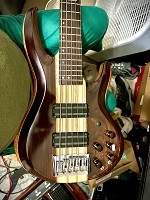
While I have a 2017 Fender Professional J bass I have to say my 2018 Fender Player Series P is very nice and lower price pointDon’t waste your money upgrading a Squire. Save and buy a used MIA P.

Hmm... just curious. Does your Obsidian harness have the treble bleed mod in it? Not sure if they are necessary or effective in a single-pickup instrument. A few months ago, I bought an Obsidian hardness for Jazz bass that includes the treble bleed. I installed it, and did not like the tone when I turned down either volume knob. It didn't stay in very long - I took it out, ordered pots, an output jack, a tone cap, and built my own.
I understand how treble bleeds work, and I've used them in the past (but not Obsidian's version). This was different, in a bad way. I also understand that with a passive bass you can only cut frequencies, not boost. The Obsidian sounded, to me, like a high-pass filter with the cutoff frequency fairly high - as if all the lower frequencies were being filtered out - and again, very much unlike any other treble bleed I've used.
I DO like the solderless concept, and how Obsidian uses it - very well thought out. It was the treble bleed that turned me off to it.

I'm not an electrical engineer - my understanding (and I have noticed this) is that when you turn down a volume knob on your guitar/bass, some of the high frequencies bleed off (they are lost). A "treble bleed mod" is usually a combination capacitor and resistor that is soldered between the lugs of the volume knob, that prevents this from happening. The choice of resistor and capacitor values influence how the mod affects tone, as does the choice of whether they are wired in series or parallel.I don't think there's a treble bleed. (actually I don't know what that is!) just volume and tone.


250k ohm pots with a 0.1uF tone cap.