• TalkBass has been independent since 1998. Add your voice.
    Create a free account to reply to discussions, view embedded media, and browse with fewer display ads.
    Join freeLog in
    Want zero display ads or expanded classifieds tools? Compare plans.

Paranoia or thorough?

beaglesandbass

Anti-Tort Activist
Staff member
Gold Supporting Member
Supporting Member
Aug 14, 2001
14,774
19,438
Philly Suburbs
I have an issue, and I'm not sure if I'm being paranoid about it, or just being thorough. Until recently I only used 1 bass at gigs, but I always bring a backup. My wireless receiver has a built in tuner, so I don't have a dedicated tuner on board. I would typically just tune both basses, put one on a stand and hope I don't have to use it.

Now we are using a couple songs that I need my 5 string for. Ideally I would like to keep downtime to a minimal, so I bought a ABY pedal, so I leave one bass connected wireless, and one wired. When the time comes I just put one down, pick other up, hit the switch and boom, good to go.

My issue (paranoia) is that the bass is going to somehow come out of tune between tuning pre-gig and picking the bass back up (we usually play those songs in the 2nd set). I thought of getting a dedicated tuner and just throwing it on the board that both basses can run into, it just seems redundant as the wireless receiver already acts as a tuner, and I imagine the bass probably isn't going to come out of tune just sitting on a stand.

So, am I being paranoid or being thorough?

In theory, I could get rid of my current DI and buy one that has a tuner built-in (GK Plex or Sonic Nuance), or just tell myself to stop worrying.
 
  • Like
Reactions: salmon256 and JRA
Without adding a pedal on your board, you can just put a little tuner on the head of the five string. Couple of bucks = peace of mind
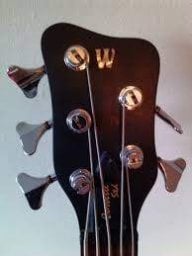
Yeah I've thought of that. I have a couple Snarks, one made by D'Addario, and I actually have one that screws into the back of the headstock using the tuning machine holes. I've found that as much as they advertise they can, they just don't track well for the low B.
 
  • Like
Reactions: Reedt2000
I don't think I'd keep a bass around that goes so far out of tune, so quickly, that it's a problem in just a couple of sets.
You could also just check / re-tune between sets though? Should only take a few moments to do two basses. If it's still managing to go out of tune... I'm not sure having a tuner right there is going to really solve things.
I run all of my basses through my AX8 which has a built-in tuner. While redundant, a dedicated tuner on your board would end up being what you use for both basses, and be the "simplest" solution that I can imagine right now.
 
I don't think I'd keep a bass around that goes so far out of tune, so quickly, that it's a problem in just a couple of sets.
You could also just check / re-tune between sets though? Should only take a few moments to do two basses. If it's still managing to go out of tune... I'm not sure having a tuner right there is going to really solve things.
I run all of my basses through my AX8 which has a built-in tuner. While redundant, a dedicated tuner on your board would end up being what you use for both basses, and be the "simplest" solution that I can imagine right now.

No, it doesn't come out of tune that quickly. I'm just worried I'll bump
or or accidentally knock it out of tune.
 
I use a headstock tuner just in case but I have a tuner sitting on my amp.

When I use more than one bass I tune both between sets and have never had a problem.

I find that if I leave the basses out after soundcheck they acclimated to the air conditioning and may shift slightly but once tuned before the first set they typically stay there for the rest of the night.
 
Unless your bass has issues staying tuned, or you're playing in changing temperature conditions, you're being overly concerned in my book. Like you, I have a spare that gets tuned to start the gig and then shelved until needed. If I had to use it unexpectedly mid-set, I would strap it on, plug it in and expect the best - and tune as I went if it was awful - I find that most will never know if the low strings are out of tune anyway. If it's higher string, I'd avoid it if it was sour until the song ends. A clip on tuner is probably best for an emergency tuning.

I'm in the habit of checking my tuning before each set anyway, so if I knew I was using my spare, I'd double check both basses between sets.
 
I think you're worried about something that may only happen oncein a great while. If you tune both basses early on when you setup, then check again before your 1st set starts (and before any other sets depending on what a typical gig is like) you'll be just fine. A clip on tuner on the 5 string is a good idea just in case. The TC polytune tracks the open B great... but it eats batteries like crazy and is not the least expensive option. I find the Snark is ok though I double check the B to the 12th fret harmonic just to be sure.
 
I've found that as much as they advertise they can, they just don't track well for the low B.
Yeah, I'm with you on the low B, but you can just hit the harmonic and it tracks better and quicker.
 
What if the four string goes out of tune / gets bumped while you're playing the five string? Get a TurboTuner ST-300 mini and put it as the last thing on your chain before your DI. Now you can mute everything if a cable goes wonky or a pedal's bypass stomp switch fails and the effect won't turn off. Whatever the case, you can mute everything and if you position things correctly you can set it up so that you can bypass everything else on the board and plug directly into the tuner to get through the set and then troubleshoot any issues at break. The TurboTuner will tune faster and more precisely than the tuner built into your wireless.

This isn't the mini, but if I have any issue with my pedalboard, I unplug the tuner input, run the instrument cable into the tuner (all while muted) and I'm back in business in a few seconds. The Noble DI powers the board and is the DI, so if it fails I'm completely screwed and would need to breakout the passive JDI that I usually carry as a backup. But that's a major operation as levels will need to be adjusted. Hey, I'm playing for $100 / night not bassist for Carrie Underwood. I think I'm probably still proportionally overkilling this.


15DAE4D0-9F7C-4F62-A561-BA0CC89DC750.jpeg
 
Last edited:
  • Like
Reactions: J-Bass RMR
1) Have you thought about using the 5-string as the primary gig bass and bring another bass as a backup?
2) Headstock tuners are cheap, cheap, cheap insurance.
3) Do you keep the last set of bass strings you took off the bass to have spares in case a string breaks? (the reason for keeping the last set: if you do have to change strings, nobody will hear "boom-boom-thud-boom," but everybody will hear "boom-boom-twang-boom" from a string out of a new set.
4) Extra cords?
 
Last edited:
  • Like
Reactions: smogg
I have an issue, and I'm not sure if I'm being paranoid about it, or just being thorough. Until recently I only used 1 bass at gigs, but I always bring a backup. My wireless receiver has a built in tuner, so I don't have a dedicated tuner on board. I would typically just tune both basses, put one on a stand and hope I don't have to use it.

Now we are using a couple songs that I need my 5 string for. Ideally I would like to keep downtime to a minimal, so I bought a ABY pedal, so I leave one bass connected wireless, and one wired. When the time comes I just put one down, pick other up, hit the switch and boom, good to go.

My issue (paranoia) is that the bass is going to somehow come out of tune between tuning pre-gig and picking the bass back up (we usually play those songs in the 2nd set). I thought of getting a dedicated tuner and just throwing it on the board that both basses can run into, it just seems redundant as the wireless receiver already acts as a tuner, and I imagine the bass probably isn't going to come out of tune just sitting on a stand.

So, am I being paranoid or being thorough?

In theory, I could get rid of my current DI and buy one that has a tuner built-in (GK Plex or Sonic Nuance), or just tell myself to stop worrying.


I vote for being prepared.. it's the old Boy Scout in me.
 
I think it all comes down to how much assurance you need. Entire orchestras play without a single tuner on stage. Nobody in my band (19 piece jazz ensemble) brings a tuner. But nobody leaves the house with an instrument that isn't trusted to stay in tune over the course of a set.

On the other hand, acoustic instruments can be tuned discreetly on stage, and there are different traditions about whether it's OK to be heard while you're tuning.
 
  • Like
Reactions: wmmj and dalkowski
Not sure what the concern is. Tune each bass during each set break. Tune during the set as needed.

ABY works fine if both basses have similar levels and similar EQ requirements. Otherwise it's best if each bass has its own tone and gain controls. However, if the reason you change basses is because a few songs require notes on the B-string, a better solution may be to learn to play the 5-string well and use it as your primary. Then you will only play the 4-string if the 5-string fails.

For the record my #1 since about 1995 has been a 6-string. There are some very limited circumstances where a 4 string would be a better choice, but I am rarely faced with them. I tend to use the 6-string even when I don't need to play notes on the B or C string.

There is a difference between being a natural 6-string player and being a 4-string player and faking it. If you only play 6-string, you eventually develop a different way of navigating the neck; I.E different finger and shift patterns. When you cover a lot of range with 4-string you have to shift up and down the neck. When you have extra strings, you typically play across the strings and shift less. Over time this way of thinking becomes automatic, so you play effortlessly without thinking about it.

I only own one 6-string. I also own multiple 4-strings and a pair of 5-strings. I don't like playing the 4-strings and 5-string too much because it requires me to think about how I will navigate the neck rather than just doing what comes naturally on the 6-string. If I play a 4-string or 5-string too much, it actually degrades my skill on 6-string.
 
  • Like
Reactions: wmmj