• TalkBass has been independent since 1998. Add your voice.
    Create a free account to reply to discussions, view embedded media, and browse with fewer display ads.
    Join freeLog in
    Want zero display ads or expanded classifieds tools? Compare plans.

Passive vs Active, what do you actually gig with?

Not what sounds best in theory, what do you actually take to rehearsals and gigs?

And do you ever use the onboard EQ, or just leave everything flat?
Really?

All active, all the time, and the EQ is there to be used. There’s nothing better than a nice active double filter setup for a wide range of tones in a cover band.
 
  • Like
Reactions: Afc70
Active most of the time.. I always use my onboard eq, generally I boost up the bass 80% or so, bump the mids slightly , & treble usually close to, or just a bit past center detent. I have a passive Lull T-Bird 5 that sounds wonderful too, I enjoy those passive bass tones as well.
 
I play professionally and use both. I need both sounds for recording, just as one needs different basses with different strings, pickups, etc for options. But for live when I use a passive bass I pretty much always use an outboard pre of some kind because that finessed tone goes DI to FOH. I try to approximate the sound of the bass DI'd in the studio and with some EQ for my signal to send FOH live.
 
Last edited:
For me, active or passive depends on the gig.
My favorite bass is a passive P, so I play that most of the time.
Some gigs demand a 5 string, though, and I'll usually play an active bass on those to clean up the B string.
Other gigs demand a specific sound, so if I have that sound in the arsenal, I'll use that.
 
I play three main basses: a Fender P with flats (passive), a Fender J with nickels (passive), and an Sadowsky M5-24 (active).
  • In my opinion, the Sadowsky is designed for use with the preamp. Without it, it sounds wimpy. I use the preamp to gently boost the bass and treble, without stepping into the role of the sound engineer.
  • I use my passive basses either through the venue amp, or through a phantom-powered preamp/DI like Aguilar Tone Hammer or MXR M81; where I likewise do some mild shaping.
 
I have (among others) a G&L L-2000 Tribute 4-string bass in Blue Burst. This bass is odd, in that it has three switches in it that will select the pickup(s), change from passive/active mode, and change series/parallel mode. It also has G&L MFD pickups that are super-hot just as they sit, even in passive mode.

In active mode, I have to turn the volume back to around 50% to keep the pickups from overloading the front end of my Rumble 500. In passive mode, I also have to turn the volume back at least 25% or the input section of the amp will clip. Alternatively, I can turn down the bass control some -- but I like to rattle the windows and set off car alarms.
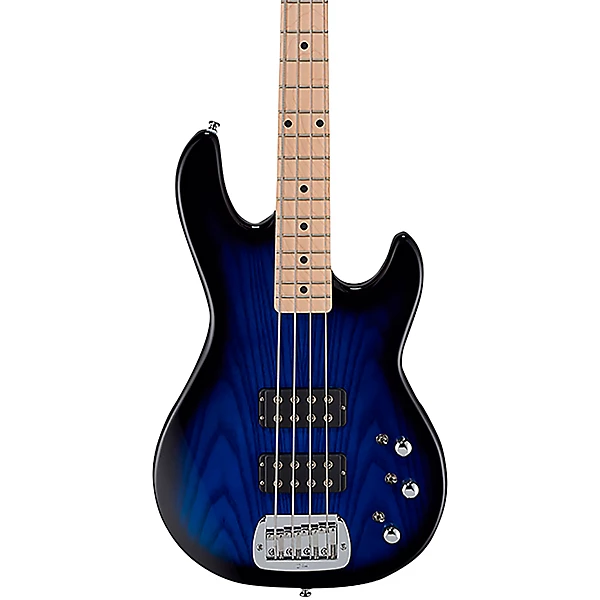
GL L2000.webp

I find I like the active tone in the bass more than the passive tone. However, the G&L L-2000 is not a "dime the controls and forget it" instrument. You can get a wide variety of tones by manipulating the various knobs and switches. Once it is dialed in to user preference, the bass is a real beast.

The one downside to this bass is that it takes six screws to get to the 9v battery. If the battery were to die during a gig, it would not be quickly replaceable. I have played with the passive settings engaged and can get a reasonably nice tone out of it that still has girth, so I don't worry about battery failure with this bass. (I'm quite anal about unplugging the cable too, so hopefully this will prevent unanticipated battery failure.)

My other two basses have an easy-access battery door, and an extra 9v waiting in the guitar case - which covers my anxiety about battery failure well enough to get by most days. I've never had a battery fail though - I replace them [probably way too] often, just to be sure.

I have my eye on a Yamaha BB734a, which also has the active/passive option and AN INDICATOR LIGHT FOR WHEN THE BATTERY IS LOW. (Why other manufacturers can't include this feature on their products is a befuddling mystery to me.)

That all said, I prefer "active" (on the one bass I own that has the active/passive option) but could easily live with "passive" after some knob tweaks.

My other basses are active only, and especially the Sterling Stingray Ray4 HH, I can't imagine them sounding good as passive basses.
 
Active with rechargeable lithium 9v batteries.

Which ones do you use? I tried some and they lasted a month or so. I gave up on them, but I would like to come back.

In my case, all my 5-string basses and my 6-string are active (Yamaha BB735, Fender American Ultra Jazz Bass, Fender American Deluxe Dimension V and Cort A6). However, I always want them to have a passive switch for emergencies. It is just mental peace for me. I even modified my Dimension because it was only active.
For 4 string basses, they are all passive. I must say that I have never did that on porpouse, but it happened and I am happy this way.
 
Quality alkalines are literally 2 or 3 dollars a pop. Lithiums are sexy to use in theory, but don't make too much of a difference in practice as I discovered. Replace them at least once a year... every 6 months if you're super paranoid. Have only experienced one battery failure in my almost 30 years of playing... I was using a Sadowsky outboard pre almost from the get-go in 1997 so I've got a lot of miles with active and active-adjacent basses. Preventive maintenance is key.
 
Well, let's see:

Ric 4001 - passive
Carvin LB070 - active
Sire MM V7 - active
SBMM Ray24CA - active

It doesn't really matter to me as long as the bass can deliver what I am looking for across all the cover songs we do. The active preamp does allow me more flexibility than the passive basses, but my Ric 4001 is pretty versatile and I can get most tones I want with it. I have mostly used the SBMM Ray24CA, though, over the last year or so.
 
Not what sounds best in theory, what do you actually take to rehearsals and gigs?

And do you ever use the onboard EQ, or just leave everything flat?
For what type of music?!
As with most questions, it depends on the details.

I actively gig in a cover band that spans many decades of material and an active bass with on board with EQ is extremely helpful in adjusting to the required tones to cover that span of music.
 
  • Like
Reactions: dabbler
I spent the busiest ten years of my playing life with a single active jazz bass. After a bad wreck, a couple years of recovery put me out of the game, a break which lasted about 8 years before I hobbled back in, with a passive Mexican Jazz bass. I tried my old reliable active but it was not a good fit for what I was doing so I went back to my humbucker equipped MIM J basses. These days I'm no longer involved in playing outside of occasional jams with family and friends. I've still got my old active Jazz but it was my inability to continue on 34" scale basses that put me out of playing in bands. I've got a 30" scale I'm tinkering with these days but not very often. It's safe to say my life as a regular band bass player is officially over.
 
  • Like
Reactions: Flipflop Mojo
Not what sounds best in theory, what do you actually take to rehearsals and gigs?

And do you ever use the onboard EQ, or just leave everything flat?
Most my basses are active. I run the EQ flat on my amplifier and adjust the on-board pre. If I play one of my passive basses I turn on the Aguilar DI which is also a preamp. Essentially, I never touch anything on the amp but the volume knob.
 
  • Like
Reactions: BassicJazzy