I can’t stand the idea of having to put a battery in my bass. Now, if they ever came up with a phantom-powered bass - maybe that would change my mind. At this point I have a great preamp on my board, and that works for me.

Enjoy the benefits of a premium membership!
Upgrade Account
-
TalkBass has been independent since 1998. Add your voice.
Create a free account to reply to discussions, view embedded media, and browse with fewer display ads.
Join free Log in
Want zero display ads or expanded classifieds tools? Compare plans.
You are using an out of date browser. It may not display this or other websites correctly.
You should upgrade or use an alternative browser.
You should upgrade or use an alternative browser.
Passive vs Active
- Thread starter TheArchitect
- Start date
More options
Who Replied?

It really depends on the situation. Most of my basses are passive, but have a couple of actives which btw all have passive switches, so it depends...

I started out on an active. I just started using a passive P bass and find getting sounds much easier. What drew you to active electronics?
It's easier because you have less variables and there is not a single setting that sounds bad in a pbass.
An active bass with two pickups and a 3 band eq, can sound as good as the pbass, but you can also dial in a setting that is virtually useless.
The only reason why I avoid active basses is that I want to avoid the use of batteries whenever possible.
I started out passive because.
Then went active.
Currently play passive.
The last active bass I owned was a Stingray. I had to repair the wiring at the battery box terminals a couple times.
I have never used the tone control on any active bass. For those reasons; and then decided I just didn't want to fuss about a battery, I went back to passive.
I prefer the simplicity of passive although I do recognize the benefits of active basses.
Then went active.
Currently play passive.
The last active bass I owned was a Stingray. I had to repair the wiring at the battery box terminals a couple times.
I have never used the tone control on any active bass. For those reasons; and then decided I just didn't want to fuss about a battery, I went back to passive.
I prefer the simplicity of passive although I do recognize the benefits of active basses.

songwriter21
I have an obsession for wood. The musical kind.
I started out on an active. I just started using a passive P bass and find getting sounds much easier. What drew you to active electronics?
Good example here:
Middle of our band's set on Fri night, I go to turn the volume back up on my Carvin, and...nothing. I usually run passive into a pedalboard, so dead batteries weren't to blame. I immediately went for another cable, quietly cursing to myself during this whole process, and again...nothing. Our soundguy and I started checking the pedalboard cables, and barely got a ground signal. So, we just basically said screw it, and had my bass go straight to my Radial DI.
How please I was that some quick on-board eq'ing got me close enough to my pedal tone, and super-thankful for having active eq as a backup. After the soundguy raised the gain on his tablet, I was back in the game (bass' trimpot is set pretty equal between active/passive, and my pedal's level is up a good bit in passive mode). This is why switchable a/p electronics are IT! I found out today, by process of elimination, that my Markbass MiniBoost pedal crapped the bed, so I'm glad that I had a new backup at home.

Passive only for me. Had plenty of active basses, only one I would buy again is the EBMM Stingray.

Because I started in the 80's and active was a thing. I also put piezo on my bass. And then my second bass was an upright and you needed a preamp for that. Then the more experienced guys told me to get one passive bass for studio work and I did (ESP Japan Jazz) yet Will Lee with his Sadowsky was the thing. 3rd bass was a Pedulla and then the first BSX upright. Then Y2K got me a TRB6. No other bass until Fender Jazz Special in 2008 - that bass had so much juice in the passive pickups and the TBX tone control. I did finally get the "requisite" passive Fender Precision and Jazz in the 2010's.
I really do not care. But I can't imagine a passive 6 string
I really do not care. But I can't imagine a passive 6 string

Freekmagnet
Commercial User
I’ve come to see the active vs. passive debate as a Pepsi vs. Coke argument. Active or passive, a good bass is designed with its own tonal characteristics in mind. If I pick it up and it’s easy to play and sounds good, that’s all that matters to me.

I have both. I use both.
The narrative here is that every popular song was recorded with a P bass but the other reality is a lot of those songs were recorded with an Alembic or Ray or later, a Wal because engineers knew exactly what they’d get with less noise.
Use what you like.
The narrative here is that every popular song was recorded with a P bass but the other reality is a lot of those songs were recorded with an Alembic or Ray or later, a Wal because engineers knew exactly what they’d get with less noise.
Use what you like.
My profession is electronics so when Active stuff hit the market, I had to check it out. When I tried/owned a few active guitars and basses I discovered that they are not for me. I don't want to be thinking about batteries and I don't experience any great tonal features that impress me. More volume available, but so what? Obviously not my preference.
Just add active vs passive to that list of repetitive threads for 2023.
Just add active vs passive to that list of repetitive threads for 2023.
I’m originally from Atlanta. It’s Coke.I’ve come to see the active vs. passive debate as a Pepsi vs. Coke argument. Active or passive, a good bass is designed with its own tonal characteristics in mind. If I pick it up and it’s easy to play and sounds good, that’s all that matters to me.

Noise floor. When I re-joined my party band in 2012, they had purchased a Behringer digital board. My basses were too noisy, even with good shielding. After research, it became apparent that EMG actives with their average -100 dB noise floor were the answer. On stage, with a good sound man, it really doesn't matter what you use per se tonally, because the sound is all in the mix. So I chose a 40CS for the neck and 40JX for the bridge to get a broad, even, versatile, spectrum. I added an EXB to get a little scoop when I needed it, and put a tone control (the one that comes in the box) at the end of the signal chain before the jack to cut the last bit of residual hiss and to tame new string zing as necessary. I tried a bass with an onboard preamp for a couple of years, but it was too fiddly for stage work, so I went back to my current setup: Balance, EXB, MV, Tone. I have passive basses, and on any particular gig with another band, one of them may have the characteristics that feel and/or work better for that repertoire, where the noise floor is not as important (read: older PA system that just doesn't matter). But for my #1 gig party band bass, EMG active pickups with the >-100dB noise floor direct box into the digital board are the way to go.
Last edited:
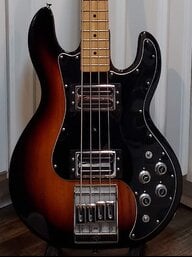
Not a big fan of active electronics. All my basses are passive except for my Ray. The Ray can sound really good, but it takes a while to dial it in. It's a "different" sound that I am still trying to get familiar with.I started out on an active. I just started using a passive P bass and find getting sounds much easier. What drew you to active electronics?

I am drawn to simplicity. Hence.....(you know what.)

I have had both but ended up with active. I have grown accustomed to not touching my amp once set, then controlling tone from my bass and my pedal board. I find that the active electronics allow for a greater diversity in tone that can be achieved in seconds or less, wherever I am standing. Though I do set up with my volume dimed. If the band can no longer hear me, they have gotten too loud.
D
I purchased my first active because "everyone" told me it was better than passive. It didn't take me very long to find out that I massively prefer passive. I have yet to hear an active bass that can roll of the highs without completely ruining the tone in the process. I also love the resonant peak that fattens the mids when rolling off the tone with a passive tone control. No active eq I've tested will do that.
Of course, active eq's can dial in a LOT of tones that are impossible with a passive tone control but most of those tones are useless to me. Who really needs the amount of high/low gain available from most active basses???
I still own a couple of active basses but I rarely use them. 95% of my basses are passive.
Of course, active eq's can dial in a LOT of tones that are impossible with a passive tone control but most of those tones are useless to me. Who really needs the amount of high/low gain available from most active basses???
I still own a couple of active basses but I rarely use them. 95% of my basses are passive.

Turnaround
Commercial User
Flexibility. And to be as flexible as possible I have the same passive tone control on my basses as all-passive basses have so I can go entirely passive or active at the flick of a switch.I started out on an active. I just started using a passive P bass and find getting sounds much easier. What drew you to active electronics?

Depends on the situation. Different charachter for different songs or different styles. I have a Sadowsky Will Lee and can bypass the preamp when I want to go passive. So I have the best of both worlds.

I have had both but ended up with active. I have grown accustomed to not touching my amp once set, then controlling tone from my bass and my pedal board. I find that the active electronics allow for a greater diversity in tone that can be achieved in seconds or less, wherever I am standing. Though I do set up with my volume dimed. If the band can no longer hear me, they have gotten too loud.
I just recently switched from passive basses to active and this alone is reason enough for me to stick with active. I’m very much a set and forget kind of guy, and so far setting my amp eq to noon and adjusting the preamp from my bass to taste has worked extremely well for me. Far better than I had thought it would. Couple this with the incredible range of tones the onboard preamp can give and I feel little reason to return to passives unless I want a traditional sound. Even then, for what I play, traditional sounds aren’t particularly the best.


