
Enjoy the benefits of a premium membership!
Upgrade Account
-
TalkBass has been independent since 1998. Add your voice.
Create a free account to reply to discussions, view embedded media, and browse with fewer display ads.
Join free Log in
Want zero display ads or expanded classifieds tools? Compare plans.
You are using an out of date browser. It may not display this or other websites correctly.
You should upgrade or use an alternative browser.
You should upgrade or use an alternative browser.
Paulownia bass
- Thread starter BG6654
- Start date
More options
Who Replied?
My Adler's body is made from Paulownia...capped with flame maple. Not much help as far as neck weight for that reason I'm afraid. I haven't really noticed alot of instrument makers using that wood for necks.


Does anyone have a bass made of Paulownia, or played one??
My only real concern is if it's neck heavy?
Appreciate some input..
Thanks
IME, IMHO, Unless the bodywood is exceptionally lightweight; the neck-heaviness of a bass is more likely influenced by the # and weight of the tuners; the weight of the woods used in the neck; the size of the headstock; and the body's shape and where it allows the front strap button to be placed.
A body shape with little or no upper horn (Tbird or Explorer, for example) is more likely to have balance issues than one that has a long upper horn.


JAUQO III-X
Inactive
I own basses that are made with Paulownia bodies(made by luthier Mike Adler) and I have no problem with neck weight issues. I've even played a few Conklins that had bodies made of Paulownia and not neck heavy at all. In fact they all balance exceptionally well.


JAUQO III-X
Inactive
doesn't bill conklin also call this stuff dragonwood?
Paulownia and dragon are the same wood(just different names).

If you have never heard of Royal Paulownia it is a fantastic wood choice...It is a extemely fine grained, very light, and warp resistant. Not to mention Paulownia is extremely fast growing; some species of plantation Paulownia can be harvested for saw timber in as little as five years. Once the trees are harvested, they regenerate from their existing root systems, earning them the name of the "Phoenix or Dragon tree." Paulownia has the ability to reclaim ecologically stressed and degenerate patches of land relatively quickly. Its root systems run deep and penetrate compacted and contaminated soils which have resulted from industrialized development. Paulownia is also a highly developed phyto-remediator, increasing the organic content of degraded soils, processing and filtering contaminants through the uptake of its vascular system, and emitting oxygen into the atmosphere. The bark is made into numerous types of dyes, and the leaves are used in vermicide preparations. Tone wise it is very similar to Ash! It is also rot resistant and a has a very high ignition point. So from an ecological (read green tree hugger) standpoint this wood can't be beat! plus it's quite attractive
I have two Trabens made from this wood and no not neck heavy at all, they balance quite well...
http://www.talkbass.com/forum/showthread.php?t=535251&highlight=royal+paulownia
Meet my ladies:
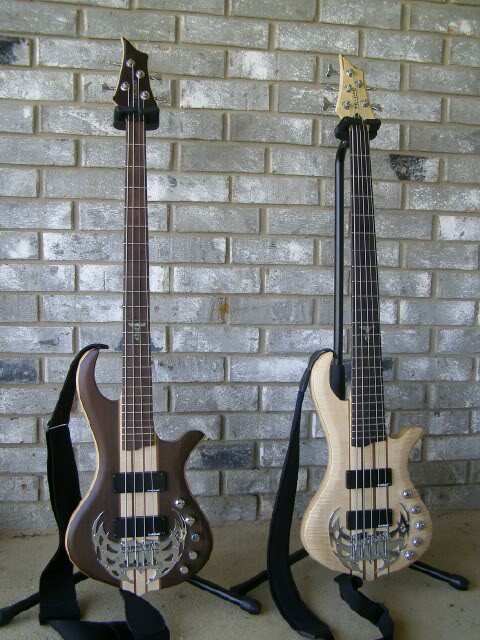
I have two Trabens made from this wood and no not neck heavy at all, they balance quite well...
http://www.talkbass.com/forum/showthread.php?t=535251&highlight=royal+paulownia
Meet my ladies:

If you have never heard of Royal Paulownia it is a fantastic wood choice...It is a extemely fine grained, very light, and warp resistant. Not to mention Paulownia is extremely fast growing; some species of plantation Paulownia can be harvested for saw timber in as little as five years. Once the trees are harvested, they regenerate from their existing root systems, earning them the name of the "Phoenix or Dragon tree." Paulownia has the ability to reclaim ecologically stressed and degenerate patches of land relatively quickly. Its root systems run deep and penetrate compacted and contaminated soils which have resulted from industrialized development. Paulownia is also a highly developed phyto-remediator, increasing the organic content of degraded soils, processing and filtering contaminants through the uptake of its vascular system, and emitting oxygen into the atmosphere. The bark is made into numerous types of dyes, and the leaves are used in vermicide preparations. Tone wise it is very similar to Ash! It is also rot resistant and a has a very high ignition point. So from an ecological (read green tree hugger) standpoint this wood can't be beat! plus it's quite attractive
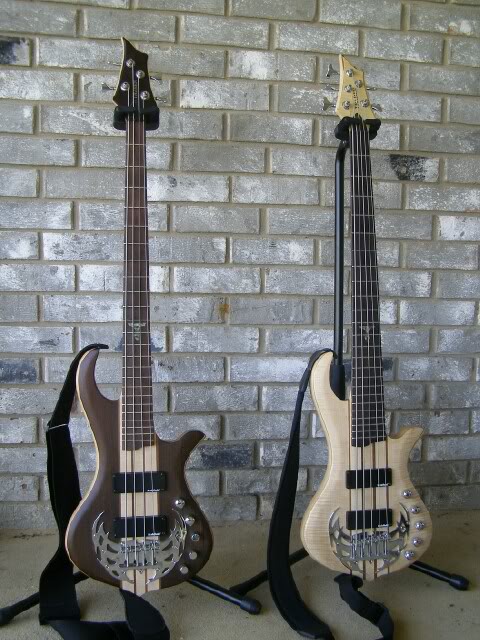
I have two Trabens made from this wood and no not neck heavy at all, they balance quite well...
http://www.talkbass.com/forum/showthread.php?t=535251&highlight=royal+paulownia
Meet my ladies:
This is super cool! I love plants like this! If we can better use land with resources like this it just makes sense on so many levels!
D
Hi TB family,
Just recently had a J Bass assemblied from a hodgepodge of parts I've collected here and there(see my avatar pic). The body is made from Paulownia. I went with Paulownia on a whim and a good deal, hoping it would yield a lightweight, decent sounding, yet cost-effective custom instrument. Even though the body has the standard J Bass shape, the wood is very lightweight(less than 4 lbs). With the final assembly and setup of the Mpl/Mpl neck, EMG PUPs, and hardware the instrument still weighs less than 8lbs. Unbelievable, but true. The tech who assembled the bass said the wood was a little tricky to work with, it seemed brittle in some spots and hard to drill in others. Wink wink, I did say I got a good deal... PSA aside, this is by far the lightest bass guitar I've ever owned. One thing that surprised me was that the body balanced better than I expected with the neck and vintage-style tuning keys. Granted it does have a slight nosedive, but straplocks and a wide strap help offset that a bit. Tonewise I would agree with Snakeman1066 in that Paulownia is bright, punchy, with a fast attack similar to Swamp Ash. This particular instrument is very much a slap/tap/thump/pop-friendly axe in the mode of Marcus Miller, Louis Johnson, and Larry Graham. Doesn't seem to have as much bass as my Ash and Alder bodied basses but that's a minor gripe, and not really surprising given its weight. I'm sure my back, left shoulder, and left elbow won't mind me having to boost the bass on my amp for those really long sets...
 . So far I've only played it at home, haven't had a chance to play it in a live setting. Not sure about how durable the body will be over time either; I've heard that Paulownia isn't necessarily a glutton for getting banged around. But we shall see. So far I'm pretty happy with the sound and feel of this tonewood, and the finished instrument overall. I'll post an update as I get more playing reps on the instrument. Hope this helps, peace.
Just recently had a J Bass assemblied from a hodgepodge of parts I've collected here and there(see my avatar pic). The body is made from Paulownia. I went with Paulownia on a whim and a good deal, hoping it would yield a lightweight, decent sounding, yet cost-effective custom instrument. Even though the body has the standard J Bass shape, the wood is very lightweight(less than 4 lbs). With the final assembly and setup of the Mpl/Mpl neck, EMG PUPs, and hardware the instrument still weighs less than 8lbs. Unbelievable, but true. The tech who assembled the bass said the wood was a little tricky to work with, it seemed brittle in some spots and hard to drill in others. Wink wink, I did say I got a good deal...
PSA aside, this is by far the lightest bass guitar I've ever owned. One thing that surprised me was that the body balanced better than I expected with the neck and vintage-style tuning keys. Granted it does have a slight nosedive, but straplocks and a wide strap help offset that a bit. Tonewise I would agree with Snakeman1066 in that Paulownia is bright, punchy, with a fast attack similar to Swamp Ash. This particular instrument is very much a slap/tap/thump/pop-friendly axe in the mode of Marcus Miller, Louis Johnson, and Larry Graham. Doesn't seem to have as much bass as my Ash and Alder bodied basses but that's a minor gripe, and not really surprising given its weight. I'm sure my back, left shoulder, and left elbow won't mind me having to boost the bass on my amp for those really long sets.... So far I've only played it at home, haven't had a chance to play it in a live setting. Not sure about how durable the body will be over time either; I've heard that Paulownia isn't necessarily a glutton for getting banged around. But we shall see. So far I'm pretty happy with the sound and feel of this tonewood, and the finished instrument overall. I'll post an update as I get more playing reps on the instrument. Hope this helps, peace.
Last edited:

Just started a Jazzbird parts bass and the body is Paulownia. It is just crazy how light the body is. I am a little worried it will be neck heavy in the end. Figure a high mass bridge and maybe swap to Hipshot ultralight tuners if I need to upon completion.



This frankenjazz has a paulownia body from Guitarfetish. I wouldn't say it has neck dive but its "equilibrium point" is a bit lower than I would've liked. I had originally wanted to install a Gotoh bridge but figured I better keep the Badass to help "counterweight" the thing.


I suspect that the reason for this thread is because of the price of GFS bodies which are Paulownia and really cheap in price. I have threaten to buy one myself for a project, but I always thought that the wood would be really soft, and perhaps ding up pretty easy. I don’t know that for a fact, but came to that conclusion for some reason.
057912
057912
I suspect that the reason for this thread is because of the price of GFS bodies which are Paulownia and really cheap in price. I have threaten to buy one myself for a project, but I always thought that the wood would be really soft, and perhaps ding up pretty easy. I don’t know that for a fact, but came to that conclusion for some reason.
057912
I have one and I can say they *do* ding pretty easily. Also the accuracy of neck pocket rout and quality of the finish are not so good. Having said that, compared to what a finished body would cost you from Warmoth or one of the other companies, they're a screaming deal!
I bought an unfinished one and a fellow TBer make the routes to accept Gibson TBird pups. I had to sand the neck pocket to accept the Jaguar neck.I have one and I can say they *do* ding pretty easily. Also the accuracy of neck pocket rout and quality of the finish are not so good. Having said that, compared to what a finished body would cost you from Warmoth or one of the other companies, they're a screaming deal!
I bought an unfinished one and a fellow TBer make the routes to accept Gibson TBird pups. I had to sand the neck pocket to accept the Jaguar neck.
Mine also took quite a bit of Dremel work to get the neck to fit.

mine had awful pitting in the finish, scrapes from the factory, a sloppily-repaired gouge about the size of a quarter, and gobs of paint runoff in all routs. I exchanged it and got another that was not quite as bad but still unacceptable. Ended up selling it supercheap in the classifieds rather than use it or eat the shipping charges to return it.


