• TalkBass has been independent since 1998. Add your voice.
    Create a free account to reply to discussions, view embedded media, and browse with fewer display ads.
    Join freeLog in
    Want zero display ads or expanded classifieds tools? Compare plans.

Pbass wiring

Help for a real newbee on wiring.

I bought a Washburn pbas body and neck on ebay and I have all the parts to install a new pickup and pots etc... When I do a search for standard Pbass wiring I find a ton of images and none of them seem the same? Here is one from SD-
[Invalid or Expired Link Removed]

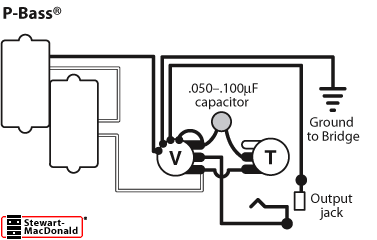
Another from Stewmac-
pbass_wiring.gif


are these both standard wiring?
 
They are both functionally the same, just the cap is moved. I prefer the Stewmac as it has only one ground point. Actually at first glance it seems that a connection is missing from the Basslines drawing - the volume pot is not grounded.
 
Actually at first glance it seems that a connection is missing from the Basslines drawing - the volume pot is not grounded.
The unstated assumption is that all the grounds are tied together by the foil backing on the pickguard.

If that is not present, or if you want a belt-and-suspenders approach, you can run a wire from the back of the tone pot to the back of the volume pot. Technically, that creates a ground loop, but no one seems to worry too much about it.
 
Just to clarify there are (at least) two ways to wire a p-bass. The second diagram is the 'vintage' way and the SD one the modern way. They tend to give different tonal characteristics along the lines you would expect.

I am prepared to be shot down in flames for that comment.
 
Just to clarify there are (at least) two ways to wire a p-bass. The second diagram is the 'vintage' way and the SD one the modern way. They tend to give different tonal characteristics along the lines you would expect.

I am prepared to be shot down in flames for that comment.

Explain.

The two methods are electrically identical. (Save for possible ground loops, which are too small to even begin to think about.) The only difference is the method in which you physically solder the parts together.
There should be no tonal or functional difference whatsoever between the two methods.
 
Just to clarify there are (at least) two ways to wire a p-bass. The second diagram is the 'vintage' way and the SD one the modern way. They tend to give different tonal characteristics along the lines you would expect.

No, they work exactly the same. The only difference is in one the cap is used as a wire. But the cap is still wired in the circuit exactly the same way electrically.

And please explain what a "vintage tone" would be.
 
Well, fender uses that wiring scheme for their vintage instruments. For example -

[Invalid or Expired Link Removed]

I have tried both and the 'vintage' scheme seemed muddier whereas the SD one seemed to give more clarity. I'm not saying it's impossible that other factors weren't involved but equally I'm not completely convinced by the 'electrically identical' hypothesis either.
 
Well, fender uses that wiring scheme for their vintage instruments. For example -

[Invalid or Expired Link Removed]

I have tried both and the 'vintage' scheme seemed muddier whereas the SD one seemed to give more clarity. I'm not saying it's impossible that other factors weren't involved but equally I'm not completely convinced by the 'electrically identical' hypothesis either.

Draw both diagrams out in true schematic form. You will find that they are identical.
 
Any thoughts on why Fender started out using the scheme with the cap wired between the pots then changed to grounding it on the tone pot?

Probably because of the type of caps used. They used to use a larger longer barrel shaped cap, so it was easier to attach that way. They used those caps because they also used them in their amps. Modern caps are smaller, so it's easier to attached them to the pot.

But the basic circuit is the same, one side of the cap goes to ground and the other to hot. In the Duncan diagram the pot comes first, and in the Stew-Mac the cap comes first.

Also keep in mind that the Fender you know today is not the same company that Leo started. He sold that company to CBS in 1965, and then they sold it to some of the employees in 1985. In 2004 it was reportedly for sale again.

But who ever owns it, manufacturing methods change, parts change, and they find some cheaper ways of doing things, such as the plastic bobbin pickups.

It was not wired up one way because it was better, it was just the way it was done.

Also, vintage P basses are not muddy at all. They sound pretty much like the current ones. What you hear on old recordings was the tone of basses that was popular at the time. They used flat wound stings, and string mutes, and the amps were not as clear as today. Also the older flats did not sound as bright as todays flats. The electric bass was still trying to sound like an upright, because that's what the music called for.

Here's some real isolated Motown tracks. All of them were done with P basses. Hear all the high end in those? Most of them are not muddy at all. It's a myth that the Motown sound, or that P basses are very bassy with no high end. You just don't hear the highs in the mix, but it helps the bass have definition. Even Jamerson was using a bright tone (last cut). You can also hear Jamerson's signal clipping (the bass was recorded direct... no amps).

Link Removed
 
But the basic circuit is the same, one side of the cap goes to ground and the other to hot. In the Duncan diagram the pot comes first, and in the Stew-Mac the cap comes first.
huh?

you were right the first time, it's exactly the same, including the "order" of the tone pot and the cap.

it's just that the ground leg of the cap is soldered to a different spot, which obviously makes no difference at all.
 
huh?

you were right the first time, it's exactly the same, including the "order" of the tone pot and the cap.

it's just that the ground leg of the cap is soldered to a different spot, which obviously makes no difference at all.

D'Oh! You are correct! I thought on the Stew-mac version that the tone pot was grounded. I've seen it done that way.

Now I see the cap is grounded. They just have all the grounds at the volume pot.
 
your larger point stands though; if the cap was on the counterclockwise tone pot lug and the center lug jumped to the volume, it would still sound the same.