
What screw were you turning ? T40 tuners are held on by a nut. The only screw is the one on the cog wheel and you don't take that off when removing tuners.Took my time unscrewing each tuner screw

TalkBass has been independent since 1998. Add your voice.
Create a free account to reply to discussions, view embedded media, and browse with fewer display ads.
Join free Log in
Want zero display ads or expanded classifieds tools? Compare plans.
What screw were you turning ? T40 tuners are held on by a nut. The only screw is the one on the cog wheel and you don't take that off when removing tuners.Took my time unscrewing each tuner screw

Good point!What screw were you turning ? T40 tuners are held on by a nut. The only screw is the one on the cog wheel and you don't take that off when removing tuners.
The sets I’ve tested gave different readings on my meter. So, there has to be some difference.
Good point!

Take it to someone who might be able to drill the old screw out somehow?

The broken screw is the one,holding the cog wheel in place.I've had that happen before. What I've done is to cut/grind out the wood around the screw (as little as possible), just enough so that I can get a pair of thin needle-nose pliers on it and turn it out. Once that's done, drill out a hole just big enough to remove the damage you just did, then glue in a hardwood dowel of the appropriate size, and cut to length so that it's flush with the existing wood.

The broken screw is the one,holding the cog wheel in place.
View attachment 3436848 View attachment 3436849 View attachment 3436850
If you are referring to the edges of the steel frets...and not the actual fingerboard (wood) part.
Your fretboard has shrunk due to lack of humidity/getting dried out. You can try and rehydrate it and see if it smooths out the edge or you can have them (frets) filed down until they are smooth.
This is the first result on a YT search. There are many examples

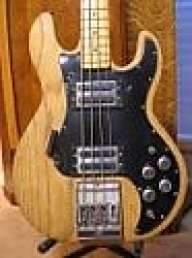
I never throw anything away @eldoryder..i'm a real hoarder, much to my wife's frustration lollThose are some great ads, Giffro.....thanks for sharing! I've never seen these before.
 I finally decided to finish converting my extremely worn T-40 neck to 1.5” nut width. You guys might remember the bass... I bought a neck and white body. The necks frets were completely flat, and it was obvious it had been a school bass that had been played and beaten up by hundreds of kids, for decades. After a refret (my first), I sanded off the finish and a million dings, and applied tung oil. I mounted the neck to another T-40 and saw that the neck was so worn that it was skinnier than it should be, around the 7th fret... it gradually curved inward from wear, on the treble edge. After laying a straight edge on it, it was apparent that I could make it 1.5” at the nut, and sand the edge straight, and create a jazz dimensions T-40. I lost the nut I had ordered, so I have another one coming.


That Helmuth Lemme link doesn’t work anymore...Resistance readings don’t tell the whole story of what you end up hearing. It’s a lot more complicated than that. The “transfer characteristics” of a pickup also involve its impedance and other factors such as eddy currents. Helmuth Lemme gets into this in depth in his book Electric Guitar: Sound Secrets and Technology which is pretty much the bible on the topic. If anybody’s interested, you can read a chapter (in PDF format) that hits on all the high points found in the rest of book. Read it here.
Lemme pointed out that pickup manufacturers are very reluctant to share much information about what they consider their proprietary designs. So they cleverly avoid sharing any useful information, such as a pickup’s impedance, or the gauss (or Tesla if you prefer) measurement of any magnets being used. However, they’re very happy to discuss the resistance reading of the coils because that measurement will tell you virtually nothing about the pickup’s design - or how it’s likely to sound.
tl:dr - It’s generally not a good idea to read too much into a pickup’s coil resistance reading. That can give you some clue about how hot (louder or softer) it is. But it won’t tell you much (or anything) about its overall tonal qualities.

That Helmuth Lemme link doesn’t work anymore...
That Helmuth Lemme link doesn’t work anymore...


