• TalkBass has been independent since 1998. Add your voice.
    Create a free account to reply to discussions, view embedded media, and browse with fewer display ads.
    Join freeLog in
    Want zero display ads or expanded classifieds tools? Compare plans.

Pedal Chain Question

Greetings all,

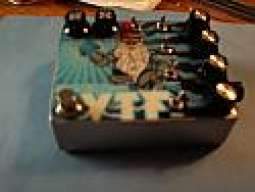
Recently purchased a Philosophers Tone Germanium Gold and was wondering where it would be best in my chain. Since it is a compressor I know it should be near the front but where I am curious is whether it should go before or after my bass whammy. Where would the pedal be more effective? I'm looking to do either tuner> philosophers> bass whammy or tuner> bass whammy> philosophers.... any thoughts?

Best,
Dave
 
There are several schools of thought as to where to put a compressor ... with the pedals you mention I don't really think there is any particularly right or wrong order though. Maybe tuner somewhere before whammy, but other than that however it best fits on the board.
 
While yes, there are no rules in effects order(sometimes happy accidents), there are certain placements that yield optimum results. In your case, a tuner should probably be first, or at least looped or diverted off sideways, so that it can receive the pure signal from your bass. Then, your compressor. The PT is an interesting choice; I have one in my guitar rig, very smooth and transparent. I use a Mark Bass Compressore for bass, but I'll check out the Piggy in that capacity. The reason for putting a compressor close to the beginning is to smooth out any dynamic volume fluctuation, and to expand any dead spots. A bass is a much more dynamic instrument than guitar, and in certain situations(AND used judiciously)it can fatten/sustain your notes while containing volume spikes. This is important if you're using any kind of octave device, which your Bass Whammy is. That should be immediately next. The Whammy would like to receive notes that have an even volume level and are sustained, so that it has signal that it can grab onto and processes with minimal glitching. If you eventually use any kind of envelope filter/auto wah, that would probably be next(with fuzz/distortion before IT perhaps, if you like the results)however, turn off the compressor if you engage an EF as it works against it. To function properly, an envelope filter is triggered by the very fluctuations in dynamic range(ie dramatic change in volume level)that a comp evens out. That being said, placing a comp at the end of your chain is probably not a good idea as the accumulated noise floor of all the pedals before will be "squeezed" up in volume. Also, the flavor of any preceding effect will be squeezed as well, unless that is a sound in particular that you're going after. For example, any time based modulation(flange, chorus, phaser)has a certain amount of volume fluctuation that is part of its distinct sound. Squishing it afterwords can diminish the effect somewhat.
 
Where to put a compressor??? Maybe ebay lol. In al seriousness though I only use compressors in the studio and often by themselves for my main tone. When I record effects I only use whatever pedal I need for a certain tone. Live I don't use a compressor at all because the sound guy is going to add compression to the pa and while it may make my rig sound better it makes my tone in the pa worse
 
How did that answer the OP's question? He did not state that he was at the point where he was doing any recording, or was playing shows where the venue was big enough to need bass in the PA. If so, would the sound guy even be using limiters on the bass channel? He made the decision, for whatever reason, to acquire a compressor, and was seeking advice on how to interface it with the whammy and tuner. The question was not 'do I need a compressor?'.
 
While yes, there are no rules in effects order(sometimes happy accidents), there are certain placements that yield optimum results.
...

I would agree there are certain placements that usually work very well, standard effects chains so to speak. There are many web sites that give you these tried and true configurations. I agree with your suggestion as well, as a perfectly fine starting point. At the same time I think people shouldn't be afraid to trust their ears and go against the "rules" - switch your pedals around (have some fun on a rainy night) and try other combinations, you may find something which works even better.