I'm definitely in the camp of making sure any and all pedals that might get switched during a song are placed in the front row, and any pedals that only get switched between songs or not at all are placed in the back row. And that means my input is always in the back row, and will either be a tuner, an acoustic resonance enhancer, or a single loop switcher.
I now prefer to keep my tuner off the board, so that it can be used separately, but my main bass pedalboard consists of six pedals in two vintage Boss BCB-3 cases, so the tuner is first. I tend to use a much simpler board for bass than for guitar, but in my current main guitar board, the tuner sits off the board, but gets power from the board when on stage, and from battery when off stage.
From the tuner, I go to a One Control BJFe 1Loop, which allows me to route my signal through the front end of my Boss GT-1000Core for the acoustic resonance enhancer and compressor, then back out to my analog drive pedals, before hitting my DSM & Humboldt Electronics Simplifier. The back end of the GT-1000Core sits in the Simplifier's effects loop for stereo mod/delay/rev.
I do have a Simplifier Bass Station, but it's not currently incorporated into my main bass board. It's on a mini board with a One Control BJFe Lemon Yellow Compressor, Blackberry Bass Overdrive, and Sonic Blue Twanger.
While it's always a good idea to keep your signal chain as short as possible, the addition of a 75 cm patch cable to allow you to place your pedals in the configuration that makes the most logistical and musical sense is not going to significantly affect your signal in terms of degradation due to capacitance, particularly so when you pedals are in use, or when you have a buffer in the signal path.
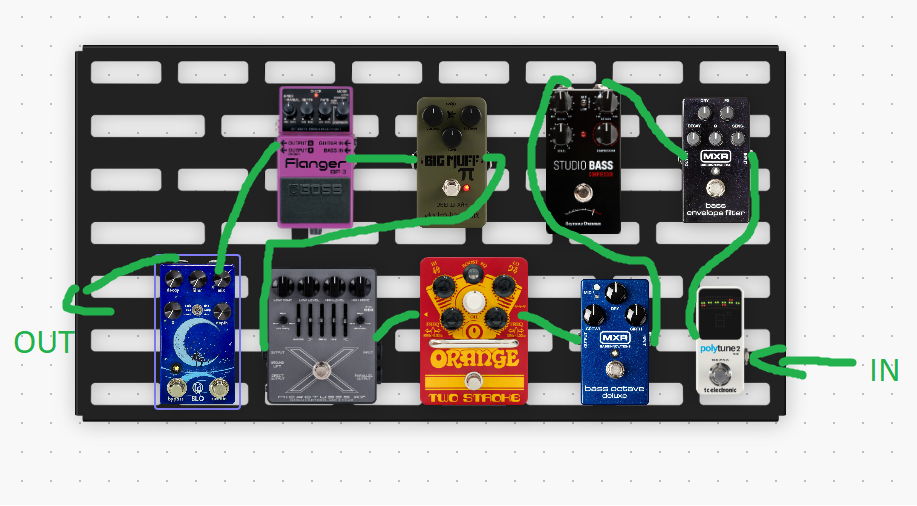
Looking at the pedals you have in that diagram, I think you should ask yourself whether or not you have a lot of duplication in your effects. How many preamp and drive pedals does a bassist really need?