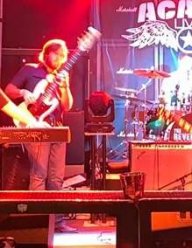
In over 30 years of listening to the Dead, I have listened very intently to Phil's style, but never once have I tried to learn his lines. Sure, I've learned a bunch of Dead tunes and it's hard not to play Not Fade Away or Lovelight using lines that are similar to or almost identical to Phil's.
But my point is that I absorbed his style more through listening than through playing. His style is very singularly characteristic of himself and, as a result, very personal. I have no desire to play just like Phil, but I am glad to have been able to incorporate some of his philosophical approaches to playing bass into my own style.
Here are a few of my observations:
1. When you expect me to anchor, I may or may not.
2. When you expect me to push the boundaries, I may or may not.
3. When I feel the band is ready to make that leap to reach the apex of a song, I will cue you with a musical line that diverges from what I've been playing and it will happen.
4. Know exactly where the 1 is at all times and avoid it whenever you feel like it or hammer it mercilessly.
5. Play roots on weak beats (e.g., 2 and 4) and/or on the off-beat.
6. Never abandon a melodic approach; even repeated notes and octaves can be made melodic.
7. Don't so much focus on locking in with other band members such as the drums or rhythm guitar; rather play in in a style that constructs a singular framework that all band members can latch onto in their own preferred manner.
8. Use non-roots and non-chord tones as anchor points, pedals, and as pivots.
9. Descending runs on bass are far more effective at getting your band to up the energy level than are ascending runs. The runs may be linear and scalar (e.g., F# E D C# B A G# to resolve to E Mixolydian - preferably start the run on a beat other than 1), or staggered and scalar (e.g., G# E F# D B C# B F# G# D to E Mixo; again starting on a beat other than 1). Be sure to hammer a full four string E to finish that run!
10. Throw all this out the window and just play.