• TalkBass has been independent since 1998. Add your voice.
    Create a free account to reply to discussions, view embedded media, and browse with fewer display ads.
    Join freeLog in
    Want zero display ads or expanded classifieds tools? Compare plans.

physics behind bolt-on vs thru-neck

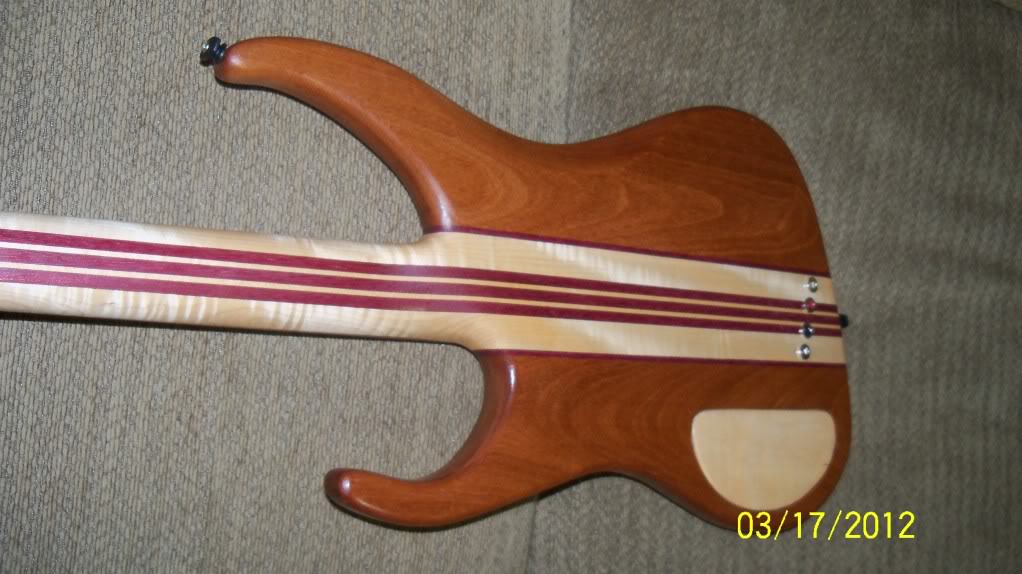
Neck thrus are so much sleeker, unlike the big neck joint on my P bass. They just look so much cooler and it's not that hard to build them.
100_1930.jpg
 
A great bass is a great bass. Whether it's bolt on or neck through is just a conversation topic. Once you get your hands on a great bass, just play it and forget how it was built. It was built for you to forget about how it was built.

Reverse engineering a great bass don't seem to work in the real world. Bolt on won't make a crappy bass sound punchier as neck through won't give it more sustain. Besides, sustain on a bass is kinda overrated, isn't it?

There. I said it :D
 
My experience is that neck-through versus bolt-on makes no perceptible difference to sustain or tonal quality, but that the choice of woods and the tightness of a bolt-on junction both noticeably impact the midrange and treble aspects of the tone.

I have a solid-body walnut with maple/walnut neck-thru, and it's got a very bright upper end and a tight (but not very beefy) low-end due to the density of those woods. Think Les Claypool's original CT 32" walnut 4-string... that's the tone.

I also have two different bolt-on basses which I've completely taken apart and reassembled and tinkered with at various times, and what I discovered through trial-and-error is that as soon as you reduce the amount or solidity of contact through the neck pocket via any kind of a shim (whether it's a tiny shim at one end of the pocket or a flat shim cut to completely fill the pocket), there's a noticeable drop-off in midrange and high-end that makes the bottom end seem softer/rounder. (Also, neither of these are woods as dense as walnut, so neither one has that upper-mid "twang" so characteristic of Les Claypool's tone.) On the flip side, if you add more/larger bolts to a standard 4-bolt Fender Jazz bolt-on, you get noticeably more midrange and upper crispness (mainly because their lame 4-bolt tiny-screw design doesn't result in as tight of a junction as you could otherwise achieve).

Of course lots of other things impact tone, ranging from pickups to electronics to preamps and amps and EQ settings, but the neck junction does play some role.
 
John Hall at Rickenbacker claims that basses with bolt on necks lose energy at the neck joint and therefore lose sustain. I have owned dozens of Rickenbackers. The one with the best sustain was a 1986 2030 with a bolt on neck.
 
grendle said:
I wouldn't see why not?

How is an investigation into the effect of rot pockets in a beam on MOE and damping factor pertinent to a discussion of bolt-on v. neck-thru? Tangentially at best, I think. The difference in neck joint styles is matter of solid to solid full-section discontinuities, not the minimal-section solid to air discontinuities of the paper. Beyond that, neck joint concerns the zone where a cantilevered beam communicates with a significantly broader, non-beam-like body, as opposed to discontinuities within a beam.

A bit like trying to apply a recipe for poached salmon to a basket of peaches. They're both food recipes, but...
 
I read what the link leads to -- which is "Effect of Artificial Structural Defects on the MOE and Damping Properties of a Wood Element -
Djamel Ouis"

Were you referencing something else?

Yep that would be the one. I was trying to be helpful with the original title of the thread which was "physics behind bolt-on vs thru-neck". The paper has a lot of good info in it especially if you look at it from the NT perspective. These threads usually ( as this one has) turn into personal testimonials instead of anything physics related. The article does give formulas and testing methods which would be consistent with the title of the thread. They may help some to get a better understand of the propagation of sound waves through a solid and what happens when you change that solid intentionally ( drilling holes as in the example given). As an engineer I thought you in particular would enjoy the read, but if you get more technical mileage from personal testimonials, so be it. I would love to read anything technical on par with the subject that you could provide which you feel would be more pertinent to the discussion. There wasn't anything else mentioned though.
 
So, I wont claim to have a handle on half the engineering talk. I'm following but could never attempt to converse it. But instead I'm pose a question.

A lot of the talk in regards to when a vibration comes to the neck joint is its interaction in regards to changing from a beam structure to a full body structure, and that this transition is inherent in the loss of quality or strength of the vibration. If that statement is incorrect, please correct me. It's only part of the discussion, I know, and it's what this rube picked out of the jargon.

In regards to That very specific concept (and taking a half-step away from the topic at hand, for which I apologize) would there be an argument that a headless/bodiless steingberger style bass would have less attenuation, considering there's less body for the signal to get lost into?

Of course this is a very general question disregarding a plethera of other factors. This is a hypothetical, where we could turn other variables into constants and actually attempt a scientific endeavor. Which isnt possible regarding he forces of nature, like trees.

On that note, now that I think of it. Could this be something we could look into with a material that is less variable? Like acrylic, or Carbon fiber? Do a NT and BO out of acrylic, and define the difference in sound as "punch" and conversation over.
 
If I remember correctly, back in the late 80s early 90s, neck through basses were very popular and thought to be the best.

After that, the bolt on was thought to have a "certain sound" that was lost with neck-through basses.

"Which ever the way the wind blows." "What comes around goes around."

It seems that most 24 fret basses are neck through and under 24 frets are bolt on.

IMHO, bolt on or neck through. I can't tell any difference in quality of sound. Can you?
 
How is an investigation into the effect of rot pockets in a beam on MOE and damping factor pertinent to a discussion of bolt-on v. neck-thru? Tangentially at best, I think. The difference in neck joint styles is matter of solid to solid full-section discontinuities, not the minimal-section solid to air discontinuities of the paper. Beyond that, neck joint concerns the zone where a cantilevered beam communicates with a significantly broader, non-beam-like body, as opposed to discontinuities within a beam.

A bit like trying to apply a recipe for poached salmon to a basket of peaches. They're both food recipes, but...

I'd have to disagree with you here and agree with grendel, this paper is more applicable to the matter at hand than any of the speculation in this thread so far. Here's a translator if that helps -

"artificial structural defects" - holes and joints

"reverberation time" - sustain

"studies of wood . . . show some frequency dependence already at a few Khz" - wood affect mids and highs

"sound source" - strings

"major resonant frequencies" - the opposite of this is dead spot

"impulse response" - an impulse essentially contains all frequencies so a hammer blow is a reasonable way to test the across-the-board frequency response of a bar

Figure 6 notes that the more mechanical defects in a wood bar, the MoE drops. I'd have to think a bit as to what this means for a guitar neck but figure 7 indicates only a modest impact on sustain.

The section in the middle of page 7 which talks about damping of waves in beams is particularly illuminating. "The most important form of damping . . . is material damping." and "energy can also dissipate at various boundaries of the beam" - boundaries here inclusive of neck/body joints and transtions between types of wood. This correlates with at one other statement in this thread (perhaps yours) that a change in wood type has an impact. Another - "radiative energy loss is . . . small compared to . . . bending mode excitation". I interpret this to say the overall structure of the neck (weight, thickness, length) have more to do with the response than the material or NT vs BO.

It helps to have an EE background where the mathematics of frequency response is drilled into the eager minds of the students.
 
Michael Tobias used to build basses with neck thru layout, then moved to bolt-on.

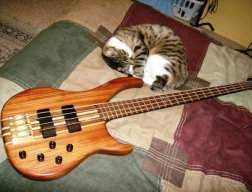
I have one of them. Here it is, I used to have a p bass with bolt on, and this has much more sustain, same strings, but that might be the long scale as opposed to short scale, though.

Personally, I'm not advanced enough to know or care about the sound that much. I'll never play in a band, so the bass will never be thrown around, so I'm not bothered about "repair-ability".

Personally, I really love the look and the slimmer profile of the thru-neck, I think it's beautiful.

5ace9ca3-5eaa-0f95.jpg
 
Have both NT and BO neck basses and like them all for their unique voices.Being made of wood,though,it seems like a lot of nonsense to try and compare them against each other with the amount of variables inherent in this material.Even the same species,from the same tree,depending on where it's cut,have different physical characteristics.Chill out and play some music,we'll all have a good time.:D