• TalkBass has been independent since 1998. Add your voice.
    Create a free account to reply to discussions, view embedded media, and browse with fewer display ads.
    Join freeLog in
    Want zero display ads or expanded classifieds tools? Compare plans.

Piano scavenging adventures

Because I have no brains and no shame, I long ago decided I'd try and save this piano after it couldn't be a piano anymore.

IMG20161024124659_zpsvamnqm9r.jpg


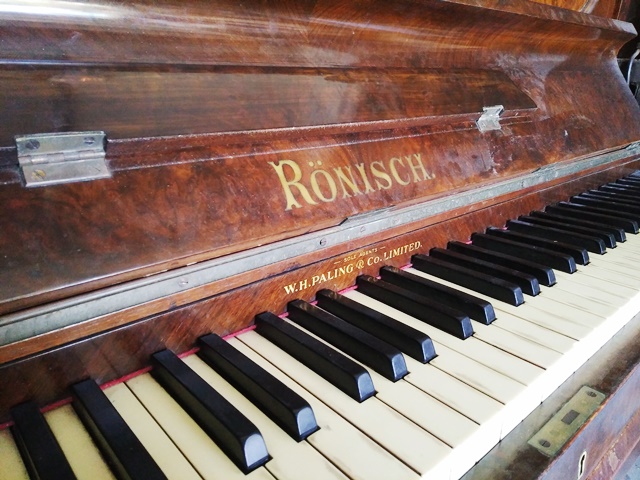
The piano in question is an 1880s German Ronisch. I belonged to my grandmother and then my mother. Story goes, my Nana bought it when she moved into a proper house. She used to turn the lights off at night and play and sing to my grandpa in the dark. When he died (before I was born), she couldn't bear to play it for a long time. Eventually my mother grabbed off her and started learning seriously while I was a kid. It's been rebuilt once, but about 8 years ago, it stopped holding tune properly for my mother's piano teaching business. She passed it onto me. For the last 4 years, our Piano tuners (Tony and Steve Lette) has been making it last longer as a favor to my mother. The other week, it finally gave up the ghost. Multiple notes started dropping tune (F#s curiously) and sticking. We decided enough was enough. So there's new piano in the loungeroom... 2 weeks before my kids piano exams!
IMG20161024124726_zpso3wkdbmn.jpg


IMG20161024124741_zps58ghppyb.jpg


The piano is so old, the keys have ivory veneers on them. They'll go to the tuner for restorations/repairs on other old pianos. Ivory can't be bought or sold, so it's the only way he can source it. My mother also wants the bottom octave as a momento, as well as a few other bits. The black keys are all ebony. So there's a million thing I can do with that. :)

So the other day I started pulling it apart. The external panels, action, keys and the like all came out of the piano in about 15min. That's the easy bit. Things got more complex when I wanted to remove the strings. I was warned I needed to loosen them for safety sake. That's where the mission began. To begin with, the best I could do was this 6mm spanner...

IMG20161027101147_zpsqffzzdmn.jpg


Suffice to say. I was going ok, but it took ages. Gotta cook dinner now, but I'll show you more later.
 
Pulling most of the piano apart wasn't much harder than undoing a lot of flablade screws, which is what I did a lot of. By today I had the shelf gone and was really doing to taking the strings off. Which was proving pretty painful. One thing I did twig on was the need for lubrication. After 135 years, anything would help it to move a little more. So pored this stuff in round the pins. I've hit each one a couple of times with lube. A few of them let go straight away just with the lubrication.

IMG20161027100933_zpsgbrbao51.jpg


Then I went off to the local tool shop with a pin and they looked at all manner of things, before we came up with 2 different solution...

12 point, 6mm ratchet spanner. I could easily loosen off most of the pins then.

IMG20161027114940_zpsqvztulba.jpg


And a 1/4 socket adaptor. It's not perfect, but the combination of a hex bit and the adaptor meant I could simply back the pins out with my cordless.

IMG20161027120109_zpsdprrvxut.jpg


IMG20161027122457_zpsy4x9addh.jpg


By the time I'd worked this all out, I'd already detensioned and cut a bunch of strings.. which turned out to be a mistake. Don't cut the strings. For most of the upper strings, as I backed out the pins at speed, the strings unhooked out of the pins. The lower ones needed some extra love, but it was pretty easy really. Just remember your cordless and the your right hand will take a beating. My right thumb is pretty sore now.

IMG20161027154056_zps0xy8c0i4.jpg
 
  • Like
Reactions: StayLow
Mmm, big roundwounds!

IMG20161027211924_zpsbmxflrxf.jpg


As soon as I saw the bottom strings I started looking more closely at the strings and the fixings holding them in the piano. These "A clefs" were of particular interest to me.

IMG20161027211702_zpsslh6olsc.jpg


They have both single and double string A clefs.

IMG20161027211724_zpsdklgsyj9.jpg


They easily came unscrewed from the frame. Steve the piano tuner clued me up on ow to get them out. WD40 + a big flatblade screwdriver and they came undone easily. I'm hoping I can use them for some sort of preject with the bass strings.
The timber in the piano is not quite what I expected. I was hoping for some maple or similar. I'm not 100% sure what a lot of it is, but I suspect pine.

IMG20161027212200_zpsnssnoeb8.jpg


IMG20161027212012_zpsdosgxq52.jpg


IMG20161027212217_zpslbuwbu2o.jpg


It could be spruce. Either way, the grain is tight and straight. It's also 135yo and stable. That said, there's some beautiful veneer on the outside.

IMG20161027212126_zps1iodtweg.jpg


I've got some crazy ideas for the frame, but I'll tell you about that later.
 
My grandparents had an old farmhouse in Maine and there was an old pump organ in the attic. Way, way too far gone to consider any sort of rebuild, but I grabbed all the ivory and ebony off it. Many years later, I was able to trade it for some refretting work at a respected local luthier. (He loves repurposing old wood and materials; he has an old Steinway soundboard that he uses for guitar repairs, as well as wood from a biplane that flew over Argentina in the 1930s.)

More recently I helped a friend disassemble an old upright and I grabbed the soundboard from that for use in a bass building project I have in mind. We didn't loosen the strings; last I knew the harp was sitting outside his backdoor. I was tempted to hang it in a tree as a wind chime, but it's damned heavy. The piano, after the initial easy parts came off, was surprisingly difficult to disassemble.
 
I don't know anything about pianos, but to see an old instrument like that dismantled is surprisingly heartbreaking! Was there really no hope to fix it? Surely if it was built, it can be fixed? Genuine question.

I know what you mean, but it wasn't holding tune and was getting more and more worn out. That's the issue with pianos. Once they can't hold pitch anymore they become very inconvenient boat anchors. Better to salvage the wood and materials than throw it out.

I talked to my mother a few minutes ago and the frame will become the support structure for a glass top table. All it needs is legs. She's very excited.
 
As an aside, I happen to be in the middle of reading Piano: The Making of a Steinway Concert Grand by James Barron. Sounds like it should be dull (and probably why it ended up on the library's fifty-cent table), but it's far more engaging than you'd ever expect. It describes the eleven-month process in building a Steinway concert grand while recounting the company's history and setting it in context against US history. Highly recommended.
 
BTW, Mum was telling me the reason that iron frames became so good is the metallurgy of the period was improved by cannon building for various wars and revolutions. Before that, the frames were all wooden and didn't last nearly as long.
I don't know about that - but I'm pretty sure that it was an American who invented the cast iron frame in 1837 (Chickering company) which really revolutionized pianos allowing them to stand a lot more tension and stay in tune.
 
I don't know anything about pianos, but to see an old instrument like that dismantled is surprisingly heartbreaking! Was there really no hope to fix it? Surely if it was built, it can be fixed? Genuine question.
Round here you can get a free (other than your moving it labor) piano pretty much every week off CL, always seems like someone wants one gone, organs too
 
  • Like
Reactions: twocargar
I know what you mean, but it wasn't holding tune and was getting more and more worn out. That's the issue with pianos. Once they can't hold pitch anymore they become very inconvenient boat anchors. Better to salvage the wood and materials than throw it out.

I talked to my mother a few minutes ago and the frame will become the support structure for a glass top table. All it needs is legs. She's very excited.
Sorry to break it to you but the peg block could have been replaced. It's not a terribly hard thing to do but it does take a bit of time. Also, there is enough tension on the strings that if you loosened them from one side to the other, not staggered, it could have ended badly/painfully. Enjoy the build though .
 
The guys who've been tuning this piano over the last 30 years are restorers as well. When they say, "it's done" I'll take their word for it. If there had been a chance to fix it in the past, I know my mother would have taken it.

Re- detensioning; I loosened each pin half a turn to begin with. From there I went to WD40 and more drastic loosening.

@wraub - I think we could work something out. ;)
 
  • Like
Reactions: wraub
My brother recently got the old upright piano my dad learned to play on when he was a kid. One of our cousins got it when our grandmother died. He's had it at least 40 years, but didn't play and his wife wanted it gone so he decided to give it to the musical side of the family. My brother had it moved to his studio and got it tuned and spiffed up to working condition. The tuner looked it up and it's 109 years old. My dad said it belonged to his grandmother and came to their house when she came to live with them in her later years. It's nothing fancy but it's in really good condition and is heavy as heck. Best I can tell looking inside where the wood is not painted, all the wood is maple.
 
  • Like
Reactions: Will_White
I think it's sad that it can't be kept up but, it's great that your salvaging what you can from a family heirloom. If it was mine I would be reluctant to use it for non-personal things, aside from a couple keys and giving up the ivory veneers so that someone else's heirloom can stay in good condition. You should do a build using as many parts of it as you can, maybe even using the tuning pins if they're in working condition, depending on what you find for lumber in it you might even be able to make a complete instrument with nothing but parts from it that would be the ideal thing at least IMO, so it could live on making music and be passed down. I'm looking forward to seeing what comes of this project.
 

Latest posts