
Also, I forgot to add... use a metronome. If you dont have one, they have free aps for android and iphone. Just set a slow, comfortable pace and increase as you feel more confident.

Enjoy the benefits of a premium membership!
Upgrade Account
-
TalkBass has been independent since 1998. Add your voice.
Create a free account to reply to discussions, view embedded media, and browse with fewer display ads.
Join free Log in
Want zero display ads or expanded classifieds tools? Compare plans.
You are using an out of date browser. It may not display this or other websites correctly.
You should upgrade or use an alternative browser.
You should upgrade or use an alternative browser.
Picked the wrong bass or my hands need more training?
- Thread starter villarddefender
- Start date
More options
Who Replied?

I'm 5'11" and got to move my hand a bit when my index is on the 1st fret and I want to play a note on the 4th fret with my pinky. The scale length of my bass is 34"
I know a popular bassist named Tetsuya Ogawa from japanese group l'Arc-en-ciel who's 5'6" and the scale length of his bass is 35"...
This makes me wonder if I should go for a small/medium scale bass OR if I just need more "stretch training" lol
Not everyone's hands are built alike. You'd be surprised how even a subtly different scale bass can make things just "fit" that much better.
I've switched to a 33" scale instrument, and after using them for the past couple of years, I'll never go back to 34" (or higher). I've tried many 30" scale basses, and they seem a bit cramped for me. But 33", that feels like home.
So forget "practice practice blah blah blah", and don't be afraid to mess around with other scales. There's no shame to it.
Side note - I played bass for almost 30 years before I tried a medium scale instrument. I sure wish I had considered/tried them earlier on.

Also, I forgot to add... use a metronome. If you dont have one, they have free aps for android and iphone. Just set a slow, comfortable pace and increase as you feel more confident.
 I like to use 1 of the 3 beats that comes with vox amplug 2 headphone amp rather than a regular metronome is this a good habit
"Economy of movement" is a complex topic. One of the arguments for "shift; don't stretch" is that large-muscle movements are often less fatiguing than small-muscle movements. The player who is constantly shifting up and down the neck may appear to be "working harder" but will have an easier time staying relaxed, because his fingers are neutral and the motion initiates from strong muscles in his shoulder, elbow, and arm. Whereas the player who keeps his hand in one position and relies on "spider legs" finger stretches might experience more fatigue and cramping by the end of the night, because tension accumulates in the hand, wrist, and fingers.
A non-musical example might be, try to open a stuck kitchen drawer by pulling it toward you with just your fingers (small muscles). Then try opening the drawer by pivoting at the shoulder and dropping your elbow toward the floor (large muscles).
Of course, your mileage may vary. Bass is a young instrument, with a diverse group of players, so there really is no absolute "right" or "wrong" technique.
A non-musical example might be, try to open a stuck kitchen drawer by pulling it toward you with just your fingers (small muscles). Then try opening the drawer by pivoting at the shoulder and dropping your elbow toward the floor (large muscles).
Of course, your mileage may vary. Bass is a young instrument, with a diverse group of players, so there really is no absolute "right" or "wrong" technique.
If I switch to a smaller scale I'd probably go medium too (32") but wouldn't want to spend much money on it so I've considered the Link Removed!Not everyone's hands are built alike. You'd be surprised how even a subtly different scale bass can make things just "fit" that much better.
I've switched to a 33" scale instrument, and after using them for the past couple of years, I'll never go back to 34" (or higher). I've tried many 30" scale basses, and they seem a bit cramped for me. But 33", that feels like home.
So forget "practice practice blah blah blah", and don't be afraid to mess around with other scales. There's no shame to it.
Side note - I played bass for almost 30 years before I tried a medium scale instrument. I sure wish I had considered/tried them earlier on.
That sounds pretty yin yangBass is a young instrument, with a diverse group of players, so there really is no absolute "right" or "wrong" technique.
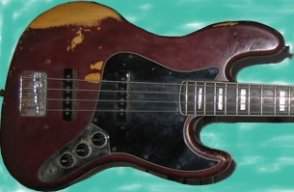
Don't force the stretch! Down low like that I can get by sort of rolling on my thumb to shift without totally shifting, but honestly in Fm I am liable to just play an octave higher at the 8th fret. For Bb I would try to get by without the low "7" (Ab) in my line.

I also like Scott Devines theory about positions. 6 frets per position. One fret per finger, slide up or down. Position 1- 2nd to fifth fret, slide up or down one feet for 1st. Or 6th. Position - 8-13, slide one fret for 7th or 14th fret. Pos 3-all the rest.
I like the possibility of playing at other places as well! (as long as it's not above the 12th fret lol)Don't force the stretch! Down low like that I can get by sort of rolling on my thumb to shift without totally shifting, but honestly in Fm I am liable to just play an octave higher at the 8th fret. For Bb I would try to get by without the low "7" (Ab) in my line.
absolutely... whatever makes sure that youre staying on a consistent pace.
Totally agree, its such an efficient approach.I also like Scott Devines theory about positions. 6 frets per position. One fret per finger, slide up or down. Position 1- 2nd to fifth fret, slide up or down one feet for 1st. Or 6th. Position - 8-13, slide one fret for 7th or 14th fret. Pos 3-all the rest.
I would personally
Never bank on pinky strength at lower frets. Too much stress on too little mass and muscle.
I play upright so I learned to use my pinky and ring finger as one unit, I rarely use my pinky or ring finger individually unless it’s for runs across stings higher up on the neck.
Never bank on pinky strength at lower frets. Too much stress on too little mass and muscle.
I play upright so I learned to use my pinky and ring finger as one unit, I rarely use my pinky or ring finger individually unless it’s for runs across stings higher up on the neck.

I'm 5'9"
I have a 34" scales fretless.
I can fret the first fret and reach the fourth with my pinky without shifting.
Regularly.Without thinking.
A five and a half inch stretch.No problem.No stress.
I'm used to reaching.
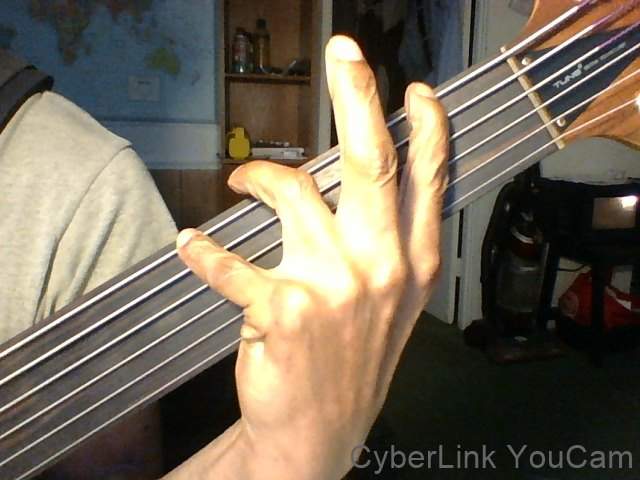
I have a 34" scales fretless.
I can fret the first fret and reach the fourth with my pinky without shifting.
Regularly.Without thinking.
A five and a half inch stretch.No problem.No stress.
I'm used to reaching.
Last edited:

Don't keep your first finger anchored to the first fret, let it come off the board a bit.
I'm shorter than you and play a 35" 6 string and can stretch 1 - 4 no problems.
I'm shorter than you and play a 35" 6 string and can stretch 1 - 4 no problems.
Don't keep your first finger anchored to the first fret, let it come off the board a bit.
I'm shorter than you and play a 35" 6 string and can stretch 1 - 4 no problems.
it gives me hope!
It's just practice, lots of practice.
One thing I've always done, almost every single day for a warm up, is the 1 finger per fret exercise.
E string 1 2 3 4
A string 1 2 3 4
D string 1 2 3 4
G string 1 2 3 4
D string 2 3 4 5
A string 2 3 4 5
E string 2 3 4 5
A string 3 4 5 6
D string 3 4 5 6
G string 3 4 5 6
Etc etc working your way up to the 12th fret. Then back. Then mix up the pattern 4 3 2 1, 1 3 2 4 etc.
Practice your Major & Minor scales in one position.

Stretching 1 to 4 is not something everyone can do. The frets are damn wide apart. I have long fingers, and tend not to do that stretch, either. One thing you can do to make it easier is to instead of stretching to the side, to stretch up and down. You pinky comes into your palm. This gives you a little more range between first and pinky. But the way I prefer going that low is to play with an upright technique of using fingers 1, 2 and 3/4. Leaving finger per fret for the higher, easier to fret notes.
Playing a Squier affinity Olympic white pj bass standard tuning EADG which had 45-100 strings roundwounds which are currently being replaced by a luthier for D'Addario flatwounds 50-105 strings (who probably won't be replaced for 2 decades like James Jamerson lol)Btw what kind of bass are you playing on and what string guage/tuning?
nice! i think youll find the flats a bit comfier to play as well as the benefit of a fresh setup.Playing a Squier affinity Olympic white pj bass standard tuning EADG which had 45-100 strings roundwounds which are currently being replaced by a luthier for D'Addario flatwounds 50-105 strings (who probably won't be replaced for 2 decades like James Jamerson lol) View attachment 2830125

Check out Rocco Prestia I’m referring to how he plays shift fingering he doesn’t stretch.Thanks for the advice I'll take it! Thanks for making me discover the "shift; don't stretch" technique: I'm learning bass by myself and haven't heard of that technique before. Thanks as well for making me feel more "normal" by mentioning that your pinky is on the 3rd fret!
Last edited:


