• TalkBass has been independent since 1998. Add your voice.
    Create a free account to reply to discussions, view embedded media, and browse with fewer display ads.
    Join freeLog in
    Want zero display ads or expanded classifieds tools? Compare plans.

Pickup continuity question

Apologies if this has already been discussed elsewhere, I couldn't find an existing thread on this topic.
I'm new to DIY guitar/bass electronics and am wondering something about pickups.
Using a multimeter, should I be getting continuity from one pickup pole to another on the same pickup?
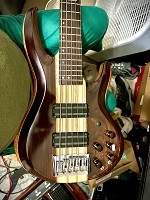
I'm troubleshooting a wiring problem on a project bass at the moment and am not getting a reading on the meter when placing +/-'s on two different poles on the same pickup. Just wondering if this is to be expected for some reason or if there should be continuity between the poles. I've round robin tested all the poles against each other and am getting the same result of no reading.
Thanks.
 
Apologies if this has already been discussed elsewhere, I couldn't find an existing thread on this topic.
I'm new to DIY guitar/bass electronics and am wondering something about pickups.
Using a multimeter, should I be getting continuity from one pickup pole to another on the same pickup?
I'm troubleshooting a wiring problem on a project bass at the moment and am not getting a reading on the meter when placing +/-'s on two different poles on the same pickup. Just wondering if this is to be expected for some reason or if there should be continuity between the poles. I've round robin tested all the poles against each other and am getting the same result of no reading.
Thanks.

Need a little more information
What type pickup are we talking about?Jazz style, P style, other?
Is it an active pickup ( connected to a battery)
 
The poles are not part of the circuitry. They are the magnet or attached to the magnet.

You could set the VOM to a high resistance setting and check across the jack. If you get a reasonable value maybe 8k ohms, then you know the pickup, knobs, jack are wired together appropriately. I'm over simplifying.
 
Need a little more information
What type pickup are we talking about?Jazz style, P style, other?
Is it an active pickup ( connected to a battery)
Oops, I did mean to include this info sorry.
P Bass style passive pickup, unsure of the brand or any other particulars, it's from a cheap, P Bass copy that I pulled from a friends old bass he's had stashed in a closet for years.
 
There should be a signal wire coming off top half of the P pickup and ground coming off the lower or right hand half. Then there is a jumper wire from the bottom portion to the top portion. Reading continuity between the signal wire on the top or L/H portion and the ground wire coming off the lower right hand portion. Depending on the pickup you should read between 8K-14K resistance in ohms. The two halves are wired in series.
 
  • Like
Reactions: Spidey2112
The pole pieces on a Pickup are typically isolated form the circuit, as noted previously. That said, if you ground them (using conductive tape), the bass will respond less to electrostatic interference - it'll buzz a whole lot less in certain situations.
 
  • Like
Reactions: mikewalker
I'm troubleshooting a wiring problem on a project bass at the moment and am not getting a reading on the meter when placing +/-'s on two different poles on the same pickup.

If you want to check continuity -resistance-, your need to check the pickup wires. Checking the poles -if you mean the magnets- will not get you a reading as magnets are isolated from the wiring as stated previously.
The magnets are in the pickup to magnetize the strings. When magnetized, and in motion, the strings generate a current in the pickup wiring which is amplified and gets the sound thru the speakers.
Check your pickup specs (resistance) and compare it with the reading you get when checking the lead wires. This will help you understand if the issue is in the pickup or the pots/other areas.
 
  • Like
Reactions: Spidey2112