
Enjoy the benefits of a premium membership!
Upgrade Account
-
TalkBass has been independent since 1998. Add your voice.
Create a free account to reply to discussions, view embedded media, and browse with fewer display ads.
Join free Log in
Want zero display ads or expanded classifieds tools? Compare plans.
You are using an out of date browser. It may not display this or other websites correctly.
You should upgrade or use an alternative browser.
You should upgrade or use an alternative browser.
Pickups?
- Thread starter LeFevre
- Start date
More options
Who Replied?
Um... wow... open ended question. What are you trying to do? What type of sound, what kind of bass? What's the rest of your setup like?

- Apr 18, 2008
- 16,002
- 1
- 31,693
- Disclosures
- I'm highly opinionated and extremely self-assured



- Apr 18, 2008
- 16,002
- 1
- 31,693
- Disclosures
- I'm highly opinionated and extremely self-assured
Serious answer:
Your question is like walking into a grocery store and asking "what's the best food?".
Additionally, as a brand-new TB member, you have direct access to an overwhelming wealth of opinions about all things bass-related, including everything you could ever care to know about pickups. It's in the upper right of your screen, and it's called "Search". Use it to learn as much as you can, and if you still have questions, come here and ask them as unambiguously as possible.
Your question is like walking into a grocery store and asking "what's the best food?".
Additionally, as a brand-new TB member, you have direct access to an overwhelming wealth of opinions about all things bass-related, including everything you could ever care to know about pickups. It's in the upper right of your screen, and it's called "Search". Use it to learn as much as you can, and if you still have questions, come here and ask them as unambiguously as possible.
Ok, I realize I'm new to TB, so I'll refine my question. I have a bass being built for me, and was looking for some advice on pickups. I'm not in the dark about pickups, neither is the luthier, was just looking for some additional advice in this forum. I'm going to have a P/J setup, I have Bartolinis in my Lakland, I like those and the preamp, but I've also heard great things about Aguilar or Nordstrands (not sure of the spelling).
Looking for some pickups that have great clarity and punch, not too heavy on the low end, so that the sound of the wood and my fingers are enhanced, without too much of the pickup getting in the way. Anybody, Bueller? Thanks, appreciate any advice that can be given.
Looking for some pickups that have great clarity and punch, not too heavy on the low end, so that the sound of the wood and my fingers are enhanced, without too much of the pickup getting in the way. Anybody, Bueller? Thanks, appreciate any advice that can be given.

Honestly, the first thing I would recommend is to re-think your P-J arrangement. If you have already thought it through and still want to use it, make sure you use a hum cancelling J pickup. In-line split-coils function pretty much the same way P pickups do, just housed in a J body, and IMO there is no compromise from the single-coil sound.
I can personally recommend Fender Super 55 pickups. Sweet crystal-clear tone with absolutely no noise.
I can personally recommend Fender Super 55 pickups. Sweet crystal-clear tone with absolutely no noise.
I am not fond of that setup, but primarily because most people don't address it's inherent weaknesses. (Maybe that's a poor way of putting it.) There are the two main issues with that arrangement.
The first is that most of the time, a P pickup is matched with a single coil J pickup. The P is inherently hum-cancelling, the single coil J obviously is not. In a Jazz bass, the single coil bridge pickup is matched to an oppositely wound single coil neck pickup, which cancels hum when both pickups are fully on. Such hum cancelling is not possible in a P/J arrangement, so any use of the J pickup at all introduces the possibility of unwanted noise.
The second is that the outputs of the P and J pickups are often mismatched. The P usually overwhelms the J. I have heard people defend this, saying that they only want the J to influence the tone of the P, but honestly, to me that just sounds like rationalization.
So I guess my objection isn't with the P/J pickup arrangement itself, it's with what most manufacturers and people do with it that bothers me.
If you take those things into account when selecting your pickups, and you get a hum-cancelling J pickup with enough output to keep up with your P pickup, then you should be happy with the result.
P.S. I can happily recommend Fender Super 55 pickups to use with each other, but I am not in any position to recommend a J to use with a P. If I were in your situation, I would probably go with Barts, or any other manufacturer who makes a matched P/J set with hum-cancelling J's.
The first is that most of the time, a P pickup is matched with a single coil J pickup. The P is inherently hum-cancelling, the single coil J obviously is not. In a Jazz bass, the single coil bridge pickup is matched to an oppositely wound single coil neck pickup, which cancels hum when both pickups are fully on. Such hum cancelling is not possible in a P/J arrangement, so any use of the J pickup at all introduces the possibility of unwanted noise.
The second is that the outputs of the P and J pickups are often mismatched. The P usually overwhelms the J. I have heard people defend this, saying that they only want the J to influence the tone of the P, but honestly, to me that just sounds like rationalization.
So I guess my objection isn't with the P/J pickup arrangement itself, it's with what most manufacturers and people do with it that bothers me.
If you take those things into account when selecting your pickups, and you get a hum-cancelling J pickup with enough output to keep up with your P pickup, then you should be happy with the result.
P.S. I can happily recommend Fender Super 55 pickups to use with each other, but I am not in any position to recommend a J to use with a P. If I were in your situation, I would probably go with Barts, or any other manufacturer who makes a matched P/J set with hum-cancelling J's.
One other thing. Since you are having a bass built, I reeeeeeally recommend you rethink the P/J arrangement.
It's not because such a combination is necessarily bad, it's because you have a whole world of possibilities open to you right now. Why go with something you could literally get anywhere? Now is the time to go for something different, something that will be unmistakably yours and no one else's. Maybe two P's and a J? Three J's? Three P's?
My first build was the bass in my avatar. I have never regretted spending a little extra and getting something unique and unconventional.
It's not because such a combination is necessarily bad, it's because you have a whole world of possibilities open to you right now. Why go with something you could literally get anywhere? Now is the time to go for something different, something that will be unmistakably yours and no one else's. Maybe two P's and a J? Three J's? Three P's?
My first build was the bass in my avatar. I have never regretted spending a little extra and getting something unique and unconventional.
That's some great feedback, I appreciate your time on this. I agree with your assessment of the P/J problem of the J pickup being second fiddle to the strong P; it's inherent in that setup. I was going to see if there was a hum canceling J pup that could be a bit hotter, maybe equalling the output of the P. The main problem I guess I'm having is that there are so many options at this point in regards to pickup choices, it's mind boggling! And since it's a custom build, once it is built I'm locked into whatever setup I choose. I have a Lakland with the J and humbucker, a music man, a P Bass; they're all great and different. You make a great point about having the build be uniquely mine, just which way to go with pickups, and then active versus passive; was thinking of having a preamp as well. Decisions!! I appreciate your feedback, any more insight would be helpful. Do you prefer two J's, how would three sound?
- Apr 18, 2008
- 16,002
- 1
- 31,693
- Disclosures
- I'm highly opinionated and extremely self-assured
Again, search is your friend:
http://www.talkbass.com/forum/f38/what-best-p-j-combo-pickups-843836/
http://www.talkbass.com/forum/f38/pj-replacements-599752/
Additionally, visit www.bestbassgear.com and browse through their pickup section. Several P/J sets from several reputable manufacturers. BBG are happy to answer questions about them too - very helpful folk!
http://www.talkbass.com/forum/f38/what-best-p-j-combo-pickups-843836/
http://www.talkbass.com/forum/f38/pj-replacements-599752/
Additionally, visit www.bestbassgear.com and browse through their pickup section. Several P/J sets from several reputable manufacturers. BBG are happy to answer questions about them too - very helpful folk!
I appreciate your feedback, any more insight would be helpful. Do you prefer two J's, how would three sound?
It all depends on the execution. I don't mean to cop-out, but a lot depends on the bass itself, the pickups, the choice of wiring and controls.
I can tell you that my 3-pickup bass sounds phenomenal. I have three Fender Super 55 J pickups (one bridge, two neck). The body is a Warmoth. I had them route the bridge pickup in the normal location, and then route two neck J's with 2" edge-to-edge. It was a completely arbitrary number, based on how I thought it would look.
(Caveat: many people hold to the theory that pickup placement should be related to harmonic locations. I am not one of those people. Harmonic locations change the instant you start playing up and down the neck, and there's absolutely nothing anyone can do about it, so I choose to ignore it completely.) (And even people who do believe that theory say that it doesn't matter if the pickups aren't located precisely.)
The pickups are all wired parallel to each other. Each one has independent volume and tone control. From there, the signal goes to a Turnstyle switch, to a master volume and tone control, and on out to the jack. It is all passive. The Turnstyle is a 6-position rotary switch -- position one is full manual control of all pickups, positions 2-6 are tone presets.
Michael at [Invalid or Expired Link Removed], who did the control circuitry, had this to say:
"I got the neck on it and WHOA does this bass sound good!! These pickups not only sound amazing but work exceptionally well with the Turnstyle switch. Even if these were not noise canceling, they would be worth the price just on tone quality alone. The clarity of them reminds me of the Fralin pickups I have in my Tele.
The setting with everything wide open is crazy sweet sounding. Reminiscent of the Seinfeld J-Bass tone but the middle pickup adds a whole new complexity to the tone without even the slightest hint of mud.
One-of-a-kind bass with infinite tonal possibilities."
So to answer your question, three J pickups on my bass sound exquisite. I love having three pickups, it gives me a lot of tonal flexibility. I invite you to try three J's. Or how about two J's and a MM? The possibilities right now are only limited by your imagination.
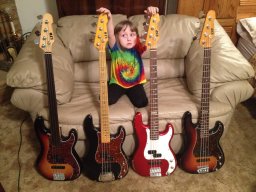
I heard the Seinfield J bass tone was actually a keyboard . Perhaps a j bass sample but nonetheless .
Thanks again for the feedback, plenty to think about here; I'll be busy for awhile trying to figure which configuration to go with!
I'll be interested to know what you decide. And if you decide on something uncommon, I'll want to see the final result.


