• TalkBass has been independent since 1998. Add your voice.
    Create a free account to reply to discussions, view embedded media, and browse with fewer display ads.
    Join freeLog in
    Want zero display ads or expanded classifieds tools? Compare plans.

piezos?

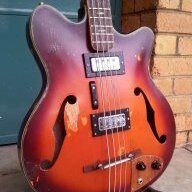
I had a bass built by Chris Stambaugh.
Chambered body, 1 Mag. P.U. 1 Piezo with buffered pre.
It came out very good. The piezo was brighter than expected
but EQ's well. The Mag PU gets me buy playing blues and rock, pop.
The piezo only has a big fat bottom. I was influenced by a Rob Allen
but wanted it to be more flexible.
 
  • Like
Reactions: friendlybass
Thanks for the video dude I see what you mean. How much, would you say, is a matter of eqing it? If I wired it like my carvin lb50 where both pickups go to the main out and only one to the second, so Id be able to send the piezo to its own preamp essentially, would I be able to shape it or in your experience is it what it is?

I think it kind of is what it is. You can cut the highs (my Curbow has a passive-type treble roll-off tone control, which helps), and maybe boost low mids, but you still have the basic compressed tone without much dynamics. Unless you really like that tone, I'm not sure I really see the point.

Remember, the video is the *best* sounding piezo tone I've heard, and not what you'd get with regular metal-core strings.

Again, I liked it better on fretless than fretted, because it seemed better suited to the singing tone and softer attack/swell of fretless.
 
  • Like
Reactions: friendlybass
I've designed all sorts of piezo preamps. From banjo/uke/mando one transducer with simple one or two fets and high pass filtering, to acoustic guitar with undersaddle and electret condenser mic mixing, to 6-string bass with mag and piezo blend. I've also seen many many poorly implemented preamp systems. Usually just some direct translation of a circuit found on the web, or an install of a circuit that was never intended as a piezo pre. IME there's no simple answer.

It comes down to simply getting the piezo pickup in/on the instrument, and going from there. If you plan to use off the shelf parts, you will really need a tech who knows what they are doing. Not just some one who can follow diagrams, but some one who can practically design from scratch. What works in one instrument may not in another. Maybe you can find an amp or hi-fi tech instead of a typical guitar tech in your town.

Most of the keys here have been mentioned. Nice high impedence (Z) for the piezo - 5-10Meg is typical, but again, until you hear your actual transducer, this could vary. Typically a fet is used, but if an opamp, then you'll have to look through data sheets to find one with fet input transistors. Plus Z and V matching with the magnetic pickup(s) of course, so a gain control as well.

But here are some things that I haven't seen mentioned that are critical. I have mentioned these in other posts so keep searching and reading.

For a bass with individual saddle pickups, you'll need a channel and trimpot for each. They never seem to work summed into one. Even if you can get the same output string to string (unlikely, especially if you play 6-string), the tone seems to turn to mush in the midrange.

The other thing that's not been mentioned is phase response. I don't think there's really a way of predicting the best phase to blend a piezo with another source. IME, you just have to try both and see. A temporary phase reverse switch on the magnetic pickups is usually your best bet.
 
  • Like
Reactions: friendlybass
I've designed all sorts of piezo preamps. From banjo/uke/mando one transducer with simple one or two fets and high pass filtering, to acoustic guitar with undersaddle and electret condenser mic mixing, to 6-string bass with mag and piezo blend. I've also seen many many poorly implemented preamp systems. Usually just some direct translation of a circuit found on the web, or an install of a circuit that was never intended as a piezo pre. IME there's no simple answer.

It comes down to simply getting the piezo pickup in/on the instrument, and going from there. If you plan to use off the shelf parts, you will really need a tech who knows what they are doing. Not just some one who can follow diagrams, but some one who can practically design from scratch. What works in one instrument may not in another. Maybe you can find an amp or hi-fi tech instead of a typical guitar tech in your town.

Most of the keys here have been mentioned. Nice high impedence (Z) for the piezo - 5-10Meg is typical, but again, until you hear your actual transducer, this could vary. Typically a fet is used, but if an opamp, then you'll have to look through data sheets to find one with fet input transistors. Plus Z and V matching with the magnetic pickup(s) of course, so a gain control as well.

But here are some things that I haven't seen mentioned that are critical. I have mentioned these in other posts so keep searching and reading.

For a bass with individual saddle pickups, you'll need a channel and trimpot for each. They never seem to work summed into one. Even if you can get the same output string to string (unlikely, especially if you play 6-string), the tone seems to turn to mush in the midrange.

The other thing that's not been mentioned is phase response. I don't think there's really a way of predicting the best phase to blend a piezo with another source. IME, you just have to try both and see. A temporary phase reverse switch on the magnetic pickups is usually your best bet.
Thanks for chiming in dude you definitely seem to know what's up! Ive been thinking more of buying an off the shelf system like the hipshot or Fishman bridge systems. I know bartolini makes a buffer/preamp specifically for piezo systems but I don't know about the compatibility factor. The research continues any suggestions are a help :)
 
Last edited:
The Spector has a Fishman bridge with individual piezo elements connected to a 'collector' pc board on the under side of the bridge, then single signal wire running to preamp/buffer.
Cort used the same bridge (in C5P) along with a Fishman preamp/buffer that has vol/tone stacked control connected to a preamp/buffer w/trim pot, that is then connected to the Mag pickup board (each board less than 2" x 2") with vol/bal/bass/treble pots, then to jack. Piezo alone is full range- deep, clean bottom, clear mids and more treble than needed- fully adjustable.
Not sure about the Spector elecs. Possibly Fishman also, sourced from the same place.
The bridges can be found around- 4 and 5 string-, not sure how they sound connected to the Bart or EMG preamp/buffer, tho.
 
The Spector has a Fishman bridge with individual piezo elements connected to a 'collector' pc board on the under side of the bridge, then single signal wire running to preamp/buffer.
Cort used the same bridge (in C5P) along with a Fishman preamp/buffer that has vol/tone stacked control connected to a preamp/buffer w/trim pot, that is then connected to the Mag pickup board (each board less than 2" x 2") with vol/bal/bass/treble pots, then to jack. Piezo alone is full range- deep, clean bottom, clear mids and more treble than needed- fully adjustable.
Not sure about the Spector elecs. Possibly Fishman also, sourced from the same place.
The bridges can be found around- 4 and 5 string-, not sure how they sound connected to the Bart or EMG preamp/buffer, tho.
Best bass gear sells these [Invalid or Expired Link Removed] with graph-tech ghost saddles, are they pretty reputable? I'm sensing this may be ambitious for my first build but the worst that happens is I learn the hard way!
 
I've no experience with the Hipshot piezos- rather expensive comparatively, but seem to be well designed and the other offerings they have are highly respected here. A complete matching system designed to for all components to work together has a lot going for it if the resulting tone options are there. I have no idea what the reviews are on Hipshot's piezo system, so you may want to search a bit for something.
The Fishman bridge in the Spector can be purchased for $50-$60, but then you need to match a buffer/preamp to it- may be risky, as I think most of the resulting tone is the result of tuning the preamp/buffer for bass: it's usually used for guitar.
Fishman arguably has the most experience with piezo design, and it shows.
Also, Ibanez used an individual-saddle system in the top models of their EDA/EDB series. Where they got the system from, no idea, but they had individual leads from each saddle with trim pots for each, same as Washburn had in some of theirs. BTW: Washburn worked with Fishman for many of their products.
 
  • Like
Reactions: friendlybass

Latest posts