• TalkBass has been independent since 1998. Add your voice.
    Create a free account to reply to discussions, view embedded media, and browse with fewer display ads.
    Join freeLog in
    Want zero display ads or expanded classifieds tools? Compare plans.

PJ Appreciation Thread!

...
So what is the definitive P Tone specs, wood, pickup, tone cap/pots, bridge, tuners etc. and or year that make all others not Pure? [not just P/J's]

There isn't one, and that's my point. The whole concept of a single definitive P tone is flawed. If something doesn't exist to begin with, how can it be screwed up bý adding anything to it? Answer is, it can't.
 
  • Like
Reactions: stingray69
Pure is what a purist would choose off the wall, knowing that he will find an instrument that will serve his purposes and that will feel like an old pair of jeans. Not talking about anything that could be considered above or below. Duck Dunn was a purist, to me: he played basically always the same instrument thru years. Steve Cropper, Clapton etc. But also here: there is nothing to really argue (caps, tuners...). If you compare two axes both just out of the production line, even there you will find subtleties that will bring you to select one vs. the other.

That sounds like personal preference to me; Purist yes is based on traditional

Another store may have had a Bass that would have served Duck's purpose equal or better 'Hanging on the Wall'
Also he did not have an option for P/J, Stingray, etc. hanging on the wall

I used my '75 P exclusively for 25yrs and it served my 'purpose' not because it didn't have a J pickup at bridge or any other differences or being more traditional made it 'Pure'

But I do understand where you are coming from and respect your stance but no reason to mock progression for 'purity' of tradition with unproven assertions that a P/J full P tone is inherently different than any 'pure traditional' P Bass along with other non vetted assertions that many claim are only opinions
 
That sounds like personal preference to me; Purist yes is based on traditional

Another store may have had a Bass that would have served Duck's purpose equal or better 'Hanging on the Wall'
Also he did not have an option for P/J, Stingray, etc. hanging on the wall

I used my '75 P exclusively for 25yrs and it served my 'purpose' not because it didn't have a J pickup at bridge or any other differences or being more traditional made it 'Pure'

But I do understand where you are coming from and respect your stance but no reason to mock progression for 'purity' of tradition with unproven assertions that a P/J full P tone is inherently different than any 'pure traditional' P Bass along with other non vetted assertions that many claim are only opinions

The misunderstanding that started all of this... snafu is that I used the term "pure" deriving it from a previous statement of a fellow bassplayer that used the term "purist". It is OBVIOUS that nothing can be defined as "pure", whatever meaning we want to give to the term. Nevertheless, remaining to your example, Duck Dunn had plenty of options thru his whole life, even when he had his last signature developed from Lakland; he could have added... a pickup at the bridge and one on the headstock :) yet he helped them to build... just a simple P with a Jazz neck (a wonderful bass). Because he was a purist, to me. That is all I intended.

...that a P/J full P tone is inherently different than any 'pure traditional' P Bass

Lots of players will confirm this. Just make a search...

PJ Basses

from the thread above, post #10:

"Now THIS is a worthwhile PJ thread. The IDEA of a PJ appeals to me. I've just yet to plug-up one I liked the SOUND of. I've always assumed that just like a two-knob Telecaster Custom, it's hard to get the two dissimilar pickups to "play nice" together, perhaps because they're back-loading an impedance on each other that makes NEITHER sound like it would in the absence of the other, so like the folks on the Tele forums do, much trial and error is required before finding a "Goldilocks combination" of two individual pickups/pots/wiring harnesses... and even placement. It ISN'T instant "best of both worlds" just because the two pickups "are there". Marrying the two brings a unique set of challenges. Some decent detail on configuration considerations being shared here so far."

Post #88:

"...The biggest problem P/J basses have is the incompatibility of a single coil and a humbucker mixed. The output near the bridge is lower than near the neck due to the narrower string vibration. Putting a weaker pickup there intensifies the effect. If a P/J had the P pickup near the bridge and the J near the end of the board like an EB- 0 it might mitigate the problem. This can be avoided by replacing the single coil Jazz pickup with a humbucker. Either that stacked type of the side by side style will work. Lowering the P and raising the J will help even them out. I like the DiMarzio Model Js with the adjustable poles and the cream colored covers. They are side by side coils and sound like a P bass only more focused. They work well in a P/J application. Hope this helps."
 
Last edited:
  • Like
Reactions: johnnynitro
There isn't one, and that's my point. The whole concept of a single definitive P tone is flawed. If something doesn't exist to begin with, how can it be screwed up bý adding anything to it? Answer is, it can't.

I suppose, in the absolute purest sense, it would be an original Fender '51 P-bass with original pickup. In which case, almost no one is rocking a "traditional P-bass tone" including the "purist" crowd who like to make those claims. Let alone be in a position to presume themselves an authority on what is, or what isn't, a definitive P tone.

Even if you could locate 2 random '51 P basses and play them side by side, things like potentiometer tolerances, the very unscientific method of hand wound pickups, inconsistent number of winds, bobbins & wire-type, etc. They would not sound 100% identical anyway. So which of these 2 "identical" basses now become the "pure tone" instrument? The one with just a tad less high end? The one with just a little more "something in the midrange"? Of all the '51 P basses left on earth - have all the owners gotten together and decided by vote which one the the purest, P-bassiest one of them all? Or is really about just being "close enough"?

But an un-amplified electric bass is not a "tone". So are we basing our "pure" tone off of some particular ampless, direct-to-recording console tone on some vintage recording? Or is it based upon some later-produced Motown recording in the 60's? If so, which recording(s)? Or is it the very specific mic'd up combo of a '51 P-bass through a very specific vintage year Fender amp? If so, what vintage & model of amp is it? And so now, what very specific vintage microphone & model do we use so we don't spoil or color the magic tone coming out of the magic amp that will be used as the golden-rule standard for generations to come?


Again, at which point no one is reproducing this "magic" combo these days. You see my point - I agree, it always has been & always will be some vague/enigmatic argument at best. I say time is better spent practicing and learning one's craft then arguing the semantics of some alleged mythical tone on a microscopic level.
 
Last edited:
@stingray69, @SteveCS: you completed misinterpreted/misunderstood what I wrote. Maybe my English is not sufficiently evolved to convey my thoughts. It's about being a "purist", not "pure" (that does not exist anyway). A "purist" looks with some perplexity at a P/J axe. And with good reasons. Then, everyone is entitled to play and treasure the axe that he likes. Please reread without prejudice. Stop for me. Have the best.
 
@stingray69, @SteveCS: you completed misinterpreted/misunderstood what I wrote. Maybe my English is not sufficiently evolved to convey my thoughts. It's about being a "purist", not "pure" (that does not exist anyway). A "purist" looks with some perplexity at a P/J axe. And with good reasons. Then, everyone is entitled to play and treasure the axe that he likes. Please reread without prejudice. Stop for me. Have the best.

No worries - it was not my intention at all to imply you are "a purist". Sorry if it came across that way, or if you thought my rambling was directed at you, or anything you've posted in this thread.

No, rather I was just on a long winded rambling in regards to the notion that crops up fairly often on TB, that there exists some "true" P tone out there. And that anyone who happens to also have a J option (whether they use it or not) sitting alongside the P pickup, can somehow never achieve it (whatever this seemingly undefinable, magical tone is).

I was just hoping to point out to thread readers in general, that it's my belief that there are so many factors tied into what people try to vaguely define as a "true P-tone". So many in fact, that the very notion itself that one (and only one), true P-tone exists - and that anyone can say exactly what that sounds like, is absurd at face value. :thumbsup:
 
Last edited:
and that anyone can say exactly what that sounds like, is absurd at face value.

Not only at face value. The more you try to rationalise it the more absurd it becomes.


Exactly my point also, although some folks do get very uptight at the mere hint that the precious P might not be all that precious after all.
 
  • Like
Reactions: stingray69
Duck Dunn had plenty of options thru his whole life, even when he had his last signature developed from Lakland; he could have added... a pickup at the bridge and one on the headstock :) yet he helped them to build... just a simple P with a Jazz neck (a wonderful bass). Because he was a purist, to me. That is all I intended.

First I will let go the fact that Lakeland was a Duck Signature based on the 'one he played'

I understand 'Purist' and 'Pure' got tangled and also understand Duck wanting to play 'his' Bass.

When I Sold my '75 P in 2000 it felt like I lost a Close Friend, hurt my heart. During those 25yrs I never even considered buying another Bass [Did Admire Stingray first time I heard in late 70's]:)

I have been called a 'Purist' but not in a good way because I would use virtually no tone control, volume, tone always full on with P bass, 10ft cord max never used a pedal in line not even tuner [xtra cord and connection to change tone of bass]Etc.; used right hand position and plucking style for different tones and Cab placement on stage with isolation if needed. Was same way with home hi-fi


Like I said before I respect your 'Purist' attitude based on tradition and sticking to it; just not all the other assertions:)

IMO Tradition needs to be respected [not worshiped] and 'Purist' well...... be a tad more open minded

I no longer fear a longer cord [have active Bass its buffered] Active Bass P/J, Stingray, Dingwall, have a tube pre between Bass and Amp input I am still alive everything sounds great and I still enjoy playing;)
 
Well, crap…so much for a "an all round positive thread about all things PJ". :facepalm:

I feel I should apologize for inadvertently setting up this situation.I was not speaking to the perceived "purity" of any particular instrument. Rather, it was people that I was talking about. I guess I should've used the hackneyed (love that word! :bookworm:) phrase, "Haters gonna hate!" instead.
 
  • Like
Reactions: stingray69
Well, crap…so much for a "an all round positive thread about all things PJ". :facepalm:

I feel I should apologize for inadvertently setting up this situation.I was not speaking to the perceived "purity" of any particular instrument. Rather, it was people that I was talking about. I guess I should've used the hackneyed (love that word! :bookworm:) phrase, "Haters gonna hate!" instead.

No worries - it was bound to come up, me thinks. I don't think too many feathers got ruffled - just good spirited discussion.

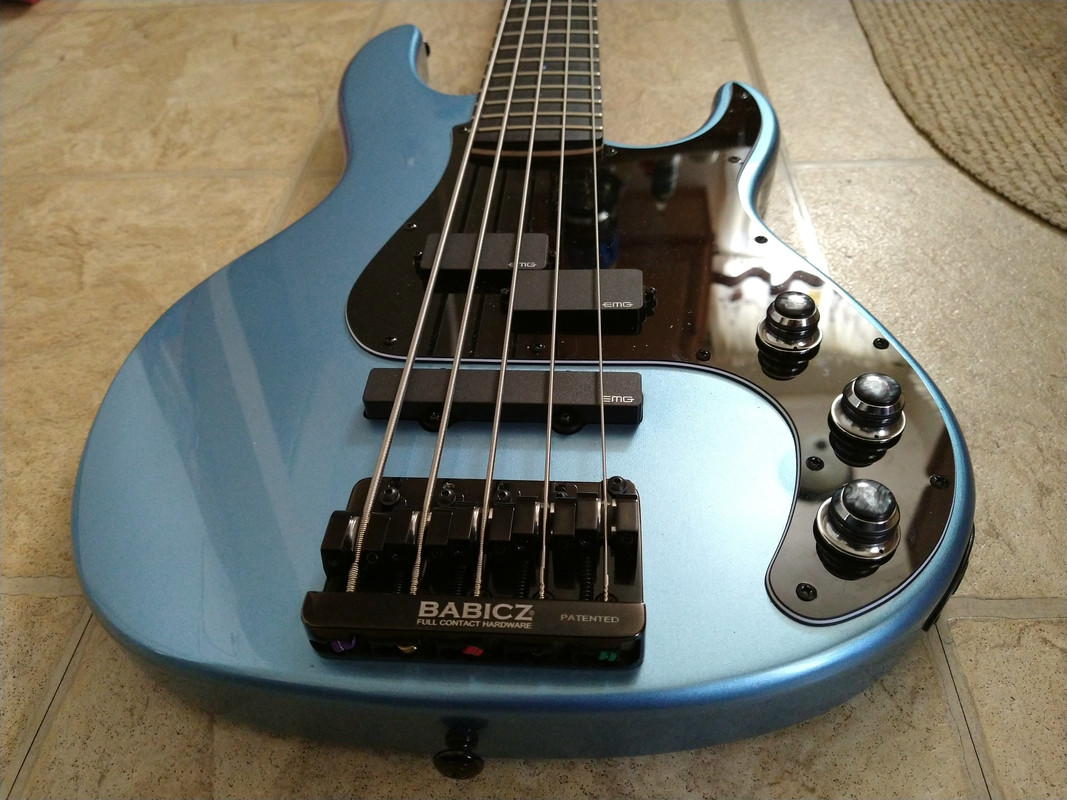
The thread will keep rolling along. In any case, since I've already posted my passive P/J (Yamaha BB's), I also have an active P/J that I occasionally will play if I think a song or situation calls for it. It's loaded with original recipe USA EMG's and Ebony fingerboard - so definitely a "modern" P-tone, but it's a very good one. :thumbsup:

ESP LTD AP-5:

IMG-2.jpg
 
First I will let go the fact that Lakeland was a Duck Signature based on the 'one he played'

I understand 'Purist' and 'Pure' got tangled and also understand Duck wanting to play 'his' Bass.

When I Sold my '75 P in 2000 it felt like I lost a Close Friend, hurt my heart. During those 25yrs I never even considered buying another Bass [Did Admire Stingray first time I heard in late 70's]:)

I have been called a 'Purist' but not in a good way because I would use virtually no tone control, volume, tone always full on with P bass, 10ft cord max never used a pedal in line not even tuner [xtra cord and connection to change tone of bass]Etc.; used right hand position and plucking style for different tones and Cab placement on stage with isolation if needed. Was same way with home hi-fi


Like I said before I respect your 'Purist' attitude based on tradition and sticking to it; just not all the other assertions:)

IMO Tradition needs to be respected [not worshiped] and 'Purist' well...... be a tad more open minded

I no longer fear a longer cord [have active Bass its buffered] Active Bass P/J, Stingray, Dingwall, have a tube pre between Bass and Amp input I am still alive everything sounds great and I still enjoy playing;)

You see: the comic part is that I am not a "purist" and I do not own and never will a P! I was just putting a point of view, some elements on the discussion table... :)
: