• TalkBass has been independent since 1998. Add your voice.
    Create a free account to reply to discussions, view embedded media, and browse with fewer display ads.
    Join freeLog in
    Want zero display ads or expanded classifieds tools? Compare plans.
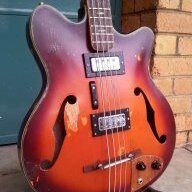
PJ bass with the split coil wired with series/parallel switch?

Yes. It works with certain pickup combos. My 80's Maton has those old cream dimarzios and the P is really hot and mid-rangey. The bass originally had a series-parallel switch that operated on both pickups at once, and the first mod I did was to disconnect the J from the switch so I could have the P in parallel and the J remain in series. IMHO the pair worked much better this way. The outputs matched better, they blended more gradually and evenly, and the brighter hollow sound of the parallel P was a good foil for the middy tone of the J.

 
  • Like
Reactions: PawleeP
Yes. It works with certain pickup combos. My 80's Maton has those old cream dimarzios and the P is really hot and mid-rangey. The bass originally had a series-parallel switch that operated on both pickups at once, and the first mod I did was to disconnect the J from the switch so I could have the P in parallel and the J remain in series. IMHO the pair worked much better this way. The outputs matched better, they blended more gradually and evenly, and the brighter hollow sound of the parallel P was a good foil for the middy tone of the J.


Thanks for the info! I was thinking about trying this with either a Dimarzio model PJ or EMG Geezer PJ set, both very heavy in the mids and with much higher P output compared to the J, so this might work here.
 
  • Like
Reactions: PawleeP
I have both sets, I wouldn't cut the GZR for passive expecting it to work as well as the Dimarzio set.

SD 1/4 lbers work just as well as the DiMarzios for this application.

What RobbieK mentioned is something I do a lot with a Warwick $$ with Nordstrand Bigmans. I should throw a deafeatable blend option and a 3-way selector switch on that bass. In his case the pickups were paired and he kicked off his J so it's acting like the bass in the video. I'd just get a push-pull pot for the P.
 
My only moddable P/J is loaded with Wilde P46/J45L wired with a series/parallel on the P46 via a push/pull volume pot. It's then routed to volume/blend/tone knobs. Having the P in parallel really does emulate a Jazz bass nicely and I use that tone often. The P46 in parallel is actually brighter than the J45. Like the video, that bass covers a lot of ground in my cover band.
 
j pup(s) that have split coils with 4 wires

Nordstrand has a split-coil J-type, but it's only 2 leads.

Fralin's are made to order, so you could contact Lindy directly & ask if they have 4 leads for parallel/series switching:

Invalid Link Removed

In parallel you might want to have them overwound 5 or 10% so they're not weak.
However, this will make them darker in series.
 
Last edited:
  • Like
Reactions: bigtone23
This is a split-coil J-type pickup:
Nordstrand_Pickups_NJ4SE_NoCover_Jazz_Bass_800x.jpg
 
I know this is an old-ish thread however i have been pondering whether or not i would benefit much from a cap and resistor (pass filter) on the volume pot of the P (on a pj) with ser-par on the P. Or would simply switching to a linear pot for the p-pup vol be sufficient. Anyone know what values to start with for a super hot 21.6k p-pup array? Would prolly try the cap-resistor type setup in series first.
 
I know this is an old-ish thread however i have been pondering whether or not i would benefit much from a cap and resistor (pass filter) on the volume pot of the P (on a pj) with ser-par on the P. Or would simply switching to a linear pot for the p-pup vol be sufficient. Anyone know what values to start with for a super hot 21.6k p-pup array? Would prolly try the cap-resistor type setup in series first.
I have treble bleeds on a few of my passive basses (all of them 80s Peavey--as it was a stock feature) and never bother to remove them as they work well. These are just a .001uF cap, just as used on many a guitar. It is a fairly aggressive treble bleed, the more the volume goes down, the brighter it gets. Not really an issue, as my volume is almost always on 10, sometimes rolled back to 8-9 and then all the way off when not playing.

To make it a little more subtle, I have installed a .0022-.0033uF cap with a parallel resistor on many of my guitars with great results. I have also had great luck with just using those cap values without the resistor. The resistor value plays off the pot value-it's usually half the value of the pot. If there is a 250K ohm pot, I use a 120K resistor, if a 500K pot, I try a 220 or 240K resistor. If a parallel resistor is used in the treble bleed circuit with an audio taper pot, it does tend to smooth out the taper--it 'linearizes' it.
There are no rules and it's fully up to experimentation to find what works best for your instrument: cap or cap/resistor in series or parallel.

For higher resistance pickups, I try a 500K pot for volume and tone first. I almost always prefer a linear taper volume and audio taper tone.
 
Does running the resistor then cap in series style still somewhat linearize an Log or A pot? Or do you know? Appreciate your ideas man! The vol pot for the hot-ish p-pup array in this PJ for now is a 500k CTS Log/Audio pot. I saw that the suggested values on this one diagram i found are different for the series style setup. Thanx, pP
 

Latest posts