Dan1099 said:indeed. What makes you think that this means the conveyer will impart any force to the plane whatsoever?
The wording in the original post.

TalkBass has been independent since 1998. Add your voice.
Create a free account to reply to discussions, view embedded media, and browse with fewer display ads.
Join free Log in
Want zero display ads or expanded classifieds tools? Compare plans.
Dan1099 said:indeed. What makes you think that this means the conveyer will impart any force to the plane whatsoever?

bmc said:If you're on a jogging machine and it's set to go at the speed you run at, how much distance will you cover in an hour, relative to the stationary floor around you? Not much. You will not have left the building while standing on the jogging machine, correct?
Davidoc said:I don't even get how this is a trick question. No acceleration through the air, no lift. BMC's treadmill comparison is a good one.
bmc said:Read the original post. The conveyor:
1. moves opposite to the direction the plane is headed.
2. it moves at the same speed as the plane.
Geoff St. Germaine said:Unfortunately it's not.
It says the conveyer will move the other way. How does this translate to force on the plane?bmc said:The wording in the original post.

Geoff St. Germaine said:Yes it does. Can you tell me how much force is being imparted to the aircraft from the conveyor? That is the key. Force balance. The plane has large engines pushing the plane forward and a little bit of friction in the wheels holding it back. The wheels would have to be terrible if they were to be able to hold the aircraft in place. One might say that they wouldn't be wheels at all.
Bassic83 said:"What is the average wingspeed velocity of a swallow, migrating?"
"Is that the African, or the European variety?"
"What? I don't know that! AAAAaaaaaaaagh!"
bmc said:I really don't think this was intended as a complex problem.
bmc said:I really don't think this was intended as a complex problem.

Geoff St. Germaine said:It only requires high school physics at best. It isn't a complicated problem. My problem is, how much current is collected out of a fully ionized, magnetized plasma by a TZM (titanium zirconium molybdenum) electrode inserted into it with a -100 V potential applied to it with respect to the vacuum chamber. I need the answer as a function of the poloidal and toroidal mach numbers and for arbitrary orientation of the probe with respect to the magnetic field lines.
Here's my probe:
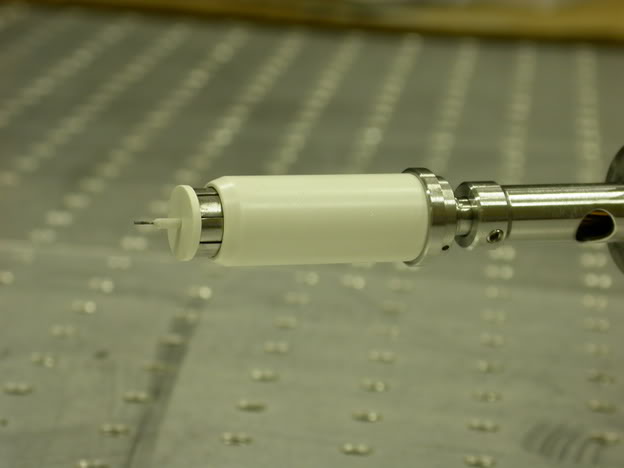
That's a complicated problem.



Dkerwood said:Essentially, we have a primary force acting as a primary means of propulsion (ie the wheels and engines therein) and we have a secondary force designed to supplement the primary force (ie the jet engines).
Dkerwood said:Wow. This has gotten really quite complicated.
Essentially, we have a primary force acting as a primary means of propulsion (ie the wheels and engines therein) and we have a secondary force designed to supplement the primary force (ie the jet engines).
Dkerwood said:The question now becomes one of acceleration. Given that the plane accelerates at rate R, regardless of where the force comes from, if the conveyor call accelerate the plane at exactly R in the opposite direction, all things being equal, the relative speed of the plane will not change.
Dkerwood said:Of course, according to the original wording of the question, the conveyor's sensors would then read the "speed" of the aircraft at zero, and reset itself to zero, at which point the plane would start to accelerate again.
Dkerwood said:However, assuming that this spaceage conveyor is capable of instantly recalibrating its speed relative to the plane, it's relatively safe to assume that the instant that the plane began to accelerate in any fashion, the conveyor would accelerate to match. The equal and opposite accelerations would cancel each other out, and the relative speed would remain at zero, given that the wheels remain in constant contact with the ground.
Dkerwood said:If the plane began to bounce, as it almost certainly would, however, the conveyor would produce no drag on the plane, and it would begin to accelerate. This acceleration would then be matched by the conveyor when the plane lands, and at this point, the plane would stop until it bounced again (unless the conveyor drags it back to its original position, which might happen, considering that the conveyor would be going the speed at which the BOUNCING plane was traveling, and thus would be traveling faster than the maximum speed allowed on the ground). At this point, we must consider these variables:
1. Maximum speed of the conveyor versus the maximum "bouncing" speed of the jet.
2. Maximum rate of acceleration of the jet given that it is accelerating from rest versus maximum rate of acceleration of the conveyor given that it is already in motion and simply must defeat the relative acceleration of the jet.
3. Length of the conveyor belt and whether or not the belt's purpose is simply to defeat acceleration or to confine the plane to one location. If it is the former, the plane will simply bounce forward until it is free of the conveyor.
4. Any other variables that may affect the situation (wind speed, durability of the belt versus that of the plane, any incline on the plane, weather conditions, etc).
Dkerwood said:All in all, if the conveyor's purpose is to defeat acceleration and its mechanical limitations are not to be considered, I do not believe that the plane would be able to take off without substantial vertical force.
Dkerwood said:Forthermore, once it made its way off of this conveyor traveling hundreds of miles per hour and transferred to the stationary ground, the plane would almost certainly lose control and crash, thus making it very difficult to take off.
Ah, then there goes my whole argument. The wheels are free spinning, then?Bob Lee (QSC) said:No, there is only a primary means of propulsion: the jet engines. The wheels no not have motors. Even when the plane taxis, it uses the jet engines to push it along. That's why when you're on a plane you can hear the pilot briefly spool its engines up to start it moving along the taxiway.