
Enjoy the benefits of a premium membership!
Upgrade Account
-
TalkBass has been independent since 1998. Add your voice.
Create a free account to reply to discussions, view embedded media, and browse with fewer display ads.
Join free Log in
Want zero display ads or expanded classifieds tools? Compare plans.
You are using an out of date browser. It may not display this or other websites correctly.
You should upgrade or use an alternative browser.
You should upgrade or use an alternative browser.
Players that won't learn a note
- Thread starter themickster
- Start date
More options
Who Replied?
I don't know why the term "theory" is intimidating. I think many people don't really have a good grasp of what it involves, including perhaps myself, because we conflate theory with note reading and what I like to call the mechanics of music.
Learning your notes and where they are on your instrument isn't theory. Theory is about why certain things sound good and certain things don't. That includes harmony, of course, but it also includes melody, it includes movement, too.
I have a bit of a hard time with relabeling something because it's scary to someone. It reeks of coddling. Who made it scary? Why not demystify the correct label rather than pretend to reinvent the wheel?
A wheel is a way to move and transport things, but yes, it can also run you over and kill you. I'm not going to call it something else just to placate the person who is wheel-phobic. I'm going to help them understand that this is not the correct way to understand what a wheel is for.
Agree. Anyone who is turned off just by the word theory probably isn't willing to put the effort into learning much of it. Just like learning anything else, you only get out what you put into it.

I like the guitarist's invariable response to all criticism; "what do you mean?" I'm gonna use that next time I get crap for hitting a clam. 

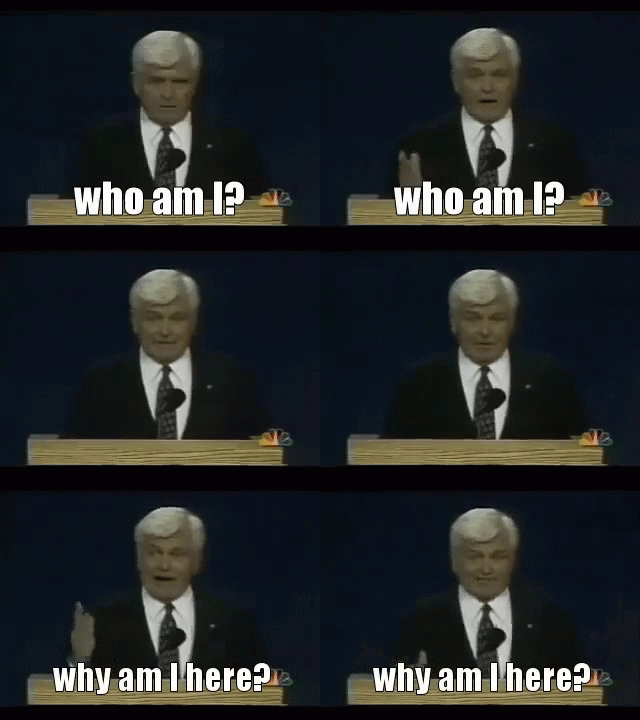
Or there's always, "What? Where am I?? Who are you people?!?"I like the guitarist's invariable response to all criticism; "what do you mean?" I'm gonna use that next time I get crap for hitting a clam.


What do you mean?I like the guitarist's invariable response to all criticism; "what do you mean?" I'm gonna use that next time I get crap for hitting a clam.
The song my boy couldn't get right is I IV V in E with a middle eight in another key. I saw a video of him playing Beat It. When the band was playing to main riff, he was his go-to twiddling three neighbouring frets as fast as he could and not even the right three for the key. This was weeks after he'd left my band. I can't be bothered to tell him he'd gone badly wrong; he won't understand what I mean.What EVH had to contend on “Beat It” would not be that much of a challenge structurally, the entire song is only three chords, up and down, back and forth. Not the usual suspect I/IV/V ... .
Exactly.That said, if you're lucky enough to be one of those people with a great ear, it can take a bit of experience to get to the point where you understand the need to learn certain things. You might find yourself learning them gradually as you gain more experience overall. Age and experience level matter here. Someone who is relatively young and inexperienced would get the benefit of the doubt from me, but they would also get the conversation about why it's important to be open to learning about the ways other people communicate.
I'm an ear player since 30 years. Never had a problem with that: always been able to play with others and (sometimes) pointed out some "mistakes" in sheets that my bandmate couldn't hear. ( i'm in a jazz 4tet and we arrange some covers). All was good. The sax and piano players are speaking together with musician vocabulary, play with sheets. Ok, i always been able to understand what to do and follow. Until today: i've composed my first original for the band. I've created it, recorded the entire tune ( with EZ drummer, sax VST plugin, .. ) but now we would like to try it, arrange it and add it to our program: it's a ..... in the ..... Never had this problem before but now that i need to explain them what i would like, and they have a less good ear than me, it's very hard... so: i've started to learn the langage.

...
recorded the entire tune ( with EZ drummer, sax VST plugin,
...
i've started to learn the langage.
...
Presumably whatever tool you used to create the 'recording' can also export as a score in standard notation? If not, it must be capable of exporting MIDI files that could be imported into something like MuseScore, by which you could generate scores and charts for everyone? At least that gets you out of the blocks. From there you will find learning the language easier as you have something concrete to provide context, and they can help you refine the charts with time/key sigs, chord symbols and the like.
'Harmony' is the term that the people I learned from used for the whole enchilada of western tonal (European) music knowledge including melody, rhythm, chords, notation, instrumentation, styles, conventions, and anything else. ['Harmony' is also the term for the chords you put under the melody and the term for chorus voices and also the term for rock'n'roll-type group singing. And the state of most bands is a lack of harmony. We need more words to choose from for the meanings we already have.That includes harmony, of course, but it also includes melody, it includes movement, too.
 ]
]Here's pics of one of the main music textbooks we used, titled 'Elementary Harmony':


You can see there are whole chapters about rhythm, about melodic lines, about connecting melodies to chords, etc.
The reason to avoid the term 'theory' is that it's inaccurate and misleading. Granted, it's a mere teaspoon in the ocean of inaccurate and misleading information that we're drowning in currently in this country, but still...I have a bit of a hard time with relabeling something because it's scary to someone. It reeks of coddling. Who made it scary?
Perhaps I'm wrong. Wouldn't be the first time. So what is the real reason that learning even the tiniest bit about our craft scares, even panics, a significant percentage of musicians? The subject itself isn't that hard. I don't understand the fear.
Offhand, I can't think of any other profession that so consistently adopts this "weeze too stoopid to know what wheez doone" pose.
-----
One of my bass teachers did a lot of studio work, often country music dates. He told me "If you play something that they really like, don't EVER say something like 'Oh, that's an X scale over a Y chord going to a Z.' That's the kiss of DEATH in that environment. Say 'I dunno, I just play what I feel.' instead."

- If literary artists could write books, screen plays, plays, poetry etc. without having learned to read and write, they would. Before an argument is made that the blind poet, Homer, author of the Iliad and the Odyssey didn’t write down anything, for obvious reasons, I’d like to know how much of either text are Homer’s actual words. Music can be played without text. It can apparently be played, after a fashion, without knowing the note names too. So since there is not a similar imperative, as is the case with the written word, there will always be a contingent of people who will defend their not knowing.

- If literary artists could write books, screen plays, plays, poetry etc. without having learned to read and write, they would. Before an argument is made that the blind poet, Homer, author of the Iliad and the Odyssey didn’t write down anything, for obvious reasons, I’d like to know how much of either text are Homer’s actual words. Music can be played without text. It can apparently be played, after a fashion, without knowing the note names too. So since there is not a similar imperative, as is the case with the written word, there will always be a contingent of people who will defend their not knowing.
Oral traditions, including poetry, plays, epic stories, laws, and mythology, predate literary traditions by a very, very long time. In the same way, there are plenty of musical traditions around the world that are passed down from teacher to student (or shared within a community) through multiple generations without having any written form.
I'm not trying to make any sort of argument against music notation, any more than I am against written language. They're both extremely useful ways of representing ideas concisely across time and space. But I think you could learn everything about music theory without learning standard notation - in fact, I would say not knowing how to read music is no excuse for not knowing or learning music theory.
The people who can't do it without a formula for it do not understand how it can be done without that, so they deny the ability exists. Which is funny, because people have made music in cultures where there was no writing at all. But I don't want to get into this tired argument here. All ways are good ways.
- If literary artists could write books, screen plays, plays, poetry etc. without having learned to read and write, they would. Before an argument is made that the blind poet, Homer, author of the Iliad and the Odyssey didn’t write down anything, for obvious reasons, I’d like to know how much of either text are Homer’s actual words. Music can be played without text. It can apparently be played, after a fashion, without knowing the note names too. So since there is not a similar imperative, as is the case with the written word, there will always be a contingent of people who will defend their not knowing.
Oral traditions, including poetry, plays, epic stories, laws, and mythology, predate literary traditions by a very, very long time. In the same way, there are plenty of musical traditions around the world that are passed down from teacher to student (or shared within a community) through multiple generations without having any written form.
I'm not trying to make any sort of argument against music notation, any more than I am against written language. They're both extremely useful ways of representing ideas concisely across time and space. But I think you could learn everything about music theory without learning standard notation - in fact, I would say not knowing how to read music is no excuse for not knowing or learning music theory.
Sure oral traditions have to predate the scribe. Some continue to this day. The very detailed body of knowledge in say, Indian classical music is still passed on orally, teacher to student. It’s not 100% improvised. It does work. What wouldn’t work would be trying to pass down the whole of known works of Bach, Beethoven, Mozart et al. without notation. There are unfortunately more than a few works of Bach that are lost forever. There was a Paraguayan classical guitarist Augustine Barrios, who was quite wayward in writing down his music. The Australian John Williams, whose recordings of Barrios revived interest in Barrios’ music in the 70’s was met with the task of painstakingly having to make his transcriptions into notation from old scratchy 78’s of those works that Barrios bothered to record. Even so there were probably works that never got salvaged. If you think your stuff is good, make sure you write it down.Oral traditions, including poetry, plays, epic stories, laws, and mythology, predate literary traditions by a very, very long time. In the same way, there are plenty of musical traditions around the world that are passed down from teacher to student (or shared within a community) through multiple generations without having any written form.
I'm not trying to make any sort of argument against music notation, any more than I am against written language. They're both extremely useful ways of representing ideas concisely across time and space. But I think you could learn everything about music theory without learning standard notation - in fact, I would say not knowing how to read music is no excuse for not knowing or learning music theory.
I think this pretty much tells the story. If you have an ear that's faster than your eye, you are stupid, according to some. So why does someone with a good ear bother to respect what you say? To them, needing all that before you can create something might look like a handicap.Offhand, I can't think of any other profession that so consistently adopts this "weeze too stoopid to know what wheez doone" pose.
Now, I have a good ear, I learn mostly by ear, but I'm not afraid to learn more when there's a reason to learn it. But characterizing someone who has this sort of learning style as you just have isn't making a good case.
I do agree with you that there are some people who think it's a point of pride to refuse to be educated but that is not unique to music.
Last edited:
Its simple, surely.
I need a quick 'language' to explain whats going on and the other guy has made being employed harder because they don't understand what's being said.
So, next time, they aren't at the top of the list, if they make it at all. Having said that, if they have perfect pitch, they are capable of bypassing all of it, but out of all the guys I know...on top of the guys we play with, I can't recall anyone with perfect pitch so that is a pretty rare ability. So, back to plan A...
I need a quick 'language' to explain whats going on and the other guy has made being employed harder because they don't understand what's being said.
So, next time, they aren't at the top of the list, if they make it at all. Having said that, if they have perfect pitch, they are capable of bypassing all of it, but out of all the guys I know...on top of the guys we play with, I can't recall anyone with perfect pitch so that is a pretty rare ability. So, back to plan A...
The lead singer in the main band I'm in has perfect pitch. I think those people are out there in far greater numbers than most people realize - they're just tired of hearing that they don't exist or are somehow less-than, so they keep that information to themselves in order to go along to get along.Its simple, surely.
I need a quick 'language' to explain whats going on and the other guy has made being employed harder because they don't understand what's being said.
So, next time, they aren't at the top of the list, if they make it at all. Having said that, if they have perfect pitch, they are capable of bypassing all of it, but out of all the guys I know...on top of the guys we play with, I can't recall anyone with perfect pitch so that is a pretty rare ability. So, back to plan A...
In my recollection, there were a lot more people in music back in the day who seemed to have strong natural abilities, but most of them got out when it started to become difficult to make a living at it. Being born to do something doesn't guarantee you'll be able to support yourself with it.
Its simple, surely.
I need a quick 'language' to explain whats going on and the other guy has made being employed harder because they don't understand what's being said.
So, next time, they aren't at the top of the list, if they make it at all. Having said that, if they have perfect pitch, they are capable of bypassing all of it, but out of all the guys I know...on top of the guys we play with, I can't recall anyone with perfect pitch so that is a pretty rare ability. So, back to plan A...
Two people with perfect pitch are still going to have awkward communication if they don't speak the common language.
Exactly! Notation doesn't really matter that much. It's only one module of general musical knowledge, a useful tool. If notation had never been invented, the rest of the body of musical knowledge would exist about the same. Whether you learn that via oral tradition, via decades of experience, music classes, or (like Thelonious Monk) figuring it out alone at the piano doesn't matter much - what matters is the practical knowledge.But I think you could learn everything about music theory without learning standard notation - in fact, I would say not knowing how to read music is no excuse for not knowing or learning music theory.
I don't understand why some people always leap to the assumption that musical knowledge equals notation - it clearly doesn't.
Ray Charles for example couldn't use notation, but he had an extremely good understanding of how the structures of music operate to evoke emotions. How the mechanics can work to create something greater. He could dictate what he composed & arranged (not just hum it) to someone who could write it down to communicate it to other musicians.
A funnier analogy would be that humans were somehow able to have sex and produce babies for millions of years before anyone came up with the Latin names for body parts.
Last edited:
And I've down it myself - and then wondered why. The most cringe in this area was when we played a battle-of-the-corporate-bands. We rocked it (had a great drummer) and came off the stage full of adrenaline. An interviewer asked us "What did you do to prepare for this event?" and I popped off with "Drink heavily". The video editor left that in, and the event was broadcast on the local PBS station. Uggh.Offhand, I can't think of any other profession that so consistently adopts this "weeze too stoopid to know what wheez doone" pose.
That's not like me in general, and I wondered what societal pressure did I feel in that moment to say something that stooopid? Why do we who practice this sonic craft often feel compelled to adopt a pose of being idiots about what we're doing? Watch Ken Burns' "Country Music" and notice how this stereotype was pervasive in the way early bands were marketed.
Or is this just an American thing? A legacy of Louis?
Last edited:
Latest posts
-

-

-
-

-
 Just picked up a used Bugera Veyron Mosfet BV1001M
- Latest: Gianni "Orlandez" Orlati