• TalkBass has been independent since 1998. Add your voice.
    Create a free account to reply to discussions, view embedded media, and browse with fewer display ads.
    Join freeLog in
    Want zero display ads or expanded classifieds tools? Compare plans.

Playing Country bass the "correct" way?

Hi guys

I play bass in a swedish country band (mostly classic stuff from the 50s, 60s and 70s).

I've been muting my notes on the snare hit but I saw some video on youtube where several commentators said you don't do that in "real country music". Listening more closely to my favorite artists it seems most bassists let the notes ring.

Are there any red blooded american country pickers here on the forum that would like to clear this up for me?



In most classic country bass parts, the notes sustain into each other as best as possible. This is also accomplished with a soft knee compressor that makes the note sound the same volume for the entire length of the note duration.

But keep in mind, the earliest Fender bass guitar parts on country records used a flatwound string and a pick; the compressor helped keep the initial attack from being too loud compared to the rest of the note. But the later addition of active onboard electronics helped the instrument break into the mix over the past couple decades.

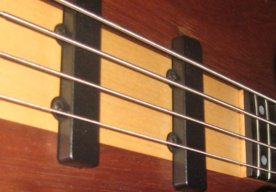
The 60s jazz bass session players, like Carol Kaye, helped to keep notes from sympathetically vibrating while using a pick by use of the foam strip under the metal guard that crossed over the strings down by the pickups. But eventually everyone took those off, so Fender quit putting them on later basses.

Much of the earliest country music was recorded with an upright bass, so some people will try to copy that sound by lightly muting all of the strings with the palm while plucking with the thumb.

You should do what sounds best to your ears, and is comfortable to your hands. The most important aspect of playing bass with a drummer, in any style, is to play as close to his sense of time and groove as you're able. This sort of thing is always something to continually try to improve upon; never stop being the bridge between the drummer and the rest of the band.
 
Hi guys

I play bass in a swedish country band (mostly classic stuff from the 50s, 60s and 70s).

I've been muting my notes on the snare hit but I saw some video on youtube where several commentators said you don't do that in "real country music". Listening more closely to my favorite artists it seems most bassists let the notes ring.

Are there any red blooded american country pickers here on the forum that would like to clear this up for me?
Record yourself often, and listen to how you're sounding with the band. No rules, but I avoid sounding choppy even if I'm playing shorter notes; I concentrate on playing smoothly.
 
Hi guys

I play bass in a swedish country band (mostly classic stuff from the 50s, 60s and 70s).

I've been muting my notes on the snare hit but I saw some video on youtube where several commentators said you don't do that in "real country music". Listening more closely to my favorite artists it seems most bassists let the notes ring.

Are there any red blooded american country pickers here on the forum that would like to clear this up for me?

Yea I've played country over 40 years... Nothing wrong with some ghost notes or mutes as an accents, depending on the song, yet typically one note rings into the the other on ballads.
If it is a 1-5 type, some song get a little swing by having a slight mute between notes, giving it an almost rockabilly feel of an upright. That's on fast stuff.
On ballads normally everything rings smoothly.

I know it's hard to hear the bass in a lot of that old stuff, you got to really listen for it.
It's not all 1-5... You have some stuff that's just root notes, then shuffles that are walking with 1-3-5 with variations. Slight muting between notes works on some of the shuffle lines as well.

It's really a feel thing. Listen to a lot of that classic stuff...even stuff that you're not playing to soak it up.

I've been told some things were not done in classic country songs, so I get the recording and show them it's there.

I treat all of them on a song by song basis, you can't just generalize the entire genre. It's wide and varied.
 
Last edited:
Thanks for all the great replies guys!
In general they confirm what I already do- shorter more rythmic notes on the faster stuff and ringing notes on ballads.
Btw I play a Dano Longhorn with flats and a generous chunk of foam under the bridge
The stuff about tic tac basses was interesting, I always thougth the tic tac was doubled with a upright playing the same pattern. A bass VI is definetly on my wishlist!
 
  • Like
Reactions: LBS-bass
I was playing a type of old country many years ago. Without drums. The older more experienced guys told me that the bass should play a little before the beat, to help the others orientate in the rhythm. When playing rocknroll, I was told to play slightly before the kick too, which was to drive the band's energy, which often seems to vanish towards the end of a very fast song. I haven't heard about this idea in other styles I played (funk, swing, rnb, latin). Perhaps this is all without merit, but perhaps there's a place to dig for some gold nuggets.
 
I'm finding for me (relaitve noob) a lot of variation. When I started playing again 6 mos ago, I decided to learn the songs we dance to, which is mostly Country. So, I'm working on everything from Classics like "Mama Tried" to Brooks and Dunn's "Hillbilly Deluxe". The list goes on and on. It helps if you like the music, LOL. There's enough style variation to keep this noob on his toes. BTW - I'm using a 3" x 3" rolled up sweatshirt scrap for a mute under the bridge on some songs. It seems to sound quite nice, but what do I know?
 
  • Like
Reactions: Zbysek
Sounds like you`re already nailing the country vibe with flats and mutes and playing with your ears. I live in north central Texas and played in several country bands since the late 60s. Started out young in a rock band doing top 40 and what`s now called classic rock. My first country gig was at a club in Mexia , Tx to help out a friends dad and I was`nt sure of anything but being young I said yes. Turns out it was Fuzzy Whitener senior who had a tune on the charts and it had a Chuck Berry vibe as did just about everything we played that night. I played 4/4 on all but a couple waltz things I picked up on. Didn`t know till later but this was bread and butter honky tonk music played for folks to dance and have fun. To this day I play in churches and clubs with all kinds of bands and for country ( especially if I don`t know the song )Ill just listen and watch the guitar for the chords and arrangement, I watch the drummer for the tempo and feel and if he hits the hi-hat im doing 2/4 and if he goes to the cymbals on the chorus I start walking. Country now seems to involve so many styles that Its best to have heard the song and have an idea how it goes. I dont know how except the Lord helping me and just listening that Ive played many a night and never heard many of the tunes untill just playing them for the first time! Country is fun but still not my first love and theres a bunch of bassplayers in Texas that can smoke me big time!But I still get called to play. Just keep on keepin on and have fun !
 
Uhhhhhh....it depends.

What effect do you wish to create? An open, more flowing kind of groove, or a staccato, more straight up, think 1940s kind of groove?

This is another of the thousands of questions asked here on the old Internets where there is no right answer.

You as a musician need to understand, in this case, both choices of articulation and how they will affect the overall groove.

The answer to your question: listen to more country music, as much as possible. Then make your own decision.
 
Slightly O/T: My biggest challenge playing the old stuff is a lot of those guys didn't really care about regular meter. Nothing like an 11-bar mandolin solo to make you sit up and pay attention.

Never mind the 11 bar break; people like Jimmie Rodgers and the Carter Family were just as likely to play a song in 4/4, but start the next verse after 3 beats of the last bar.

Stay alert out there!
 
Hi guys

I play bass in a swedish country band (mostly classic stuff from the 50s, 60s and 70s).

I've been muting my notes on the snare hit but I saw some video on youtube where several commentators said you don't do that in "real country music". Listening more closely to my favorite artists it seems most bassists let the notes ring.

Are there any red blooded american country pickers here on the forum that would like to clear this up for me?
Back in the day, ahem, vintage strings and the mute under the bridge cover of a Fender P did the dampening for you. It was a pretty quick decay.
 
I've been in a similar situation, playing country with a band playlist that starts at Hank Williams and ends, more or less, at Merle Haggard. Here's a thought: The way I learned it was to think not in terms of muting but in terms of placement and duration. Where you play the note--on, in front of, or behind the beat. Gives you a whole new sense of all the potential locations of "one". And then how long to hold it. Those old guys playing double bass had these completely mastered(As an aside, if you think the groove is going off track, shorten that duration and hear everybody tighten up in response. You'll feel good about yourself for the rest of the song.:D)

Slightly O/T: My biggest challenge playing the old stuff is a lot of those guys didn't really care about regular meter. Nothing like an 11-bar mandolin solo to make you sit up and pay attention.

A few weeks ago, I played with some folks who typically play as a duo with only guitar and mandolin. Campfire music among friends, not a gig. They were good players, but had very little sense of meter. The "eleven bar solos" even made an appearance. After we got done playing, they both remarked about how much easier it was to sing and play with a bass player than without one. The guitarist compared my playing to a driver who consistently uses turn signals; very easy to follow. Neither of these players counted off songs, tapped their feet, or knew what the meter signature was for the songs we were playing, and although they knew the chords and lyrics, they seemed not to know, or be in agreement, as to where the chords and lyrics intersected the rhythm.

I am mostly a jazz player, so playing with these two Blue Grassers was extremely different from the kinds of people I usually play with.
 
  • Like
Reactions: Bunk McNulty
Hi guys

I play bass in a swedish country band (mostly classic stuff from the 50s, 60s and 70s).

I've been muting my notes on the snare hit but I saw some video on youtube where several commentators said you don't do that in "real country music". Listening more closely to my favorite artists it seems most bassists let the notes ring.

Are there any red blooded american country pickers here on the forum that would like to clear this up for me?
Honestly? You have the original recordings to go by. Some muted on the snare. Some sustained.

I find playing sustained is actually harder. Being rhythm section people, we tend to tap our plucking fingers down on the 2 and 4. That's easy. It just comes naturally. Playing sustained takes more concentration. But if that's how it was recorded, give it a try.
 
  • Like
Reactions: AGCurry
Hi guys

I play bass in a swedish country band (mostly classic stuff from the 50s, 60s and 70s).

I've been muting my notes on the snare hit but I saw some video on youtube where several commentators said you don't do that in "real country music". Listening more closely to my favorite artists it seems most bassists let the notes ring.

Are there any red blooded american country pickers here on the forum that would like to clear this up for me?

As a rule, in country you let the notes sustain. For a livelier feel you can stop for the snare hit, like you're doing. I'm talking about honky tonk, what i think of as real country. Of course, the way to learn is to listen, and absorb what you like.
 
Hi guys

I play bass in a swedish country band (mostly classic stuff from the 50s, 60s and 70s).

I've been muting my notes on the snare hit but I saw some video on youtube where several commentators said you don't do that in "real country music". Listening more closely to my favorite artists it seems most bassists let the notes ring.

Are there any red blooded american country pickers here on the forum that would like to clear this up for me?

Don't overthink this, just play it. That's what I've been doing for years and no one has even mentioned a problem. The audience doesn't care as long they can dance or sing along. Your job is to keep time along with the drummer. The rest of the band is only listening to themselves.