• TalkBass has been independent since 1998. Add your voice.
    Create a free account to reply to discussions, view embedded media, and browse with fewer display ads.
    Join freeLog in
    Want zero display ads or expanded classifieds tools? Compare plans.

Double Bass Please explain (More Boardwalkin’ content)

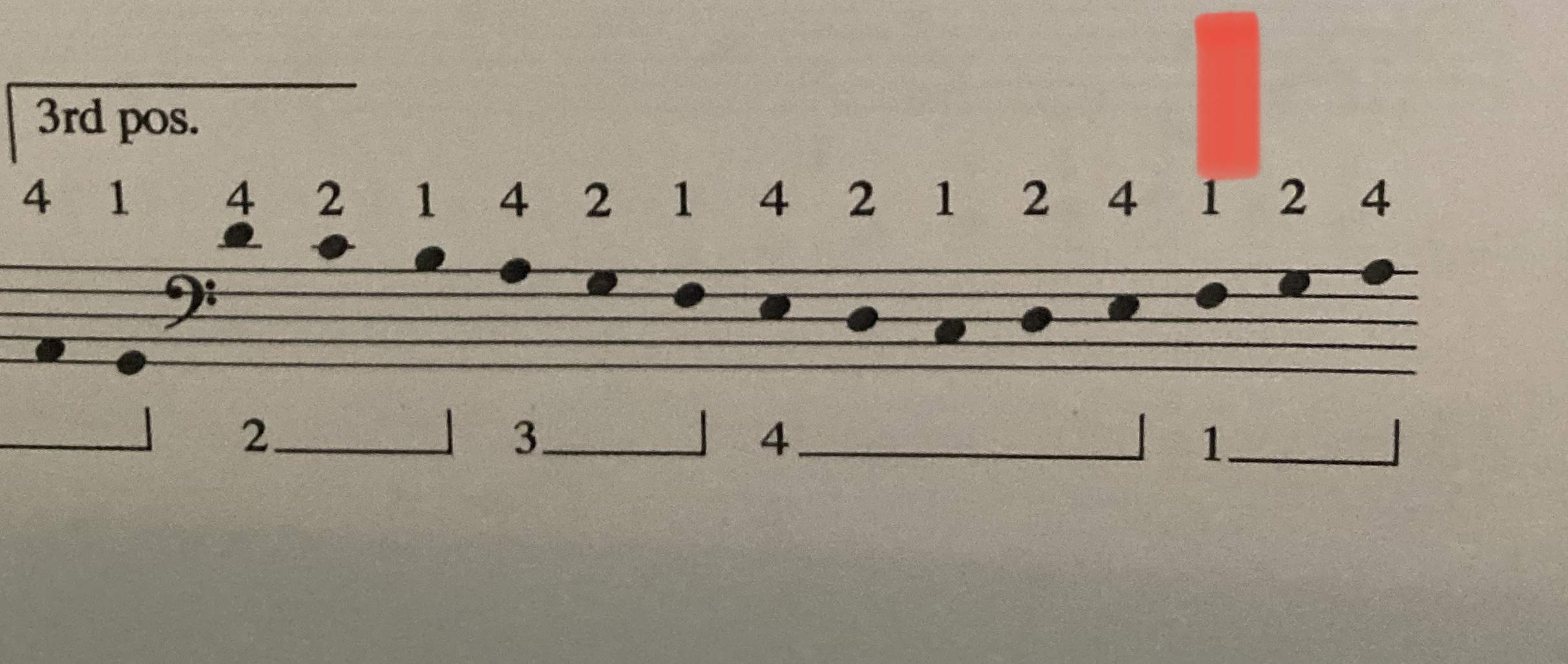
In this exercise (p.12) in the key of Ab major, in bass clef, it indicates you are to play F on the G string. I don’t know about your bass but you can’t play that F on my bass on the G string. String numbers are below the staff, position numbers above. Typo?
FBE14CD2-A4E4-41B8-87B5-286AD2BD2C9E.jpeg
 
The typo is obvious. The focus of Boardwalkin is to work through all positions (Rabbath) of all major scales. See the "3rd pos." marking in photo. Your thumb should not move as until you get to 4th or 2nd position (depending on which way you are going). The only way to play the pitches F, G, and Ab in 3rd position is on the A-string.
 
The typo is obvious. The focus of Boardwalkin is to work through all positions (Rabbath) of all major scales. See the "3rd pos." marking in photo. Your thumb should not move as until you get to 4th or 2nd position (depending on which way you are going). The only way to play the pitches F, G, and Ab in 3rd position is on the A-string.
Thanks. Amazing how often typos occur in sheet music. I think of literate musicians as fairly detail-oriented.
 
  • Like
Reactions: TroyK
Thanks. Amazing how often typos occur in sheet music. I think of literate musicians as fairly detail-oriented.

The musicians may be detailed-oriented, but not necessarily the type setters/copyists. Also, the repetitive nature of much copying work makes it more prone to errors. I have being working with Boarwalkin' for years and not noticed that typo. Once I got to Ab major I guess I got the point of the book and didn't really focus on the notation.

I have been revisiting Rabbath Book 1 and found a few typos/ambiguities that I hadn't noticed before. That's the beauty of revisiting material as you bring new experiences to something from the past.
 
  • Like
Reactions: Alexis Duntov
I’d say it’s a typo for sure. I don’t own the book but looking at the exercise and what other information is available it looks like it is.

I’ve done a lot of copyist work and music prep. As much as you try, and try your absolute hardest to make sure no typos exist sometimes one escapes you. Usually you have a pretty strict deadline to meet and, in my experience, the job comes in at the last minute so you don’t get the kind of time you want to look at it with fresh eyes. In an ideal world you’d have time to switch off from it and then check it after a day or two but the reality is ‘oh by the way I need this for Saturday’ and you spend every waking minute staring at this stuff.
 
I don't have Boardwalkin'. The fingerings correspond to to what I call "zig-zagging" across the three strings using half tone shifts as you cross the G, D and A strings.(Simandl 2 1/2 and 2nd. Positions), pivoting or using 1 2 3 4 fingering. I can't make sense of the 3rd Posn. bracket above and the numbered brackets below unless this is Rabbath-speak.

Hopefully this is not intended to be played 2 1/2 tones higher towards the bridge with same fingerings but on the lower three strings (gluttons for punishment?). While it is good to know the notes are there as part of mapping the fingerboard their use in day-to-day playing is surely more academic than practical IMO. Then again I am an orchestral player using a somewhat higher action in this area of the fingerboard.
 
Last edited:
I don't have Boardwalkin'. The fingerings correspond to to what I call "zig-zagging" across the three strings using half tone shifts as you cross the G, D and A strings.(Simandl 2 1/2 and 2nd. Positions), pivoting or using 1 2 3 4 fingering. I can't make sense of the 3rd Posn. bracket above and the numbered brackets below unless this is Rabbath-speak.

Hopefully this is not intended to be played 2 1/2 tones higher towards the bridge with same fingerings but on the lower three strings (gluttons for punishment?). While it is good to know the notes are there as part of mapping the fingerboard their use in day-to-day playing is surely more academic than practical IMO. Then again I am an orchestral player using a somewhat higher action in this area of the fingerboard.

The upper brackets refer to the rabbath position, the lower brackets refers to the string (e.g., 1=G). The highest E string use is "4th position"(thumb on the octave harmonic)

I got this book last week. While I'm not sold at all on Rabbath, I was taught the fingerboard in a very Simandl "L" shape and I want to unlearn that. I paid for the whole piece of ebony, after all.
 
The upper brackets refer to the rabbath position, the lower brackets refers to the string (e.g., 1=G). The highest E string use is "4th position"(thumb on the octave harmonic)

I got this book last week. While I'm not sold at all on Rabbath, I was taught the fingerboard in a very Simandl "L" shape and I want to unlearn that. I paid for the whole piece of ebony, after all.
I’m really enjoying the book. It’s a sort of relaxing in that there’s nothing rhythmic to worry about. Just play it at whatever speed you like. Great for string crossing, sounding point, bow speed etc. I’ve started using a drone for some of the harder keys.
 
  • Like
Reactions: Opus_Pocus
I’m really enjoying the book. It’s a sort of relaxing in that there’s nothing rhythmic to worry about. Just play it at whatever speed you like. Great for string crossing, sounding point, bow speed etc. I’ve started using a drone for some of the harder keys.
BW is a daily exercise for me. One of the most practical warm-ups I know. Stopped reading from the book years ago, though. I’ve adapted my own fingerings here and there, especially in the arpeggios.

I also do the “intermediary” positions, which is especially helpful in thumb position. That approach would be useful for improvised melodies and runs, for example, particularly if you do the same with different modes. If you ever wondered how Renaud Garcia Fons plays so fast, that would be a big hint.
 
So, Opus_Pocus, it IS meant to be played in the Dark Zone of the fingerboard !! Sadism is hereby combined with risk of injury?

I do have cut-off points on the A and E strings in practicing scales and arpeggios over one, two and three octaves with hopefully at least two good overlapping fingerings for each . These are the B flat on the E string and second octave G on the A string. Any notes above B flat on E become too thick and sluggish for both arco and pizz with my set-up and Bel Canto strings. This is why I call it the Dark Zone. I am also aware of my self imposed limitations as an orchestral player these days.

Cheers, everyone, and keep safe, DP
 
So, Opus_Pocus, it IS meant to be played in the Dark Zone of the fingerboard !! Sadism is hereby combined with risk of injury?

I do have cut-off points on the A and E strings in practicing scales and arpeggios over one, two and three octaves with hopefully at least two good overlapping fingerings for each . These are the B flat on the E string and second octave G on the A string. Any notes above B flat on E become too thick and sluggish for both arco and pizz with my set-up and Bel Canto strings. This is why I call it the Dark Zone. I am also aware of my self imposed limitations as an orchestral player these days.

Cheers, everyone, and keep safe, DP
I even include the highest positions in my routine. It is possible to make a nice sound up there, but you’re right that real-world applications are pretty rare. There are some contemporary pieces which require it, so I’m glad I can do it, although it’s not really a thing in the standard repertoire.

If it hurts, either the set-up needs to be reconfigured to this style of playing or your technique and/or posture needs an adjustment.

Super high action with heavy strings isn’t going to work for this. If your bass is extra large and your arms are on the shorter side of the spectrum, E-string thumb position is probably not a great idea.

Ideally, you would start off with a very small bass, the softest strings you can find (Corellis, or tuned-down solo strings), and lower the bridge as far as possible. Once you’re comfortable with that, you can gradually increase the difficulty by raising or changing the strings and eventually using a bigger instrument.
 
I try to play a scale with arpeggios every day. I found that it was very difficult to get any sort of clear note on the A and E above Rabbath 4th position but I switched my Flexicores for Tempera strings and now it is far, far easier. For me playing up there regularly has made my left hand much looser and my intonation better in upper thumb position. But I'm not the level of player that either Paul Cannon or David Potts is, so I need much more work.

I particularly love the arpeggios and the fingerings. My favorite is the F Augmented arpeggio, it's a real pleasure to play it up the E string and then across the fingerboard at the octave.
 
Last edited:
At 79 years I have gone all the way up to big instruments and started going down again, currently on a good 3/4. I have been using 1 2 3 4 fingering all over the bass neck for 56 years and have bought, tried and sold about 50 basses. If it hurts now it is because of mild Carpal Tunnel Syndrome and a little bit of arthritis. Yes, at 170cm I am not tall but playing orchestral music in my current situations mostly does not challenge my strength, posture or technique and certainly does not need super high action or heavy strings to make a lot of arco sound. I choose to only go up to B flat on the E string because it helps me create the second good alternate fingering for 2-octave A flat Major. Above that the notes sound better 2 1/2 tones lower on the next higher string IMO.
 
Last edited: