• TalkBass has been independent since 1998. Add your voice.
    Create a free account to reply to discussions, view embedded media, and browse with fewer display ads.
    Join freeLog in
    Want zero display ads or expanded classifieds tools? Compare plans.

Please help me keep the lows in my own house

Riff Ranger

bass/guitar/vocals in [Taking Suggestions]
Supporting Member
Mar 22, 2018
5,433
1
12,259
Bigfoot Country
thunderhorn.bandcamp.com
Moderators: the Amps/Cabs forum seemed like the best fit for this, but obviously we have more to consider than amplification here; please move this to Live Sound or elsewhere if more appropriate, with my thanks and/or apologies.

Contributors: I have read a bit about this subject on TalkBass and elsewhere, but obviously do not have a comprehensive knowledge of the topic or what has already been said on TalkBass. I hope you will kindly provide advice with my specific circumstances in mind. I would strongly prefer to solve this problem by containing my sound rather than changing or eliminating it. In that light, please do not suggest turning down, using headphones, or radically altering my settings. I can figure out any of those approaches easily enough on my own if containing my current decibels and frequencies proves infeasible. I can probably spend up to 500 USD if necessary.

With the preliminaries out of the way:

2020 forced an unexpected and unwanted major relocation upon my family, but at least we landed somewhere wonderful. We moved from a very rural location to a relatively dense neighborhood of single family homes in a college town, and I have literally no complaints about my neighbors. I wish they could say the same about me! We found this on the door this evening:
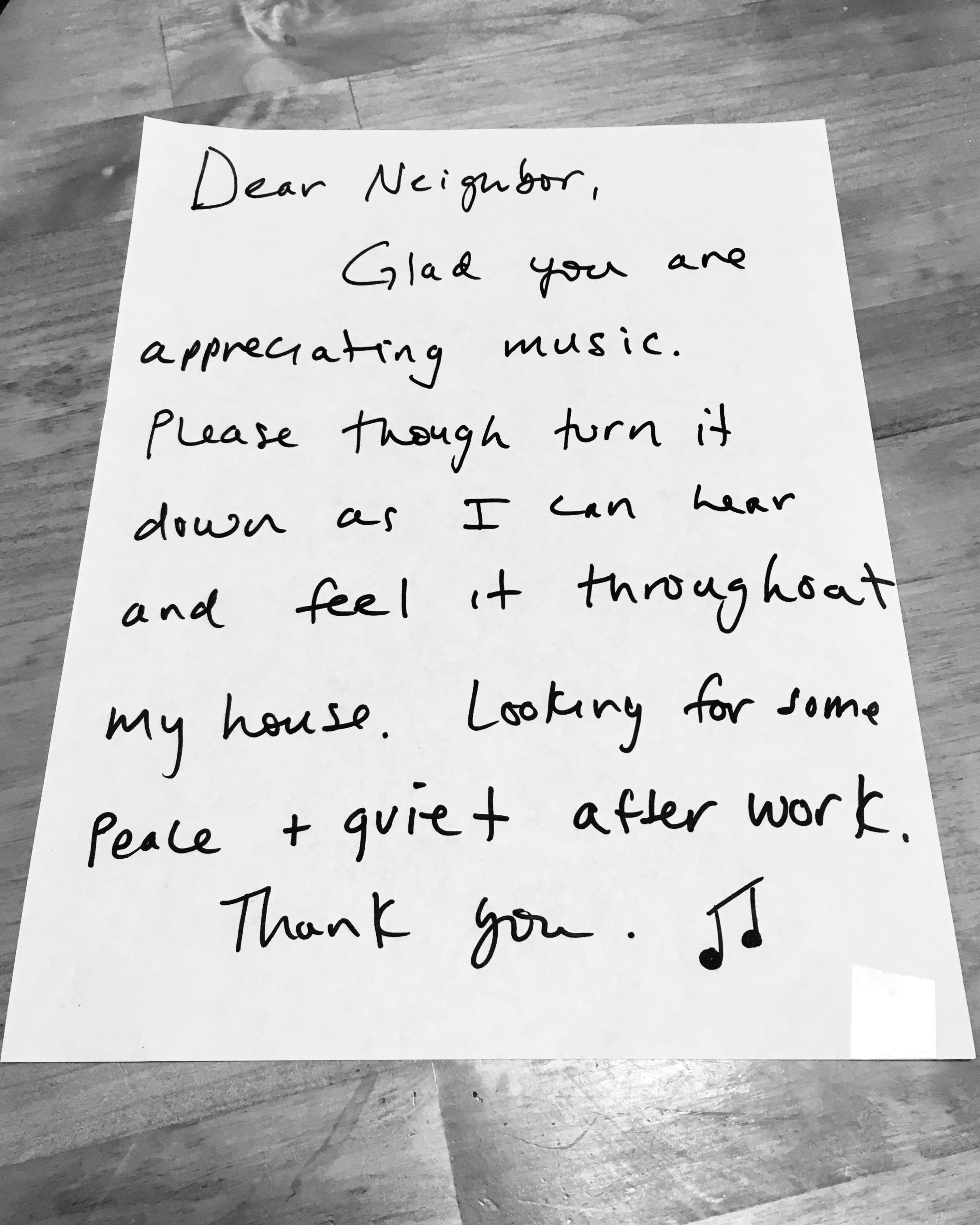
F10F86D9-B425-40D7-AD23-72EA90CD5092.jpeg


The care they took to put this as kindly as they did indicates just how good we have it with neighbors, I think. (I suspect that this would have come up in an equally friendly conversation if not for the ongoing pandemic.)

I DO NOT want to be “that guy” around here, but I would rather not retire my big iron. Can I contain my sound? If so, how?

I currently have things set up like this:
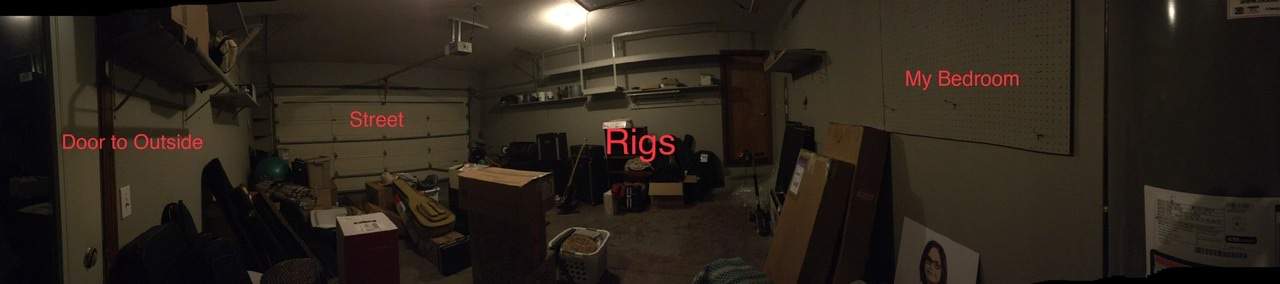
26FE66FB-5624-44C1-916E-D0D9EC26789C.jpeg


Things I have tried:

•1x15 solid state 80w combo on a stand facing the outside wall. This seemed unobtrusive until that 30-year-old combo stopped working.

•Tube 200w 1x15 combo on floor facing outside wall, or solid state 200w head w/1x15 cabinet on casters facing outside wall. Perhaps not surprisingly, these setups seem to project into my neighbor’s home :bag:

Things I could do now but have yet to try:

•I could put my extremely heavy tube combo on the stand.

•I could face any rig in any other direction.

Fun things on the way:

•I have finally cracked and will receive a brand new 200w Class D combo with a neo 1x12 by the end of the week. I can easily put that on the stand.

•I also have a period correct 2x12 on the way, but unless I use it as a somewhat expensive platform for elevating other speakers, it won’t help matters.

Things I am considering that would require expenditures:

•Something other than a stand to elevate the modular solid state rig

•Gramma pads or similar

•furniture blankets hanging everywhere

•garage door insulation, if it would allow continued use of the garage door

•a (relatively) inexpensive drum booth

It also occurs to me that I probably haven’t thought of everything.

What should I do?

Thank you for any helpful suggestions (or clever jokes).

Oh: nobody playing but me just yet, but my son’s acoustic drums will likely enter the picture soon as well.
 
Last edited:
Not an easy or practical solution, but you could fill your wall spaces with sand. Short of that, bass waves tend to go right through ordinary construction materials. If you double or triple drywall your practice room, and build a second room within leaving an airspace between, this will help too.

The simple solution is to turn down or use headphones.
 
You have a major challenge ahead of you, I respectfully suggest that you probably don’t realize how monumental the challenge is.

You need to reduce the TRANSMISSION of the low frequency energy through the walls, garage door, any windows, and the roof. Low frequencies are both omnidirectional and difficult to attenuate through ordinary structures (especially garage doors and roof).

Typical insulation at low frequencies is very ineffective unless dense/heavy and thick.

Common engineered solutions include mass (such as 2 layers of 5/8” drywall and suitable decoupled supporting structure), masonry structure (such as poured concrete, CMU, and heavy stucco over wood framing)

Nothing you can do for $500 is going to make a meaningful difference, which is why I am going to suggest exactly what you didn’t want to hear.

Turning down is the least expensive AND most effective thing you can do. Reducing the amount of low frequencies by using a high pass filter or turning down the bass eq is another.

Ultimately, the cost per dB of low frequency attenuation through a building structure is very high. I did a lot of acoustic design in my consulting work over the years and the clients were always shocked at the cost. For theaters, attenuating between 40Hz and 125Hz by 12 dB through a wall can easily double or triple the cost of construction of the wall.
 
Not an easy or practical solution, but you could fill your wall spaces with sand. Short of that, bass waves tend to go right through ordinary construction materials. If you double or triple drywall your practice room, and build a second room within leaving an airspace between, this will help too.

The simple solution is to turn down or use headphones.

These are more or less my thoughts as well. Dense housing arrangements and amplified bass guitar played through loudspeakers are not only typically incompatible, but also a tough engineering (read: expensive) problem to solve.

The only time I've seen practice spaces that were successful, they were building-within-building arrangements. One was frame construction with sand-filled walls inside a large steel shop. The other was a block building with cement filling inside a block building with cement filling. The latter had the bonus of being a tornado safe-room with a trippy interior. Both facilities were pricey, but they achieved the desired result.
 
Although it will not completely cure the problem, my experience is that insulation on the garage door does help noticeably. 2" foam panels and silicone sealer/adhesive on the back of the metal doors seems to reduce low end transfer. I think it has more to do with stiffening the thin metal door panels than the actual insulation. In any case, your garage will stay warmer in winter and won't make as much noise when you open or close it.:)
 
Moving practice into ''your bedroom'' might cut down some of it.

Your big misconception is around the low end giving a damn which way it's 'pointed' when you let it fly. It goes everywhere equally and it's really hard to stop.

Turning way down is your only real option in the garage. Even if you block walled the garage door it wouldn't let you blast away.
 
Well...I have to agree with the suggestions already stated. Bass is omnidirectional and often relies on reflective enhancement. One night I was practicing at home which I thought was a very low level. Talking level. I had moved to the back of my "jam" room and realized the ground literally was shaking out every note I played. Now at 3am (I live on 4 acres) there was the possibility my neighbors could hear and feel this as well. My remedy was to EQ the bass down and stop the shake. How many times have you heard a car with subs 1 mile away.
 
for starters, a high pass filter is a cheap option that might solve a ton of your problems. seriously, it doesn’t sound like much, but it’ll sweep up so much of that vibration your neighbors hate. however, if you’re bringing a drum kit in there... for what it would cost to isolate the sound properly, you might be better off renting a rehearsal space. i’ve lived in tiny apartments in dense cities for the past 20 years, and aside from a major acoustic engineering treatment, acoustic drums are gonna cause problems with your neighbors. have you considered an e-kit? i know a ton of professional drummers have switched to them during quarantine. they get the job done and are super fun.

anyway, start with a good hpf!
 
Moderators: the Amps/Cabs forum seemed like the best fit for this, but obviously we have more to consider than amplification here; please move this to Live Sound or elsewhere if more appropriate, with my thanks and/or apologies.

Contributors: I have read a bit about this subject on TalkBass and elsewhere, but obviously do not have a comprehensive knowledge of the topic or what has already been said on TalkBass. I hope you will kindly provide advice with my specific circumstances in mind. I would strongly prefer to solve this problem by containing my sound rather than changing or eliminating it. In that light, please do not suggest turning down, using headphones, or radically altering my settings. I can figure out any of those approaches easily enough on my own if containing my current decibels and frequencies proves infeasible. I can probably spend up to 500 USD if necessary.

With the preliminaries out of the way:

2020 forced an unexpected and unwanted major relocation upon my family, but at least we landed somewhere wonderful. We moved from a very rural location to a relatively dense neighborhood of single family homes in a college town, and I have literally no complaints about my neighbors. I wish they could say the same about me! We found this on the door this evening:

View attachment 4032003

The care they took to put this as kindly as they did indicates just how good we have it with neighbors, I think. (I suspect that this would have come up in an equally friendly conversation if not for the ongoing pandemic.)

I DO NOT want to be “that guy” around here, but I would rather not retire my big iron. Can I contain my sound? If so, how?

I currently have things set up like this:
View attachment 4032008

Things I have tried:

•1x15 solid state 80w combo on a stand facing the outside wall. This seemed unobtrusive until that 30-year-old combo stopped working.

•Tube 200w 1x15 combo on floor facing outside wall, or solid state 200w head w/1x15 cabinet on casters facing outside wall. Perhaps not surprisingly, these setups seem to project into my neighbor’s home :bag:

Things I could do now but have yet to try:

•I could put my extremely heavy tube combo on the stand.

•I could face any rig in any other direction.

Fun things on the way:

•I have finally cracked and will receive a brand new 200w Class D combo with a neo 1x12 by the end of the week. I can easily put that on the stand.

•I also have a period correct 2x12 on the way, but unless I use it as a somewhat expensive platform for elevating other speakers, it won’t help matters.

Things I am considering that would require expenditures:

•Something other than a stand to elevate the modular solid state rig

•Gramma pads or similar

•furniture blankets hanging everywhere

•garage door insulation, if it would allow continued use of the garage door

•a (relatively) inexpensive drum booth

It also occurs to me that I probably haven’t thought of everything.

What should I do?

Thank you for any helpful suggestions (or clever jokes).

Oh: nobody playing but me just yet, but my son’s acoustic drums will likely enter the picture soon as well.
Sorry, bass go wub, wub.

Maybe headphones?
 
Low frequencies travel realy well IME. I agree with agedhorse that 500 bucks is probably not enough to make a real difference...unless you are prepared to limit your volume and/or low frequencies...especially since you plan to add acoustic drum kit in the future...
 
Last edited:
  • Like
Reactions: SAlcott
While I tend to concur with everything @agedhorse said, I will observe that the roll-up door is essentially acoustically transparent to bass frequencies -- insulating that door, as per @Meghans Dad's description couldn't hurt and would probably be money well spent, especially if drums are going to be involved. Alternatively, if you can do without the roll-up door, you could build a relatively inexpensive, stud & drywall dummy wall in front of it and insulate the space in between. Otherwise, as Andy stated, the cost-per-dB of LF attenuation is extremely high and requires substantial construction; none of the solutions you've proposed would have any effect. After the roll-up door, the next best place to spend money might be re-insulating the outside wall with spray-in UF foam, or giving it the "second wall" treatment as well.
 
the roll-up door is essentially acoustically transparent to bass frequencies

I agree that the roll-up door is probably the weakest point.

My own experience: we rehearse in a similar garage with one of my bands. In order not to disturb neighbours, we put thick carpet hanging in front of the roll-up doors (inside the garage). The carpet is from wall to wall and from ceiling to the floor. While it limited highs and mids a bit, it had no effect whatsoever on bass frequencies.
 
Ooof. Quite simply, no. You're not going to trap bass in that garage. And acoustic drums in a college town neighborhood will be out of the question even if they're in your kitchen. (Ask me how I know.)

My suggestion? Find out what local volume ordinances are. Then try to come up with a compromise. If there are no daytime ordinances that helps your compromise a lot. And, as others have said, work out a time of day and days per week when they can tolerate a little bass.

If they are "feeling" bass in their home you aren't going to stop it with $500.