
Enjoy the benefits of a premium membership!
Upgrade Account
-
TalkBass has been independent since 1998. Add your voice.
Create a free account to reply to discussions, view embedded media, and browse with fewer display ads.
Join free Log in
Want zero display ads or expanded classifieds tools? Compare plans.
You are using an out of date browser. It may not display this or other websites correctly.
You should upgrade or use an alternative browser.
You should upgrade or use an alternative browser.
Possible new shop size
- Thread starter wildman2
- Start date
More options
Who Replied?

Hard to tell from the videos, but it looks like the Highline Guitars guy is working out of a two car garage, and he seems to do pretty well. Agreed that if you want this for home improvement carpenty like casework, its going to be tight. Letting 4x8 plywood.sheets dictate space seems like a waste though. All the carpenters I see on jobsites use one of the Festool or similar circular saw sled rail systems, and its just as accurate (and a lot safer) than trying to lever a plywood sheet onto a tablesaw. They knock down into a couple 4 foot sections. I have a cheaper aluminum version that works nearly as well. Another issue nobody has mentioned is spray booth for finishing. Unless you are really ruthless on dust control, most shops are way too dusty for finish work. I built a knock down booth out of 1x3 and plastic sheeting, with some HVAC filters for in and out air, and set it up in my garage for paint work. Lots of other ingenious designs online to do this via other methods. The Highline guy just uses an open sided box of sorts for spray work. If you use water based finishes, no need for explosion proof fans either.

For instruments, you don't need the floor area. Arguably, general carpenters don't need to work to the same accuracy as a cabinet maker, so a track saw is good enough, but for doing lots of repetitive cuts I would sooner have a tablesaw.Agreed that if you want this for home improvement carpenty like casework, its going to be tight. Letting 4x8 plywood.sheets dictate space seems like a waste though. All the carpenters I see on jobsites use one of the Festool or similar circular saw sled rail systems, and its just as accurate (and a lot safer) than trying to lever a plywood sheet onto a tablesaw.

I purchased a 12x20 it's a nice size but I put all my drills and saws (except table saw) on stands that can roll away when not being used. They look a lot bigger until you start pulling stuff in them. I told a friend I was getting one, he ask what size I told 12x20 he laughed and said to small. then followed up with what ever size you get is to small even if it was a 40x40. LOL

I just took a walk around my shop space at work. If my only option was a 12x 20 space and I was only using it for a few instruments p/yr and other small projects, I could absolutely make that work. Even with the tools listed by OP. Naturally, if bigger is an option, more space helps.
If I was regularly cutting 4x8 sheet goods, 8'+ lumber and also had to store it in the space, 12x20 would be a PITA and I'd want a bigger space.
If cutting bigger lumber for general carpentry is only an occasional thing, it's no biggie to simply do it outside with sawhorses, circ saw and chop saw.
If I was regularly cutting 4x8 sheet goods, 8'+ lumber and also had to store it in the space, 12x20 would be a PITA and I'd want a bigger space.
If cutting bigger lumber for general carpentry is only an occasional thing, it's no biggie to simply do it outside with sawhorses, circ saw and chop saw.

I have a large shop, and I even have two full size tablesaws. But I still don't have clearance to maneuver 4 x 8 sheets through either of them. That requires an enormous amount of floor space. And, unless you are doing projects that go through stacks of plywood every day, it isn't necessary. Most of us only occasionally need to handle a 4 x 8 sheet.
Years ago, when I was in a much smaller shop space, I built a lumber rack that also functions as a rough panel saw. Here it is, with some other machines on casters parked in front of it. It's built from 2 x 4's, forming a group of compartments for stacking boards vertically.
Notice how the front boards are all leaned back, and are all in line in a flat plane. You can barely see it, but there are horizontal 2 x 4's along the bottom edge, forming a step that's raised up off the floor. There's a gap in that bottom step at the center space that a saw can pass through. And I keep a a small circular saw on a shelf in the top center, ready to go.
This rack functions like a panel saw. I can, by myself, drag a 4 x 8 sheet of MDF or plywood over and set it up onto the step. I use rulers and a big 48" aluminum square to draw the lines on the sheet. I slide the sheet sideways until the cut line is over the gap, and saw it following the line with the little circular saw.
I usually saw vertically, facing down. I can see well enough that I can keep it steered close to the line. If I need to rip the sheet lengthwise, I slip a couple of horizontal spacer boards behind the sheet, and use a couple of C-clamps to clamp the upper portion of the sheet to the rack. Draw the line and zip across horizontally with the saw.
At times I've thought up ways to mount an aluminum track rig to guide the saw, like a real panel saw. But I haven't gotten around to it. This works fine as it is, for occasionally cutting up sheets into smaller parts. I normally cut them maybe 1/8" oversize, then swing the smaller piece over onto the tablesaw and trim the edges to the final size.
This is a way that you can handle and cut up 4 x 8 sheets inside a small shop, in minimal floorspace. The lumber rack also works very well as a lumber rack. And you know you are going to need that.
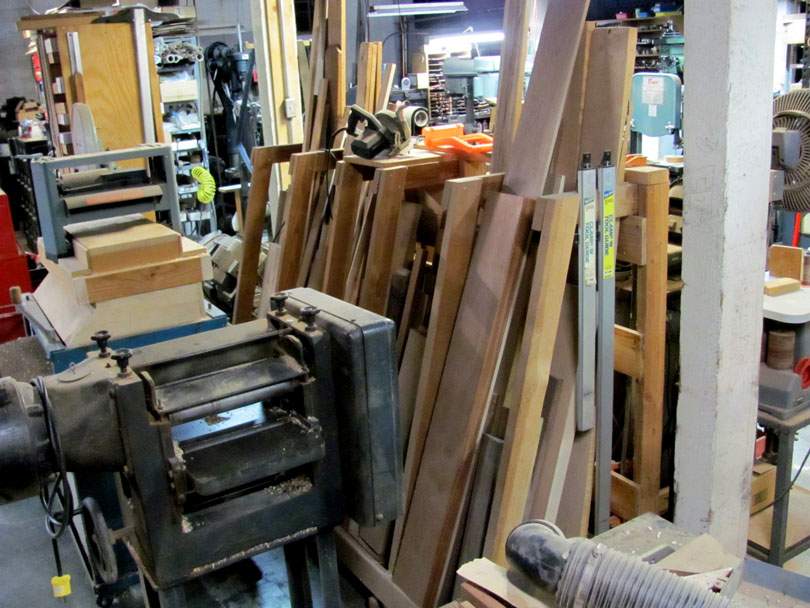
Heh. Looking at the picture, I notice that I have a pair of those clamp-on aluminum saw guides hanging on the end of the rack. A 2 foot and a 4 foot. I'd almost forgotten that they are there. I've used them sometimes, and they work. But they aren't usually worth the trouble. I can steer the saw pretty accurately along the line by eye. And I'm always going to be straightening up the edge of the board on the tablesaw anyway.
Years ago, when I was in a much smaller shop space, I built a lumber rack that also functions as a rough panel saw. Here it is, with some other machines on casters parked in front of it. It's built from 2 x 4's, forming a group of compartments for stacking boards vertically.
Notice how the front boards are all leaned back, and are all in line in a flat plane. You can barely see it, but there are horizontal 2 x 4's along the bottom edge, forming a step that's raised up off the floor. There's a gap in that bottom step at the center space that a saw can pass through. And I keep a a small circular saw on a shelf in the top center, ready to go.
This rack functions like a panel saw. I can, by myself, drag a 4 x 8 sheet of MDF or plywood over and set it up onto the step. I use rulers and a big 48" aluminum square to draw the lines on the sheet. I slide the sheet sideways until the cut line is over the gap, and saw it following the line with the little circular saw.
I usually saw vertically, facing down. I can see well enough that I can keep it steered close to the line. If I need to rip the sheet lengthwise, I slip a couple of horizontal spacer boards behind the sheet, and use a couple of C-clamps to clamp the upper portion of the sheet to the rack. Draw the line and zip across horizontally with the saw.
At times I've thought up ways to mount an aluminum track rig to guide the saw, like a real panel saw. But I haven't gotten around to it. This works fine as it is, for occasionally cutting up sheets into smaller parts. I normally cut them maybe 1/8" oversize, then swing the smaller piece over onto the tablesaw and trim the edges to the final size.
This is a way that you can handle and cut up 4 x 8 sheets inside a small shop, in minimal floorspace. The lumber rack also works very well as a lumber rack. And you know you are going to need that.
Heh. Looking at the picture, I notice that I have a pair of those clamp-on aluminum saw guides hanging on the end of the rack. A 2 foot and a 4 foot. I'd almost forgotten that they are there. I've used them sometimes, and they work. But they aren't usually worth the trouble. I can steer the saw pretty accurately along the line by eye. And I'm always going to be straightening up the edge of the board on the tablesaw anyway.
Last edited:


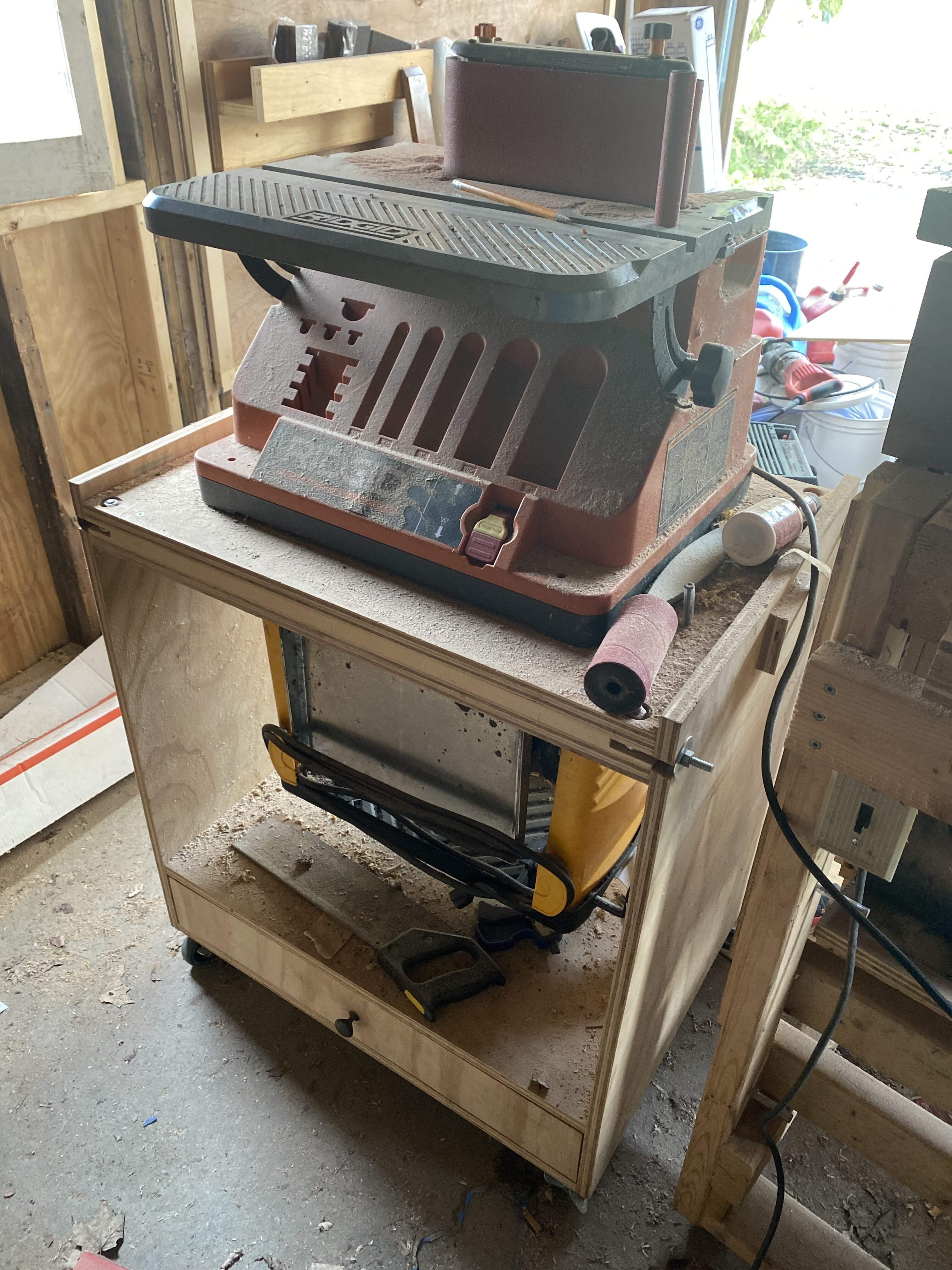
My space is 12x20, old ratty garage. We are looking into building new now actually, very excited. This space has done well for what I use it for, no cabinets or tables. I made a few rotating stands on wheels to save space. One has my sander and planer, another has a scroll saw and mitre.
However, even though my current space is cold, drafty, and damp, it has been great for me. The upgrade will just be more convenient.
However, even though my current space is cold, drafty, and damp, it has been great for me. The upgrade will just be more convenient.
Last edited:
Wife wants to buy me a 12x 20 garage that gets trucked in and set down. Just wondering if it’ll be a decent size for general wood working stuff. Not just basses and guitars. I did do a mock up in my 3D program. Seemed a little tight but doable. Table saw band saw and drill press will be floor standing,planer,joiner,radial arm saw will be table top type. Not worried about noise from it closest house is 100yards away. Power will be from a portable generator 12,000/15,000 watt.
Not hearing anything about a concrete pad?

A luthier I know uses a single bay garage as his shop and while it looks crowded to me he’s happy there. No interest in a bigger space.
There’s a pro cabinetmaker here in town who has a free standing shop that can’t be bigger than 12’ x 16’. He puts out beautiful work but I have to believe that he cuts any sheet stock (“plywood”) somewhere else and brings it in. I’ll have to talk to him about shop size sometime ... if ever there’s another regional trade show while we’re still living. The joiner who made a half dozen pieces for me fifteen years ago had a well-equipped shop of about 10’ x 20’ (or 22’) and he was organized enough that it never felt crowded.
I know that if I had a 30’ x 40’ hangar I could keep it cluttered and hard to use.
There’s a pro cabinetmaker here in town who has a free standing shop that can’t be bigger than 12’ x 16’. He puts out beautiful work but I have to believe that he cuts any sheet stock (“plywood”) somewhere else and brings it in. I’ll have to talk to him about shop size sometime ... if ever there’s another regional trade show while we’re still living. The joiner who made a half dozen pieces for me fifteen years ago had a well-equipped shop of about 10’ x 20’ (or 22’) and he was organized enough that it never felt crowded.
I know that if I had a 30’ x 40’ hangar I could keep it cluttered and hard to use.
I know that if I had a 30’ x 40’ hangar I could keep it cluttered and hard to use.[/QUOTE]
Yup, this
Yup, this
I know that if I had a 30’ x 40’ hangar I could keep it cluttered and hard to use.
Yep. My old shop in Burbank was 1800 sf. It sure felt big when I moved into it in 1993. By 2013 it was crowded full, including the fenced yard out back. So I moved up to my current shop in Fillmore in 2013, where I had 2700 sf! Should be plenty of space. Uh-huh. In 2021 I just took over two other units next to mine, giving me 550 sf additional shop space and 700 sf of clean warehouse/storage space. Now I should have plenty of space!
The problem is that classic old woodworking and machine shops are closing down all over the Los Angeles area. They are going out of business, moving out of state, or upgrading to modern CNC machines. Beautiful old-school machines are being sold off for dirt cheap, given away, or sent to the scrapyard!
The real problem is that I have a very difficult time refusing a fine old machine. I keep finding ways to acquire them for almost nothing and squeeze them into my shop. As a quick estimate, I think I'm over 18 tons of machines now.
I’ve more or less given up trying to cut 4x8 plywood on a table saw. It’s just too unwieldy. Safer and easier to just use a saw guide and a circular saw, but really, how much plywood are you cutting for guitar building? I just buy the 2x4 or 4x4 “handy panels” at HD when I need plywood or MDF, never needed anything bigger for bass building templates or jigs.
I wasn't suggesting that a table saw was the best way to cut a full sheet of plywood. I was just pointing out that the size of the boards you plan on cutting could be limited by the size of the shed and visa versa. So, yeah, opening up doors on the ends for the occasional long board or taking it outside to cut are great options as long as the weather cooperates.
Wife wants to buy me a 12x 20 garage that gets trucked in and set down. Just wondering if it’ll be a decent size for general wood working stuff. Not just basses and guitars. I did do a mock up in my 3D program. Seemed a little tight but doable. Table saw band saw and drill press will be floor standing,planer,joiner,radial arm saw will be table top type. Not worried about noise from it closest house is 100yards away. Power will be from a portable generator 12,000/15,000 watt.
You can organize a lot of productive space in a relatively small area if you think your usage through. My shop (HERE) was featured in Highland Woodworking's "Show Us Your Shop" series in 2016.
"I have a very minimalist shop and prefer to work with tools that can be found in the average home shop. I feel that my philosophy is well suited to folks who want to maximize their results with a minimum expenditure on equipment. My workshop is contained in one quarter of a 2-1/2 car garage (a 24 foot by 8 foot area) with lumber storage on wall racks on the "car side" of the garage."
You can often figure out how to best optimize your space by studying the shops of others closely.
The space shown is adequate for 95% of my work, without the need to roll tools to the "car" area. If I have any big projects to do then I simply pull the car out and roll tools out as needed. Immediately to the left of the open area normally occupied by one of the cars I have an easily removable wall made of 2by 4s and covered with clear heavy duty roll vinyl. That helps with keeping dust off the "good" car side of the garage and makes it much easier to heat with the overhead LP forced air heater. I haven't needed to move the wall in the last few years so it will probably just stay in place.
I'm thinking about adding some sort of air conditioning this year, as I host jams in the workshop, too. It's all insulated, but it gets warmish in the summer.
Notice the leaf blower hanging up by the door. Opening the overhead garage door and using the leaf blower makes "cleaning the shop" a 5 minute job.
I HIGHLY recommend the extensive use of 48" overhead LED lighting fixtures. I love them more and more as I get older.

Last edited:
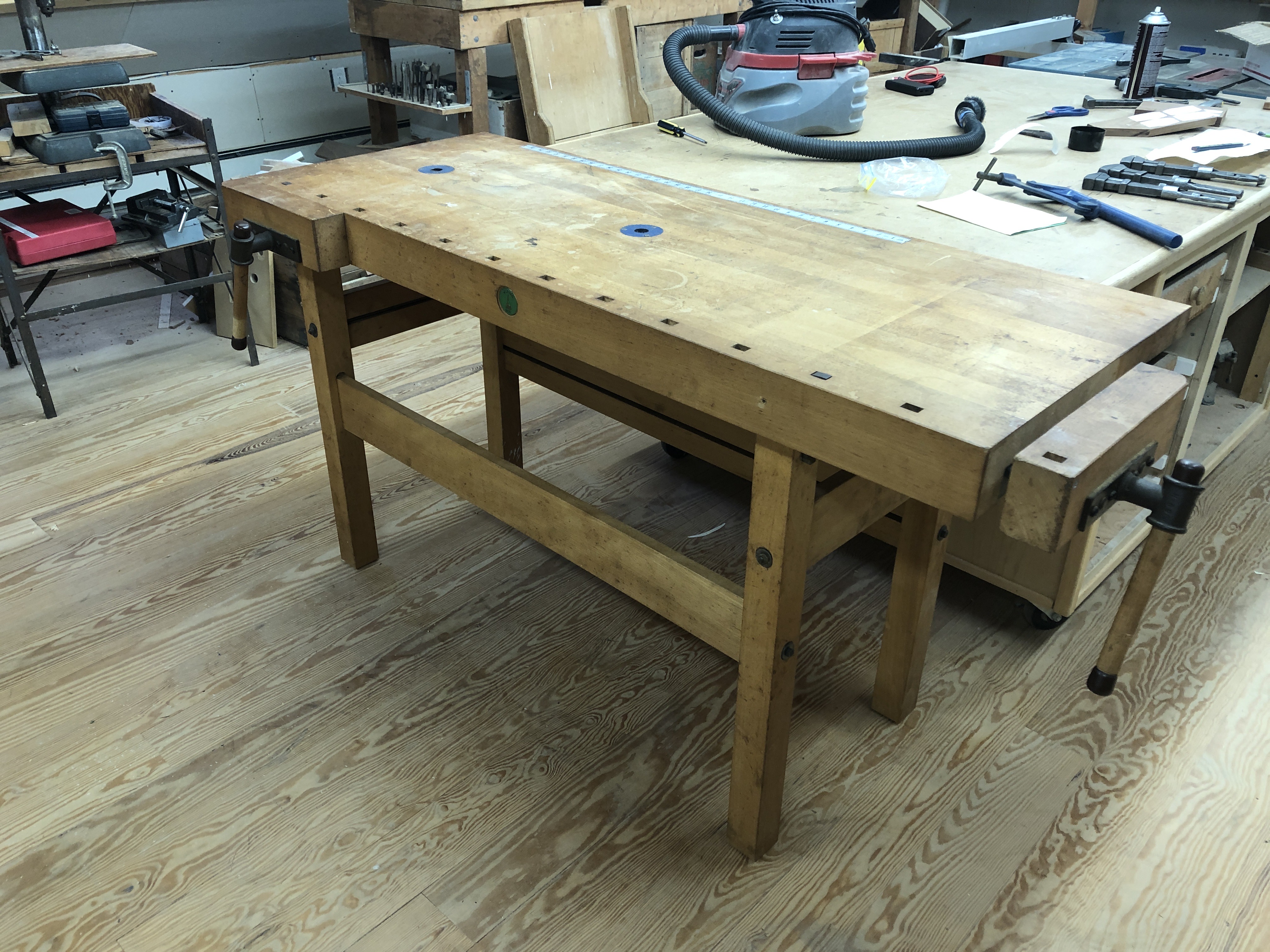
Most HD have a big vertical panel saw for cutting plywood, though I wouldn't expect a high quality cut. I had them cut a couple sheets of plywood in half to fit in my truck, not great quality cuts, but dead straight. The longest piece of "instrument grade" wood I've ever bought was an 8" wide x 8' long flame maple board, and I got three bass necks out of it, crosscut on the miter saw and ripped on the tablesaw. I can't think of a single instance needing to rip a full sheet of plywood for guitar building, but maybe you'd need to, building something like a router table or other large jig. I have this weird recent obsession with the ingenuity of the best of the "Tiny House" builds, where maximizing the available space by using convertible casework, sliding panels that change function, etc. can make even a truly tiny space useful, but its a lot of planning to do efficiently. You see a lot of that in boat interiors too. In your shoes, I'd concentrate on making the central workbench as versatile as possible, moving tools around on casters works, but it can be a hassle. I inherited an Ulmia traditional workbench with two vices, bench dogs, etc., and now i do nearly everything on it that requires a tool that will fit in my hands, including routers, and its only about 30" x 60", with an open shelf below for storage.
My Brother and I share this shop, we built the big outfeed table in line with the tablesaw, which is on locking casters, and it has a bunch of simple drawers and shelves built in. All the other tools are pretty much stationary at the perimeter, with aisle space all around the bench/table.
My Brother and I share this shop, we built the big outfeed table in line with the tablesaw, which is on locking casters, and it has a bunch of simple drawers and shelves built in. All the other tools are pretty much stationary at the perimeter, with aisle space all around the bench/table.
Last edited:
Lots of good stuff/ideas to go over in my head. The building will have a wooden floor I worked in a factory for 25 yrs hate working on concrete. Did get her to go with a bigger one today 14x36. It’ll also be closer to the house. That should be good enough. It’ll have power company electric since I’ll be closer to the pole.. I have 2 electric wall heaters that have thermostats for heat. Toss out a lot of heat for their size. And an aggressive dust collecting system will be installed. Next time I go to Lowe’s I’ll look at their setup for cutting plywood from what I remember it looked easy to duplicate.
That's gonna be a great size.
Btw, this place has some really odd sizes. Did you say these are steel buildings?
Btw, this place has some really odd sizes. Did you say these are steel buildings?
Wood framing steel siding and roof 1 window one regular door and a 9x 7 roll up garage door

I am a professional woodworker, my shop is 12x15.
I am about to relocate my shop to a space that is approx. 10x25, a 70 sq' gain (yeesss!).
Both shops have a driveway in front and my new shop will also have a side door that opens onto a 10'x15' slab.
A small shop does pose certain challenges and you will develop work-arounds. It will also force you to develop the habit of thinking through the order of operations for each project (and each phase thereof) in great detail, this is a good thing.
Also keep in mind that floor space is only part of the issue, wall space and ceiling space are critical parts of the equation too. Modular tool stations/workbenches are very helpful and wheels are your friends!.
You will want to get dedicated power installed sooner rather than later, the generator will most likely become a limiting factor pretty quick if you are using your shop on a regular basis.
Best of luck with the new shop, hope to see progress posts as it comes together.
I am about to relocate my shop to a space that is approx. 10x25, a 70 sq' gain (yeesss!).
Both shops have a driveway in front and my new shop will also have a side door that opens onto a 10'x15' slab.
A small shop does pose certain challenges and you will develop work-arounds. It will also force you to develop the habit of thinking through the order of operations for each project (and each phase thereof) in great detail, this is a good thing.
Also keep in mind that floor space is only part of the issue, wall space and ceiling space are critical parts of the equation too. Modular tool stations/workbenches are very helpful and wheels are your friends!.
You will want to get dedicated power installed sooner rather than later, the generator will most likely become a limiting factor pretty quick if you are using your shop on a regular basis.
Best of luck with the new shop, hope to see progress posts as it comes together.
Latest posts
-

-
-

-

-
What Frequency Response is Actually Needed for Low Tuning?
- Latest: bass player 53