
Enjoy the benefits of a premium membership!
Upgrade Account
-
TalkBass has been independent since 1998. Add your voice.
Create a free account to reply to discussions, view embedded media, and browse with fewer display ads.
Join free Log in
Want zero display ads or expanded classifieds tools? Compare plans.
You are using an out of date browser. It may not display this or other websites correctly.
You should upgrade or use an alternative browser.
You should upgrade or use an alternative browser.
Post Your Pedal Board XII - Dirty Dozen
- Thread starter crimson_basser
- Start date
- Status
- Not open for further replies.
More options
Who Replied?Hows the Zvex Lofi Loop Junky?
The loop junkie was actually a decent surprise as I was expecting something more uncontrollable. As wild as it is, it can be tamed.
It is a looper with alot of character
very useable even for long repeats if set subtle, eventually it does finally warp your signal completely over time, very analog sounding, but Im not sure that it is.
cabo, dude. that s*** is niiiiiiice. both boards.
+ infinity.

thanks for all nice comments,,,just a result of many years trying to figure out what is neccesary and what works best.
the Squeeze box has worked out real nice and another side note if I were to get another bass whammy I would get definately get the little blenda pedal to go with it!

So because my new board is pretty bare, I was talking to my guitar player about buying a MicroPog and he says "Oh I have the full size POG. I loaned it to my cousing. I'll get it for you."
Can't wait for practice tonight!
Can't wait for practice tonight!
scotch
It's not rocket science!
- Nov 12, 2006
- 6,944
- 2,083
- 51
- Disclosures
- Please see Profile for Endorsement disclosures
No huge changes, but I thought I would post what my boards look like now. I've also included my typical studio set-up (minus the amp, since I only get to use an amp about 5% of the time recording.... )
)
Primary Live/Recording Board:
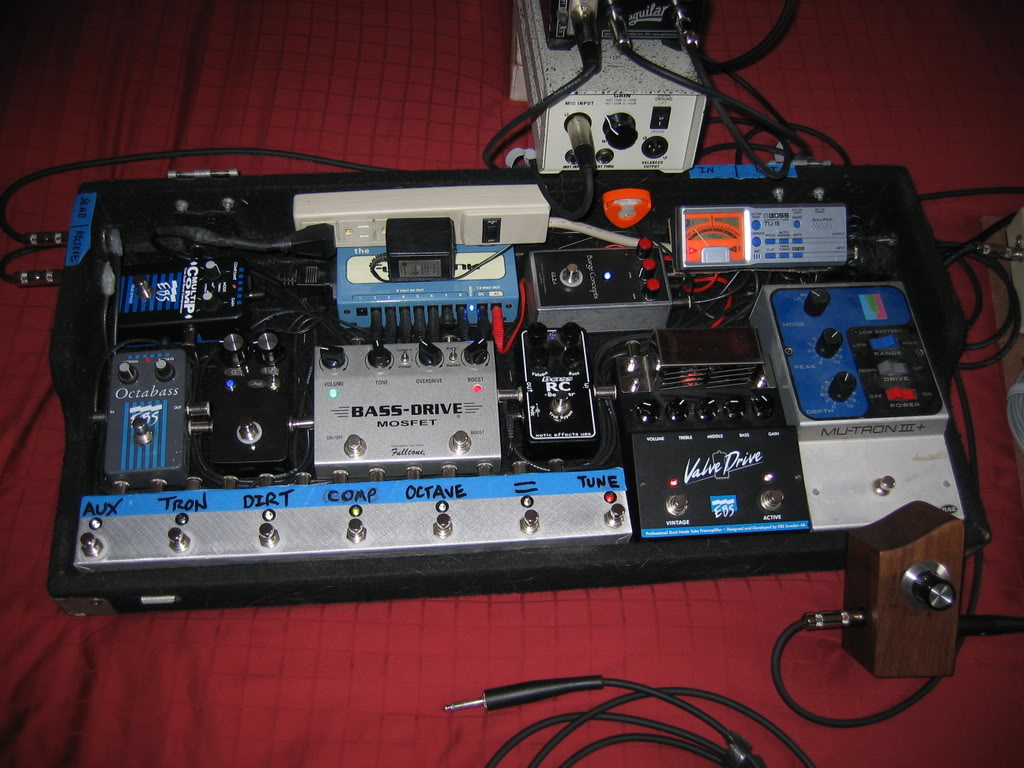
All powered by T-Rex Fuel Tank (except Mu-Tron by it's own adapter) The Boss TU-15 Tuner runs off of the Loop-Master & is never in the signal chain (I'm very paranoid about tuners after recording a great take through a TU-2 years ago- only later to realize the tuner was making all sorts of weird noises in the bass track!!!!)
Bass>Birdsong B-Box (passive tone filter like a Gibson Varitone, but for bass!)>Barge GLZ-1 Buffer/Impedance/Volume Control (for evening out different instrument volumes & making sure my tone gets preserved through long cable runs)>Xotic Bass RC Booster (I usually use it to roll off some treble when I switch to a pick, but it also can drive my od's harder and the eq is excellent!)>EBS Valve Drive (Pretty much always on - my secret weapon! I use it as my primary recording preamp as well as to add a little fur to my overall sound. It can also do some great organic crunch...)>Loop Master 5-Loop TB Box w/ Master Bypass & Tuner Out (The control center. I can keep all the "extras" out of my clean signal path. Silent tuning + I can engage combinations of effects with one stomp using the master bypass.)>EBS Octabass (eventually I may upgrade to the Black Label series, but the EBS octave tone is by far my favorite...)>EBS Multicomp (Used pretty infrequently, I'm anti-"compressor on at all times". I use mine for occasional slap/pop work in multiband mode & I like the tube sim mode for thick double-stop work and soloing.)>Dirt Loop containing Bogdan Helter Skelter/Polish Love into Fulltone Bass-Drive Mosfet (Between these two pedals I have 3 cascading gain stages from light od, to aggressive crunch, to full-on distortion: all without touching a knob! The Fulltone's "clean" boost mode is also great for certain situations. I use the Bogdan set for very light od & run that into the Fulltone set for more aggressive tones.)>HAZ Mu-Tron III+ (Try as I might to find a smaller unit to replace it, I keep coming back to this thing....)>Auxiliary Loop (I usually will just put one pedal here, like my Mesa V-Twin or Moog BassMurf. The V-Twin has amazing overdrive tones for bass! It's just too big to live permanently on my Board - I mainly pull it out for recording. Often, I hook up my Auxiliary Board to the Aux loop - makes sense right? see below>To Di and Amp see below:
Auxiliary Studio Board:
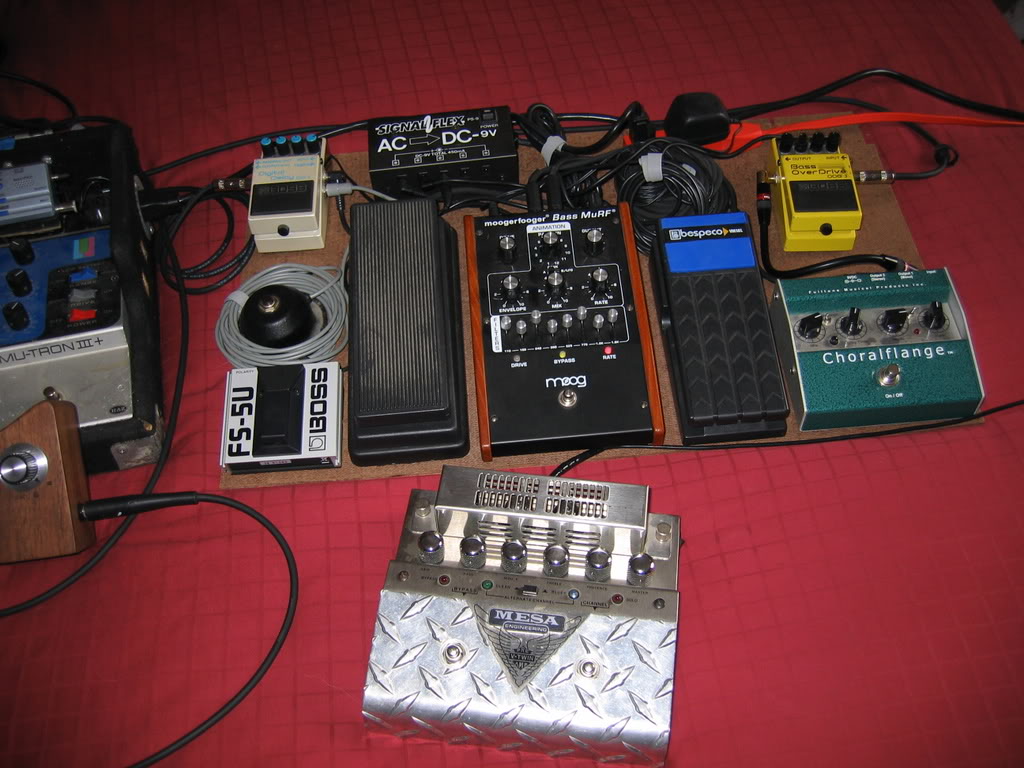
Powered by Moogerfooger Adapter & Signal Flex power supply. (The signal Flex is a little "ghetto", but it has always worked well for me...)
The Aux Board usually stays in my home studio. If I need an effect for a gig or session somewhere, I usually just pull one pedal off & stick it in my Aux Loop of my Primary Board (above).
Chain is >Boss ODB-3 (Much maligned, but killer for over-the-top industrial noise!)>Fulltone Choralflange (Great pedal, but using a chorus too much is a great way for a working studio player to stop getting called!!!)>Moog BassMurf w/ Expression pedals for mix & envelope as well as Boss FS-5U for tap tempo (Fun pedal for creating cool textured bass parts. Mainly used for creative ideas in the studio, but I have toured with it as well for vibey song intros and outros...)>Boss DD-5 Delay w/ tap tempo pedal (I have put a lot of miles on this delay in the past, but rarely use it anymore. Still, delay is a must-have in some situations!)>Back to Loop Master (see above)
And lastly, the DI options:
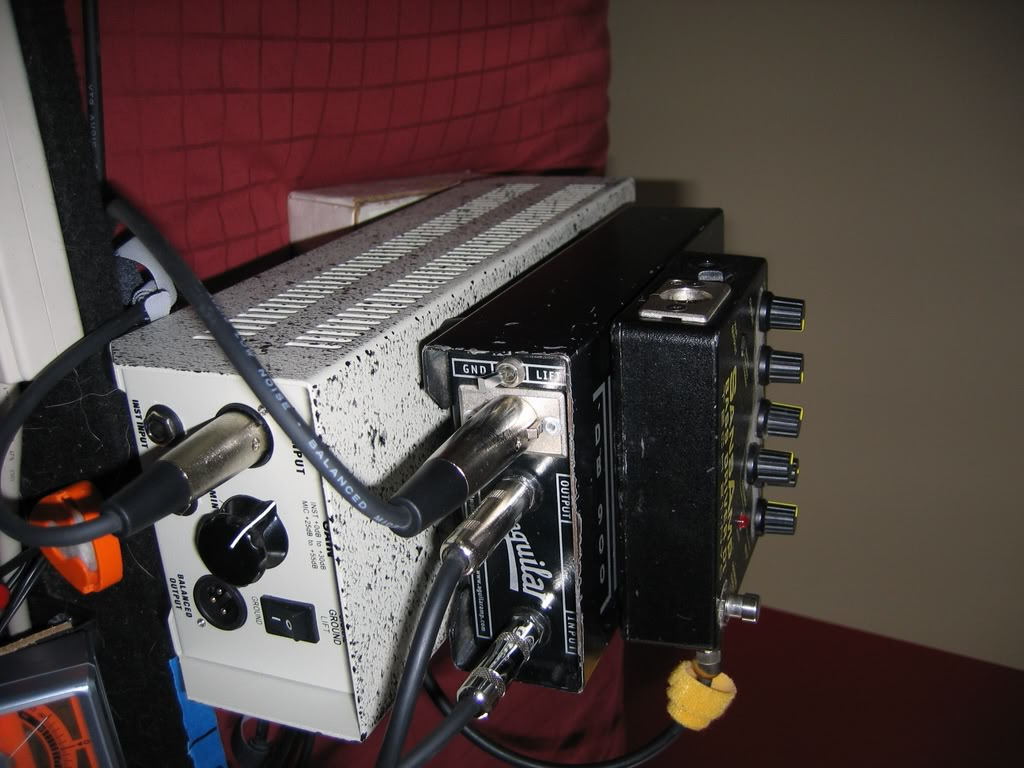
There's also a Line 6 Pod X3 (not pictured).
For important sessions (full album projects or higher production value affairs) I run my Primary Board into the Aguilar DB-900 Tube Direct and use it's mic level signal into the Groove Tubes Brick Pre. Either a SansAmp BDDI or an actual Amplifier is run off the parallel out of the DB-900. I always use the Aguilar Di. It really makes a huge difference! Live or studio - I don't leave home without it! It's 1/4" output jack also benefits from the tube circuitry, but is at unity gain, so my amp also benefits from the Aggie tone. I run the Aggie into the Brick in situations where a hot +4db signal is needed (often times at project studios). Using the mic input on the Brick adds an extra tube stage that the 1/4" input does not utilize- plus I can use the unity gain 1/4" output from the Aguilar to properly feed an amp or Pod or SansAmp.... Less often, I use the just the Pod X3 or the SansAmp (it's nice to have options & change thing up!). If I'm using the Pod, I generally don't use my Primary Board (Pod's don't really like pedals in front of them, plus I've customized the X3 to my liking).
Whew, way more than anyone probably wants to know, but it's raining & I'm bored!!!!
)Primary Live/Recording Board:
All powered by T-Rex Fuel Tank (except Mu-Tron by it's own adapter) The Boss TU-15 Tuner runs off of the Loop-Master & is never in the signal chain (I'm very paranoid about tuners after recording a great take through a TU-2 years ago- only later to realize the tuner was making all sorts of weird noises in the bass track!!!!)
Bass>Birdsong B-Box (passive tone filter like a Gibson Varitone, but for bass!)>Barge GLZ-1 Buffer/Impedance/Volume Control (for evening out different instrument volumes & making sure my tone gets preserved through long cable runs)>Xotic Bass RC Booster (I usually use it to roll off some treble when I switch to a pick, but it also can drive my od's harder and the eq is excellent!)>EBS Valve Drive (Pretty much always on - my secret weapon! I use it as my primary recording preamp as well as to add a little fur to my overall sound. It can also do some great organic crunch...)>Loop Master 5-Loop TB Box w/ Master Bypass & Tuner Out (The control center. I can keep all the "extras" out of my clean signal path. Silent tuning + I can engage combinations of effects with one stomp using the master bypass.)>EBS Octabass (eventually I may upgrade to the Black Label series, but the EBS octave tone is by far my favorite...)>EBS Multicomp (Used pretty infrequently, I'm anti-"compressor on at all times". I use mine for occasional slap/pop work in multiband mode & I like the tube sim mode for thick double-stop work and soloing.)>Dirt Loop containing Bogdan Helter Skelter/Polish Love into Fulltone Bass-Drive Mosfet (Between these two pedals I have 3 cascading gain stages from light od, to aggressive crunch, to full-on distortion: all without touching a knob! The Fulltone's "clean" boost mode is also great for certain situations. I use the Bogdan set for very light od & run that into the Fulltone set for more aggressive tones.)>HAZ Mu-Tron III+ (Try as I might to find a smaller unit to replace it, I keep coming back to this thing....)>Auxiliary Loop (I usually will just put one pedal here, like my Mesa V-Twin or Moog BassMurf. The V-Twin has amazing overdrive tones for bass! It's just too big to live permanently on my Board - I mainly pull it out for recording. Often, I hook up my Auxiliary Board to the Aux loop - makes sense right? see below>To Di and Amp see below:
Auxiliary Studio Board:
Powered by Moogerfooger Adapter & Signal Flex power supply. (The signal Flex is a little "ghetto", but it has always worked well for me...)
The Aux Board usually stays in my home studio. If I need an effect for a gig or session somewhere, I usually just pull one pedal off & stick it in my Aux Loop of my Primary Board (above).
Chain is >Boss ODB-3 (Much maligned, but killer for over-the-top industrial noise!)>Fulltone Choralflange (Great pedal, but using a chorus too much is a great way for a working studio player to stop getting called!!!)>Moog BassMurf w/ Expression pedals for mix & envelope as well as Boss FS-5U for tap tempo (Fun pedal for creating cool textured bass parts. Mainly used for creative ideas in the studio, but I have toured with it as well for vibey song intros and outros...)>Boss DD-5 Delay w/ tap tempo pedal (I have put a lot of miles on this delay in the past, but rarely use it anymore. Still, delay is a must-have in some situations!)>Back to Loop Master (see above)
And lastly, the DI options:
There's also a Line 6 Pod X3 (not pictured).
For important sessions (full album projects or higher production value affairs) I run my Primary Board into the Aguilar DB-900 Tube Direct and use it's mic level signal into the Groove Tubes Brick Pre. Either a SansAmp BDDI or an actual Amplifier is run off the parallel out of the DB-900. I always use the Aguilar Di. It really makes a huge difference! Live or studio - I don't leave home without it! It's 1/4" output jack also benefits from the tube circuitry, but is at unity gain, so my amp also benefits from the Aggie tone. I run the Aggie into the Brick in situations where a hot +4db signal is needed (often times at project studios). Using the mic input on the Brick adds an extra tube stage that the 1/4" input does not utilize- plus I can use the unity gain 1/4" output from the Aguilar to properly feed an amp or Pod or SansAmp.... Less often, I use the just the Pod X3 or the SansAmp (it's nice to have options & change thing up!). If I'm using the Pod, I generally don't use my Primary Board (Pod's don't really like pedals in front of them, plus I've customized the X3 to my liking).
Whew, way more than anyone probably wants to know, but it's raining & I'm bored!!!!
scotch
It's not rocket science!
- Nov 12, 2006
- 6,944
- 2,083
- 51
- Disclosures
- Please see Profile for Endorsement disclosures
thanks for all nice comments,,,just a result of many years trying to figure out what is neccesary and what works best.
the Squeeze box has worked out real nice and another side note if I were to get another bass whammy I would get definately get the little blenda pedal to go with it!
I coveteth thine Squeeze Box!!!! Nice Board Cabo!

heres an shot of my old PTpro set up,,
current PT2 downsized and upgraded. my 'essentials' board!
(empty spot for tuner)
Niiiiiiiiice.....

You got some nice deals on your rig man, congrats!
Thanks... I am always looking for a great deal...
And always working some.
Whew, way more than anyone probably wants to know, but it's raining & I'm bored!!!!
Actually, I loved the in depth look at your board. I was going to comment on it earlier but had some things I had to get done first. And we're finally getting some much needed rain up here this afternoon too.
It's nice to see someone else that feeds the Polish Love into another dirt pedal. I'm finding it adds quite a bit to several other distortion/overdrives that I have.
I'm going to have to take a closer look at your DI setup. I've only just recently considered DI as something to look into and picked up an MXR M-80 to play with. I like what you've got there though.
Cool I'll look around. Its against my religion to enter a Walmart though.
The devil offers good deals, all you have to do is mingle with the damned.
But, I'm sure Target would serve your elitist soul well.

Some guy on Amazing Race made that same comment last night, are you a fan?
No. I was trying to pick on the elite one. Didn't work.

Scotch, if you don't mind me asking, what band are you in? Could you post a link to somewhere with a few recordings like a myspace or something?
Totally missed Cabo's boards before. I'm envious of his pedals.
You're not alone.
You're not alone.
I would hope not. He could at least spread some of his Blueberry love to us.
 It's hard enough finding one and he's sitting on two!
current PT2 downsized and upgraded. my 'essentials' board!
(empty spot for tuner)

How do you like the BJF Filter? Is it a similar design to the Mad Professor snow white auto wah?


OK.
So I've been reading these forums since part 2 of post your pedalboards. I've bought a ton of pedals and have dwindled them down to the effects I use in my own music with my band. All these pedals are used in our current live set. So I finally felt ready and satisfied enough in my set up to commit to buying a board to put them on!
[Invalid or Expired Link Removed]
Link Removed
[Invalid or Expired Link Removed]
Link Removed
[Invalid or Expired Link Removed]
Link Removed
MIA Deluxe Jazz Bass (with Badass III and Dimarzio Model J's) -->
Boss OC-2 -> EHX XO Micro Synth -> Coloursound Tonebender -> BFJE Blueberry BOD -> Dunlop 105Q Wah -> Boss DD-20
-> GK 1001-II into a GK4x10
This is not a ATA flight rated case, it's a cheapy by CNB that i bought because it cost 1/4 as much as buying Pedaltrain 2 with flight case in Australia.
Logistically this is basically the in-efficient crappy Version 1 of the board. It's kind of space wasting atm because I'm yet to buy any right angle (or even decent) patch leads and I'm yet to buy an isolated power supply (voodoo probablly). Unfortunately this may be a while because recent turns of events have left me 2.2k in debt to the government.
Possible changes coming up are the inclusion of Dredgetone Bass Angler when they are ready, Tonebender may be swapped out for Prescription Electronics Depth Charge that is on its way to me atm (last thing i bought before the money pinch) and maybe If i eventually sortout the space issue I'll whack a pedal tuner on board.
The stuff that I've sifted through to get to this setup;
Empress Tremolo
Boss AW3 Dynamic Wah
Sansamp BDDi Programmable
Roland Jet Phaser
Barge Concepts VFB-2
Electro Harmonix Qtron
EBS MultiComp
Crowther Prunes and Custard
Boss RV-5 Reverb
DOD FX25 Lime Green
Boss HM-2 Heavy Metal
Digitech Whammy IV
Zvex Woolly Mammoth
Electro Harmonix English Muff'n
Electro Harmonix Russian Big Muff Pi
Vintage 70's Fender Fuzz Wah
Zoom Power Drive
Feels nice to finally post one!
So I've been reading these forums since part 2 of post your pedalboards. I've bought a ton of pedals and have dwindled them down to the effects I use in my own music with my band. All these pedals are used in our current live set. So I finally felt ready and satisfied enough in my set up to commit to buying a board to put them on!
[Invalid or Expired Link Removed]
Link Removed
[Invalid or Expired Link Removed]
Link Removed
[Invalid or Expired Link Removed]
Link Removed
MIA Deluxe Jazz Bass (with Badass III and Dimarzio Model J's) -->
Boss OC-2 -> EHX XO Micro Synth -> Coloursound Tonebender -> BFJE Blueberry BOD -> Dunlop 105Q Wah -> Boss DD-20
-> GK 1001-II into a GK4x10
This is not a ATA flight rated case, it's a cheapy by CNB that i bought because it cost 1/4 as much as buying Pedaltrain 2 with flight case in Australia.
Logistically this is basically the in-efficient crappy Version 1 of the board. It's kind of space wasting atm because I'm yet to buy any right angle (or even decent) patch leads and I'm yet to buy an isolated power supply (voodoo probablly). Unfortunately this may be a while because recent turns of events have left me 2.2k in debt to the government.
Possible changes coming up are the inclusion of Dredgetone Bass Angler when they are ready, Tonebender may be swapped out for Prescription Electronics Depth Charge that is on its way to me atm (last thing i bought before the money pinch) and maybe If i eventually sortout the space issue I'll whack a pedal tuner on board.
The stuff that I've sifted through to get to this setup;
Empress Tremolo
Boss AW3 Dynamic Wah
Sansamp BDDi Programmable
Roland Jet Phaser
Barge Concepts VFB-2
Electro Harmonix Qtron
EBS MultiComp
Crowther Prunes and Custard
Boss RV-5 Reverb
DOD FX25 Lime Green
Boss HM-2 Heavy Metal
Digitech Whammy IV
Zvex Woolly Mammoth
Electro Harmonix English Muff'n
Electro Harmonix Russian Big Muff Pi
Vintage 70's Fender Fuzz Wah
Zoom Power Drive
Feels nice to finally post one!
- Status
- Not open for further replies.


