• TalkBass has been independent since 1998. Add your voice.
    Create a free account to reply to discussions, view embedded media, and browse with fewer display ads.
    Join freeLog in
    Want zero display ads or expanded classifieds tools? Compare plans.

Powred Subs --- How to Install Question

totally underststand... drive rack will allow mix/match of different vendors etc.... will EQ... RTA... etc.

Powered mains / subs will replace separate power amp & passive enclosure pairings....if you decide to go with the onboard processing, so be it. Very simple to use but with some limitations. The DR PA+ is designed to be used with any passive or powered (or mixed) array and can be configured for any brand / model even those that are not included in the "set-up wizard". Mine has replaced:

*Graphic EQ
*Parametric EQ
*Crossover
*Limiter
*Feedback eliminator

Sidenote: I do carry a separate ART GEQ on board for "rescue" work at the encouragement of TBer walterw but have yet to use it in over 2 years.

The RTA auto-EQ is particularly useful for those of us with tin ears...like me! It can not / should not be used in an occupied establishment for fear of driving out the clientele and irritating management. In those instances, I'll use a stored GEQ curve from a previous engagement and tweak only the mains & subs outputs. I've used the auto-EQ dozens of times and have been surprised but the quasi-reproducibility venue-to-venue.....minor fluctuations with regards to boost & attenuation but, overall, the general curve remains fairly consistent.

Riis
 
Powered mains / subs will replace separate power amp & passive enclosure pairings....if you decide to go with the onboard processing, so be it. Very simple to use but with some limitations. The DR PA+ is designed to be used with any passive or powered (or mixed) array and can be configured for any brand / model even those that are not included in the "set-up wizard". Mine has replaced:

*Graphic EQ
*Parametric EQ
*Crossover
*Limiter
*Feedback eliminator

Sidenote: I do carry a separate ART GEQ on board for "rescue" work at the encouragement of TBer walterw but have yet to use it in over 2 years.

The RTA auto-EQ is particularly useful for those of us with tin ears...like me! It can not / should not be used in an occupied establishment for fear of driving out the clientele and irritating management. In those instances, I'll use a stored GEQ curve from a previous engagement and tweak only the mains & subs outputs. I've used the auto-EQ dozens of times and have been surprised but the quasi-reproducibility venue-to-venue.....minor fluctuations with regards to boost & attenuation but, overall, the general curve remains fairly consistent.

Riis
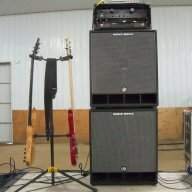
Well whatever, If you are using an all active system then all you really need is 31band EQ for room adjustments. Since i do sound from stage I don't have time to scroll through menus if feedback is occuring. Much easier to reach over and use a traditional 31 band. there are lots of threads over at harmony central dealing with driveracks. Here is one.Link Removed
 
Well whatever, If you are using an all active system then all you really need is 31band EQ for room adjustments. Since i do sound from stage I don't have time to scroll through menus if feedback is occuring. Much easier to reach over and use a traditional 31 band. there are lots of threads over at harmony central dealing with driveracks. Here is one.Link Removed

Absolutely! It's a matter of personal preference. That being said, my FOH does not feedback although I do have an umpteen band GEQ in-line for emergencies....there's dust on the sliders from non-use. Come to think of it, the GEQ would make more sense on the monitor side as that is a very common source of feedback.

The auto-EQ "forces" you into Feedback Filter mode but can be bypassed if desired. For kicks 'n giggles, I set up the PA in my living room with a mic facing the enclosures. I advanced the main sliders towards unity and the system was able to capture and squelch each outbreak. Of course, this was a particularly hostile sonic environment and not representative of actual stage placement. There are 12 feedback filters which can be assigned fixed or floating status. The system is not 100% immune if proper system set-up is ignored, especially gain structure amongst mixer, DriveRack, and power amps. This is not a plug & play unit...the learning curve is relatively steep and operation is sometimes counter-intuitive. dbx® Professional Products has an entire users' sub-forum dedicated to the finer points of operation.

Riis
 
Thanks...

We have a feedback killer on the announcements and crowd participation mike.. After using one, it's well worth the "sonic squish"

May bet spendy this summer.

Eh, I've seen them on the second-hand market for ~$300. People buy them and then get frustrated when they discover they have to actually read the manual to make 'em work properly. Here's a link to the available mains / subs / amp library. They offer a preset for the db 12 and 15 but not the 05:

http://www.dbxpro.com/Speaker_Tunings/PA+/Tuning List DriveRack PA+.pdf

I'm at an advantage using separate amps / passive enclosures. The PA+'s gain structure procedure / protocol requires disconnecting the speakers from the power amp. Not sure how difficult that would be with a pow-sub.

Riis
 
issue will be that my mains are not active.. will be using a rack mount xover.

I really do not see a problem with using powered subs and non powered tops. The trick will be to see how low your tops go. That is where I would be setting the subs to come in at. Since you are (probably) not using matching tops/subs, an external xover would be what I would do.

I would RTA the tops, see where they drop off. Lets say for arguments sake they go down to 90 Hz. I would set the powered subs at 90, use the DRPA to set the out put to the subs at 90, and call it a day.

If the tops are higher, say 120, then I would set the powered subs to the 150 setting, and the xover to 120.

The DRPA will allow you to mix and match tops and subs, with variable phase and slopes. A good thing.
It really is IMO more a good idea to use an external xover in this scenario. If at some point you get all matching powered components, then maybe get it out of the loop. Digital xovers allow for another layer of control over the speakers.

