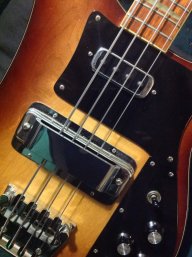
Thanks for that info - more that makes Burns unique. How's your partner? Better I hope.
She had a rough day yesterday. They might send her home tomorrow, thank you for asking.

TalkBass has been independent since 1998. Add your voice.
Create a free account to reply to discussions, view embedded media, and browse with fewer display ads.
Join free Log in
Want zero display ads or expanded classifieds tools? Compare plans.
Thanks for that info - more that makes Burns unique. How's your partner? Better I hope.

 The Visa Sonic was made from '62-'64, so this one is right in the middle.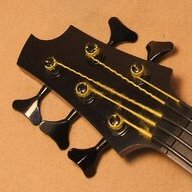
Neck looks to be sycamore as well.
If I remember right, the Ampeg literature stated sycamore as the body wood. It's probably unlikely that there were any differences between the Ampeg-branded and Burns's own instruments, other than the engraving on the pickguard.
I was going to post that it looks like you got yourself a Brazilian board there. There’s a slight difference to the grain, compared to Indian, that’s hard to describe but I know it when I see it. About the red on the heel, the entire neck was painted red wasn’t it?.I have read that in the "Pearls and Crazy Diamonds" book I have. It's dense like maple and similarly heavy. Fingerboard could be Brazilian rosewood but can't confirm that. It was used on Burns guitars/basses then along with ebony on some guitars.
I was going to post that it looks like you got yourself a Brazilian board there. There’s a slight difference to the grain, compared to Indian, that’s hard to describe but I know it when I see it. About the red on the heel, the entire neck was painted red wasn’t it?.

Hey if you wouldn't mind, could you either trace out or take some detailed pictures of that wiring harness that I could trace it from. It's pretty unique and not in any published drawings I've seen.Isn't it something? The cap is the tan sausage-looking thing > [SHC 0.02 + 20% 126V] and the other tan thin thing is a resistor > looks to be [wht/wht/blue/red/wht]. Pots are both MORGANITE 500K and the transformers have hand writing on them > D3206K
I don't mind the simple mini-toggle - it stays.
View attachment 3727558
Hey if you wouldn't mind, could you either trace out or take some detailed pictures of that wiring harness that I could trace it from. It's pretty unique and not in any published drawings I've seen.
Also the little transformer looking items are probably inductors. If you disconnect one end and check with an inductance meter the values may be helpful to others. They may be around 2 to 4 Henries.Hey if you wouldn't mind, could you either trace out or take some detailed pictures of that wiring harness that I could trace it from. It's pretty unique and not in any published drawings I've seen.

I was going to post that it looks like you got yourself a Brazilian board there. There’s a slight difference to the grain, compared to Indian, that’s hard to describe but I know it when I see it. About the red on the heel, the entire neck was painted red wasn’t it?.
I doubt @JIO has a inductance meter (fairly rare) I'm not sure he's ever found his DMM.Also the little transformer looking items are probably inductors. If you disconnect one end and check with an inductance meter the values may be helpful to others. They may be around 2 to 4 Henries.

Now you mention it the transformers could be for impedance matching. I've been working on tone circuits with inductors and capacitors so just went with that.I could swear I'd seen a Burns wiring diagram online somewhere. I'm surprised I never posted it on my old site (I own the Unofficial Ampeg page, desperately in need of a rehab). I also think the transformers are used to change impedance; I believe I've read that the pickups are low impedance and need to be upped to properly work with standard amps. But I'm not electronics tech, and I can't even remember where I read things. :/
I thought that at first also, but 2 transformers, 3 pickups is a bit odd for impedance matching IMHO. I did look at the Cadfael's book, but none of the Burns schematics have transformers or inductors in them; that's why I'm going to trace it out from photos that JIO sent me. My specialty at work is rewriting other peoples' overly complex code, so this kind of detective work comes naturally to me.Now you mention it the transformers could be for impedance matching. I've been working on tone circuits with inductors and capacitors so just went with that.



Also the little transformer looking items are probably inductors. If you disconnect one end and check with an inductance meter the values may be helpful to others. They may be around 2 to 4 Henries.
I doubt @JIO has a inductance meter (fairly rare) I'm not sure he's ever found his DMM.

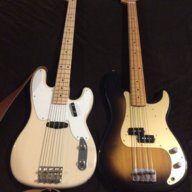
Indian tending to be comparatively lighter and often with more visible stripes. I know it's generally considered lesser than Brazilian but still find it very attractive in its own way - like here on my '66 Jazz:
View attachment 3728679


