• TalkBass has been independent since 1998. Add your voice.
    Create a free account to reply to discussions, view embedded media, and browse with fewer display ads.
    Join freeLog in
    Want zero display ads or expanded classifieds tools? Compare plans.

Proper tools needed to do a simple bass setup.

As a retired Locksmith I have a lot of specialised tools.

I know the value of them and how well they work for what you need to accomplish.

My question is this; when you set up your bass what tools do you use?

I am not doing anything other than just a proper setup. String height, pickup height, intonation and neck adjustment.

Is a simple set up kit from say like from StewMac good enough?
I have what I need to set up my Warwick, but my Fender Jazz and G&L are a lot different and these I want to get better at setting up properly.

Thanks
Clayton
 
At a minimum: (you probably already own half of these, or can re-purpose tools you own)

Set of feeler gauges
Hex key sets , metric and imperial, or just a handful that fit your bass for truss rod and bridge adjustments
Fret Rocker comes in handy for checking high frets, but not crucial.
Radius gauges
Capo
Good 6" machinist ruler graduated in 32nds, or one of the inexpensive string height rulers.

This 4 part setup guide on YT is my Go To, follow the steps in order. He just uses a few tools.

The Stewmac tools are all good quality, but overpriced IMO. Unless you do this all the time, inexpensive tools are fine. The only one I spent a bit on was the Fret Rocker, the cheap ones tend to suck

On the optional side, a decent quality straightedge, the notched ones come in handy for checking neck straightness. If you get into fret dress and leveling, a few more tool, that's a true rabbit-hole of tools and techniques.


Last edited:
You will probably get a lot of different answers here, as everyone has their own way, but once I got a string action gauge I use almost no other specialized tools at all during a basic setup. You don't need an expensive action gauge either, as cheap versions of this expensive Stew Mac one are available elsewhere:

String Action Gauge - StewMac

I use this tool to do the rough setup (string and pickup height) and then tweak after that to get the right feel and level of "clank". I don't use most other specialized tools like radius gauges, feeler gauges etc.

Of course you still need some other general tools, like screwdrivers for pickup height adjustments, hex key set for adjusting saddles, truss rod etc., a capo to remove nut height from measurements and a business card to make measuring the neck relief easier.

If you are looking for a starting point you can see how Sadowsky does it here: [Invalid or Expired Link Removed]

Good luck!
 
Last edited:
I use a straightedge cut to span the 1st and 17th frets (you can use the string and a capo, but it's not as consistent), a set of feeler gauges, various hex keys and screwdrivers, and a gauge for string spacing - I use the part that's graduated every .005". And a tuner, of course. But that's it for a standard setup - it's actually pretty simple, once you know what you're doing. If someone pays you $50 for a setup, you can pay the cost of the unique tools off in one setup.
 
  • Like
Reactions: Jeff Siddall
"I am not doing anything other than just a proper setup. String height, pickup height, intonation and neck adjustment."

As a locksmith, you probably already have everything that you need.

For intonation, you'll need an electronic tuner.

Neck adjustment, fret #1 and hold it and then fret the very last fret and hold it. Should be about a 2 business card thickness space at fret 8 or 9, top of fret to bottom of string. Some like a perfectly straight neck. There should be a little bit of neck relief though. (I expect someone on TB to challenge me on this.)

Set up information galore for bass is all over the net, YouTube, Google.

how to set up a bass guitar - Google Search
 
Some like a perfectly straight neck. There should be a little bit of neck relief though. (I expect someone on TB to challenge me on this.)

I'm going to challenge you on this and also agree with you on this! :smug:

I actually like a perfectly straight neck, but when I setup my basses I do build a minimal amount of relief into the neck (about 0.25 mm or 10 mil). Why the apparently discrepancy? Because wood and metal in a neck will move a bit with changes to temperature and humidity. A neck with a bit of relief will play about as well as one that is perfectly flat, but a neck with a bit of backbow will be horrible pretty much right away. So IME a bit of relief allows some movement without the bass playing horribly.
 
  • Like
Reactions: bassdude51
At a minimum: (you probably already own half of these, or can re-purpose tools you own)

Set of feeler gauges
Hex key sets , metric and imperial, or just a handful that fit your bass for truss rod and bridge adjustments
Fret Rocker comes in handy for checking high frets, but not crucial.
Radius gauges
Capo
Good 6" machinist ruler graduated in 32nds, or one of the inexpensive string height rulers.

This 4 part setup guide on YT is my Go To, follow the steps in order. He just uses a few tools.

The Stewmac tools are all good quality, but overpriced IMO. Unless you do this all the time, inexpensive tools are fine. The only one I spent a bit on was the Fret Rocker, the cheap ones tend to suck

On the optional side, a decent quality straightedge, the notched ones come in handy for checking neck straightness. If you get into fret dress and leveling, a few more tool, that's a true rabbit-hole of tools and techniques.


Those videos are great I learned a lot from them. Also they show the order you should do setups in. Set the neck relief first, action second, intonation third and nut height if needed last.
 
  • Like
Reactions: Gilmourisgod
Here's my side-hustle...gonna start selling this as a kit...includes the mushroom jars and coffee cans:

Toolkit.jpg
 
Posted this before, but this what I keep in a pouch ready to go. When you have/had a bunch of different basses you kind of figure out what each needs. Not pictured is the rest of maintenance stuff--consumables like wax/oil/polish and microfiber rags, polishing paper, etc that get used when I have more time than allowed to just swap strings. I recently got one of those Fret Nomad neck cradles, that thing has been very useful when I'm working on them. The big blue driver is a Cruz Tools cheater for my Fender AV63 P that has the vintage style truss rod nut and lets me make adjustments without taking the neck off. Not every Fender is the same but if you have a bass with the old heel style and it is high enough out of the pocket to get at it is very handy.
tools.jpg
 
Last edited:
I'm not able to find a good feeler gauge that isn't oiled and comes in the thicknesses I'm hoping to find: 0.012", 0.010", 0.008". Anyone know of any maker who makes one that has all three of those thicknesses on it? I see Nomad does, but it requires me to purchase two separate gauges. Surely someone makes them all in one set?
 
I'm not able to find a good feeler gauge that isn't oiled and comes in the thicknesses I'm hoping to find: 0.012", 0.010", 0.008". Anyone know of any maker who makes one that has all three of those thicknesses on it? I see Nomad does, but it requires me to purchase two separate gauges. Surely someone makes them all in one set?

I buy mine at Pep Boys, NAPA, etc. Sorry, they're oiled to deter rust but I've got paper towels. I separate the kit and mount on small wooden clothespins and mark the size with a Sharpie.

Riis
 
  • Like
Reactions: lark_z
I'm not able to find a good feeler gauge that isn't oiled and comes in the thicknesses I'm hoping to find: 0.012", 0.010", 0.008". Anyone know of any maker who makes one that has all three of those thicknesses on it? I see Nomad does, but it requires me to purchase two separate gauges. Surely someone makes them all in one set?

I do have a set of feeler gauges, but setting relief (what I assume you want those thin feelers for) is really just a starting point for the setup, after which I tweak based on how the bass plays, rather than how it measures. As such, I just use a business card (about 0.010") for setting the initial relief. Cheap, easy, and can't cause any damage to anything.

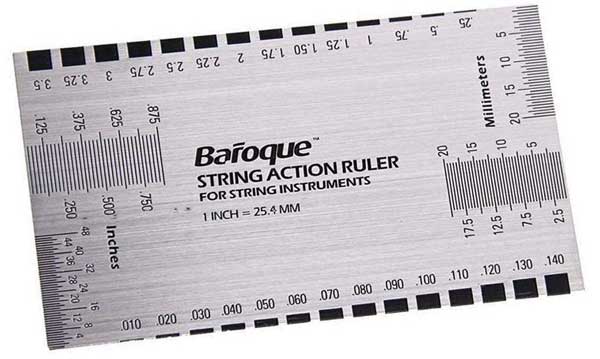
The tool I use for everything else is a string action ruler. I consider that my essential setup tool.
string-action-ruler.jpg
 
I'm not able to find a good feeler gauge that isn't oiled and comes in the thicknesses I'm hoping to find: 0.012", 0.010", 0.008". Anyone know of any maker who makes one that has all three of those thicknesses on it? I see Nomad does, but it requires me to purchase two separate gauges. Surely someone makes them all in one set?
- Ebay -- buy 'em in stacks, 5 bucks a bundle. I find them useful for a lot of things. First result I just pulled up had the 8, 10, 12, smaller ones you could stack for the same thicknesses, etc.
- Echo the neck cradle -- big help!
- And I alwasy recommend Liberon 0000 steel wool -- another cleaning consumable that is invaluable and better than hardware store steel wool.