• TalkBass has been independent since 1998. Add your voice.
    Create a free account to reply to discussions, view embedded media, and browse with fewer display ads.
    Join freeLog in
    Want zero display ads or expanded classifieds tools? Compare plans.

Question about usage of flat wound strings

One thing to be aware of on this topic is that all the major string makers make flats for bass and they sound different from each other in ways. GHS Precision Flats are designed to have a very thumpy, mellow sound with a quick decay to the notes. Sadowsky flats (which I use) are "brighter" in that you hear more overtones like you would on rounds and the sustain is almost like rounds as well. It really depends on the sound you are looking for and why you'd want to use them.

I use flats to have that smooth feel with no finger squeak but I still want punch to the tone. Labella Deep Talkin' flats are a more traditional sounding flat with muted highs and strong fundamentals. D'Addario Chromes are bright to begin with but mellow out.

My choices are limited to Fender and Ernie Ball Flats mostly. If you are lucky, you can find Rotosound or Daddario Chromes (which are limited to 40/100 gauge only)

 
My brother-in-law used to insist that he could tell the difference between various brands of American made lagers—Budweiser, MGD, etc. etc. I proposed a blindfold taste test where he would take a couple sips of five different beers, clearing the palate between tastes. He confidently identified five different brands. He was not pleased when I told him that all the samples had been Budweiser.
 
Agree with much already said here. Just want to add that there is no particular string or bass for any particular type of music. By completely rolling off the highs and playing with your fingers or thumb you can get a fat "traditional blues bass sound" (whatever that means) on either a p or j bass (or many other basses) with round wound strings. And the. reverse is true: you can get a clanky, punchy sound on either a p or j bass with flats. Think about Graham Maby's tone on the early Joe Jackson albums or Steve Harris on any Maiden album: both a p bass with flats.

As for your guitarist's concerns, does he have a clean tone or distorted? Sounds to me like he may have too much bass in his tone and that it is mixing with yours to muddy up the overall sound. While a lot of low might sound good in a guitar playing by itself, I've found that cutting the guitarists lows a bit in a band setting makes both the guitar and bass pop in a mix.
 
Hi skaine :)

Not trying to start a jazz bass vs precison bass debate here by the way. Thats not my point.

You tried not to! :D

Don' t worry! ;) P vs J threads show up weekly. We are used to that. :laugh:

Yes for blues only. He didnt tell about the string choice, he made a general statement, also it didnt come to my mind to ask if he has a bassy sound. I wanted to hear the bass guitarist side of the story from people who are more experienced than me :)

I avoid to discuss sound without giving examples. Especially when I discuss with guitarists.

I don' t know how they get their sounds and they don' t know how I get my sounds.

Discribing sounds with words is very difficult (guitarists use a different vocabulary!)

E.g. their hi mids are not what we call hi mids!

IME it' s better to say "I prefer Nathan East 's sound with Clapton to ….' s sound with …

That way it 's easier to know what the other is talking about (no square eggs vs round carrots :D)


When it comes to specific instruments opinons are often mixed with facts :laugh:

Strat vs Les Paul or Precision vs Jazz etc. Everything is fine for blues!

American boutique, Chinese copy, even Japanese firewood works! :laugh:

Just play what you have and respect each other' s sonic space.


greetings

Wise(b)ass
 
I would say that this guitar player is only concerned with how the bass blends with his/her sound. In their mind, bass is there to support their guitar. And, a Jazz bass with flatwounds is what they thinks supports their sound the best. Blues is about expressing a very complicated thing in an uncomplicated way so, K.I.S. (keep it simple stupid) is the best way to approach it and a p-bass or j-bass with flats is probably the best way to go.
 
Every band mix is unique and requires a certain amount of planning. Both P-Bass and Les Paul-style guitar have a lot of lower mids. Without hearing your band, it'd be hard for me to determine if you're getting grind up in the guitar frequencies or if he should thin out his guitar sound. If fhe situation can't be greatly improved on your current rig by messing with your knobs, it means that the guitarist needs to mess with his knobs.

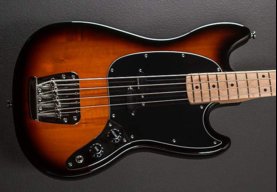
That said, beyond basic troubleshooting, a change of instruments or strings could give character to the mix between you and him. I play rock and punk, and the guitar player for my band has a middy old-school hard-rock guitar sound (modded Jazzmaster through modded Marshall). I thought that my bandmates would want cushiony mid-focused sound since we were a trio. What they ended up liking was a Mustang Bass with flats, played with a pick, which has an aggressive pick attack and a strong fundamental with just enough mids. I don't find that the guitar stands out more, but the bass certainly does, and it sounds more complimentary. Like a previous poster said about his sound, the guitar sits in a scoop that the bass provides.

But there are a million ways to get your mix, and most players in my situation fulfill the same role I do using a P-Bass with bright roundwounds and scooped amp settings.

Flats will probably help because they'll have less upper mids and sustain, and you may be able to hear yourself better too, but if he's got too many lows coming out of his amp, nothing will help much.
 
Last edited:
Today i had a conversation with a guitarist friend who mostly plays blues and an experienced one.

He told me that he prefers jazz bass rather than precison bass in a band. Not trying to start a jazz bass vs precison bass debate here by the way. Thats not my point.

I asked him why and he told me that P basses have more heavy and punchy sound compared to jazz basses, so his guitar sound disappears in that punchy sound. Because of that he prefers more round and warm sound that his guitar sound can be heard better.

I can hardly tell detailed stories in English due to my limited grammar and vocabulary, but it was like:

If a punchy P bass is a square with corners, so does his guitar sound. When played together two cornered sounds doesnt go well together, so he needs circles or ellipses instead of cornered sounds.

He told me this in a technical way of course, but i cant completely explain the details correctly :)

Back to my question, as far as i know there are many bass guitarists using P bass without a problem in a band, especially in a blues band.

So i wonder is this the reason people use flats in order to decrease that punch and get a warmer sound? What else should i consider in that matter?

I don't like the jazz or p-bass stock … I prefer a modified p-bass with 2 pickups, 5 strings and maybe a preamp. For the jazz I also like 5 strings and a preamp … the low B works well for blues. And I never use flatwound strings
 
It is a shame your guitar player does not appreciate the function of overtones to both define an instrument's tone and when played together make for a better mix between the two. If he insists on a plethora of low mids, well, eventually no electric bass will suit him because that is where most of the sonic energy is.
 
Today i had a conversation with a guitarist friend who mostly plays blues and an experienced one.

He told me that he prefers jazz bass rather than precison bass in a band. Not trying to start a jazz bass vs precison bass debate here by the way. Thats not my point.

I asked him why and he told me that P basses have more heavy and punchy sound compared to jazz basses, so his guitar sound disappears in that punchy sound. Because of that he prefers more round and warm sound that his guitar sound can be heard better.

I can hardly tell detailed stories in English due to my limited grammar and vocabulary, but it was like:

If a punchy P bass is a square with corners, so does his guitar sound. When played together two cornered sounds doesnt go well together, so he needs circles or ellipses instead of cornered sounds.

He told me this in a technical way of course, but i cant completely explain the details correctly :)

Back to my question, as far as i know there are many bass guitarists using P bass without a problem in a band, especially in a blues band.

So i wonder is this the reason people use flats in order to decrease that punch and get a warmer sound? What else should i consider in that matter?
Mellow, thick tone is why I use flats. Simple perfection on a Jazz-inspired bass.
 
I don’t think he’s crazy. A Jazz bass, favoring neck pickup, can sound smoother, warmer, and “rounder.” So if you want a bass tone that is a little more hidden, in the background, then a Jazz can do that. (TB blasphemy I know, but some like it that way.)

in my rock/ blues band, I started on a Jazz. The guitar player and I both agreed the Jazz was getting lost and buried in the mix. (I was never one for that bridge burp, so always favored the neck. Also, I’ve learned a lot about EQ since then- but that’s beside the point.) I got a P bass, was much easier to hear, and we both like it a lot better. (Imagine that- a guitar player that wants to hear the bass!) We also roll a little Bass EQ off all the amps and PA, which makes it easier to balance things all around.

I just got a set of flats (chromes) about a month ago. I haven’t really found it to be any less present in the mix; just different (I actually heard a recording of us played on phone speakers and the bass was very clear and prominent- possibly the “focused” EQ people mention with flats) but overall, they cut through just as well, I notice the difference in feel more than sound.
 
Today i had a conversation with a guitarist friend who mostly plays blues and an experienced one.

He told me that he prefers jazz bass rather than precison bass in a band. Not trying to start a jazz bass vs precison bass debate here by the way. Thats not my point.

I asked him why and he told me that P basses have more heavy and punchy sound compared to jazz basses, so his guitar sound disappears in that punchy sound. Because of that he prefers more round and warm sound that his guitar sound can be heard better.

I can hardly tell detailed stories in English due to my limited grammar and vocabulary, but it was like:

If a punchy P bass is a square with corners, so does his guitar sound. When played together two cornered sounds doesnt go well together, so he needs circles or ellipses instead of cornered sounds.

He told me this in a technical way of course, but i cant completely explain the details correctly :)

Back to my question, as far as i know there are many bass guitarists using P bass without a problem in a band, especially in a blues band.

So i wonder is this the reason people use flats in order to decrease that punch and get a warmer sound? What else should i consider in that matter?
My playing experience tells me that this is what this guitar player has experienced and his experience should not be discounted. As a bass player myself, I feel responsible for enhancing the bands overall sound and so I have several bases (P, J, PJ) and they all have different sound, effect, etc. based on what strings I use, what pedals I use and my EQ settings on my amp. I keep myself aware of what and how the bass sounds depending on the song's requirements for both the bass and guitar. For example, my P base has round wounds and my J bass has flat wounds. Pedals aside, I wouldn't use my P base on a Steely Dan song, like Rikki or Josie, because a softer mellow sound seems to play better than the potential growl of a P bass with rounds. The reverse is true for Zeppelin, like The Rover or The Who's Real Me or Won't Get Fooled Again. In those songs you need strong bass presence, plenty of bottom. They're made for amped up P bass sound. If you only play a P bass I would stay with the rounds and use your amp's EQ to soften the sound when required.
 
  • Like
Reactions: DavidEdenAria
Pardons if this is a useless post coming from me, but it's not just the strings, bass, amp, room, band/mix, etc... but it's also *how you play* the gear… Not saying that's the 'be all, end all' factor, but it's a pretty major factor.

I say this, because I'd recently joined an Iron Maiden tribute band. I'd been playing in Top 40s/pop/rock/hip-hop/rap/soul bands for some time now, and have always used different basses, almost exclusively round wound strings. Joining this Iron Maiden tribute has led me to attempt to emulate everything Steve Harris does, to include using a Precision Bass with flats. Though I've been experimenting with my amp, speakers/cabs, EQ and the bass itself, the BIGGEST impact on the sound, so far, has been *how* I play.

Naturally, I'm employing Steve's technique, and despite being a a flatwound P bass, it sounds really sharp; almost as if I had to tame the highs like a 'roundwound' bass.

The fun never really ends, huh?
;p

Cheers, peeps!
 
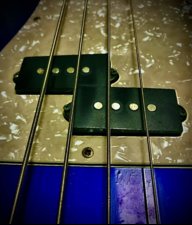
Pickup HEIGHT....this is everything especially with certain pickups with strong magnets and the only way to know for sure is play around with the height a bit at a time as well as the action on the neck.....Rounds can drive me nuts on some basses unless all is BALANCED in height and action...then you go to EQ to suit your playing style and the bass imo, no?

My cheapo MIM P bass with stock ceramic pickup and rounds is an example and the setup/pickup height are super sensitive on this bass....i imagine the ceramic magnet is strong compared to some old alnico magnets (or degaussed ones)...it mellows out considerably with the pickup lower but gets barky as all get out moved a bit higher...which is very nice actually!!