
Hey DJ, what about only replacing the Guild, maybe - and/or switch the J to a stacker? Strat-style switching? ….interesting idea.I looked up those pickups. I can't afford one, let alone 3
I think 3 volume knobs would be impractical. How many different tones do you really need? With a 3 way switch you'll have 5 tones plus the tone control.

Enjoy the benefits of a premium membership!
Upgrade Account
-
TalkBass has been independent since 1998. Add your voice.
Create a free account to reply to discussions, view embedded media, and browse with fewer display ads.
Join free Log in
Want zero display ads or expanded classifieds tools? Compare plans.
You are using an out of date browser. It may not display this or other websites correctly.
You should upgrade or use an alternative browser.
You should upgrade or use an alternative browser.
Question about wiring a bass with 3 bisonics
- Thread starter LowWay
- Start date
More options
Who Replied?
Who's DJ? Guild?Hey DJ, what about only replacing the Guild, maybe - and/or switch the J to a stacker? Strat-style switching? ….interesting idea.
Post #14 et al. We kinda derailed things, didn’t we? Oh well, as you wereWho's DJ? Guild?


- Apr 18, 2008
- 16,013
- 1
- 31,724
- Disclosures
- I'm highly opinionated and extremely self-assured
Quoting myself, and posting something that I’ve posted many times: my preferred three-pickup wiring using the Freeway Switch (toggle version):1000% agree. Three volumes is a lot of load, and isn’t particularly useful either. Switch, master volume, master tone is the way to go.
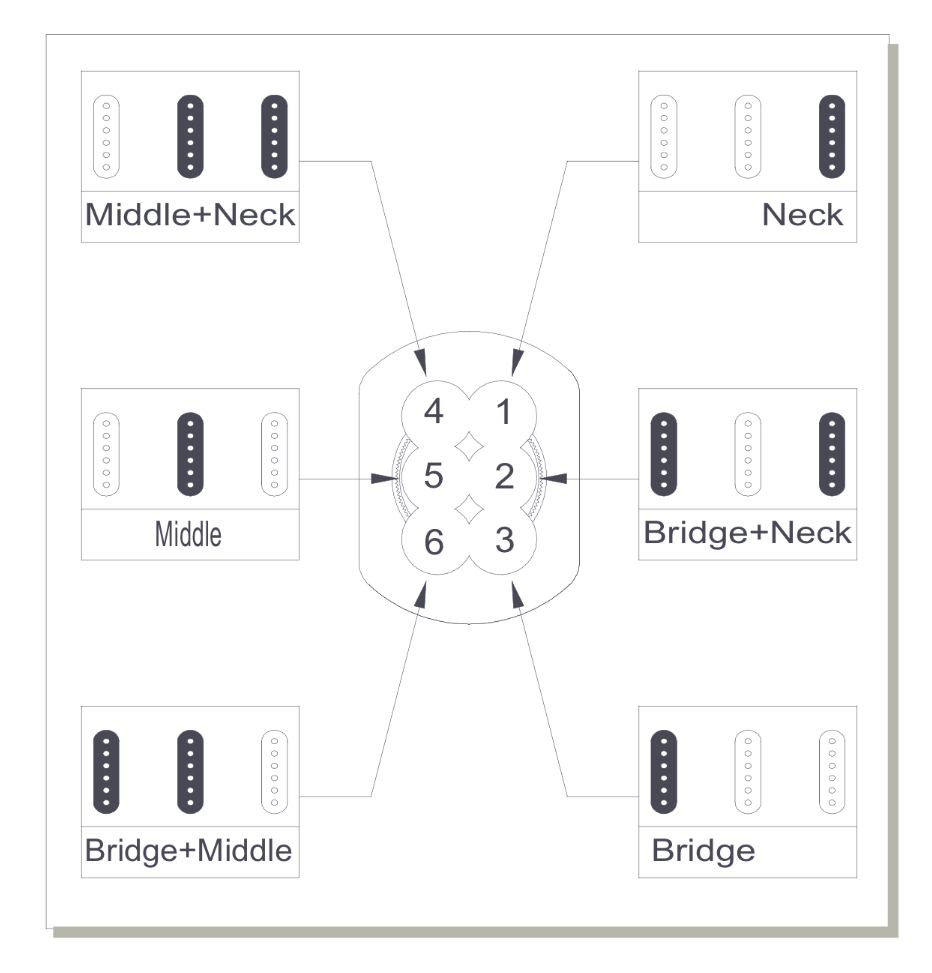
Six distinct tones, instantly accessible and repeatable, no faffing about with individual volume controls. It does everything I need.


I was thinking about this as a solution, but sometimes I don't want both pickups at 100%. Sometimes I like more bridge than neck, sometimes the other way around.Quoting myself, and posting something that I’ve posted many times: my preferred three-pickup wiring using the Freeway Switch (toggle version):
Six distinct tones, instantly accessible and repeatable, no faffing about with individual volume controls. It does everything I need.
- Apr 18, 2008
- 16,013
- 1
- 31,724
- Disclosures
- I'm highly opinionated and extremely self-assured
I get that. On a two-pickup bass I agree. On a three-pickup bass - nope. Six preset tones is plenty for me.I was thinking about this as a solution, but sometimes I don't want both pickups at 100%. Sometimes I like more bridge than neck, sometimes the other way around.
That's what active basses are for. To me, that looks like unnecessary fiddling and a nightmare on stage (I play a passive P bass and am constantly worried that my volume knob is not at 100%) as there are simpler ways to alter your tone (moving your plucking hand, EQ pedals, preamps, etc.), but if you really must have the ability to blend the 3 pickups with various volume knob combinations, 3 volume knobs are necessary, so you need active circuitry to keep a healthy signal.I was thinking about this as a solution, but sometimes I don't want both pickups at 100%. Sometimes I like more bridge than neck, sometimes the other way around.
If you could swing just two pickups, a blend knob would be the most efficient way to favor one pickup on the fly, and it would be easy to use on stage too.

I agree that such a setup could get fiddly, but when he combines pickup switches and volumes for each pickup then no need for active circuitry since the volume controls for unused pickups can be placed before the switches and so bypassed. In reality three volumes would be the same amount of load you would get in a typical dual pickup bass with a Blend and Volume control since a blend is two pot elements that are in the circuit all the time. I highly doubt he would use all 3 pickups on at any point so it would be even less load than a typical blend/volume when choosing just two pickups. I personally also find Blend controls more fiddly in passive instruments because the range of usable settings is in a very tiny little sweep of a single pot instead of spread over a wider range of two pots. YMMVThat's what active basses are for. To me, that looks like unnecessary fiddling and a nightmare on stage (I play a passive P bass and am constantly worried that my volume knob is not at 100%) as there are simpler ways to alter your tone (moving your plucking hand, EQ pedals, preamps, etc.), but if you really must have the ability to blend the 3 pickups with various volume knob combinations, 3 volume knobs are necessary, so you need active circuitry to keep a healthy signal.
If you could swing just two pickups, a blend knob would be the most efficient way to favor one pickup on the fly, and it would be easy to use on stage too.
- Apr 18, 2008
- 16,013
- 1
- 31,724
- Disclosures
- I'm highly opinionated and extremely self-assured
I agree they can work better (depending on the value used), but personally I still much prefer individual volumes to any implementation of a blend control in a passive instrument. I’ll never use a master volume in a passive bass either FWIW (I do use them in guitars though)Passive blend pots work waaaaay better when ungrounded.
Alright. I agree with the advice earlier in the thread and wish the bridge pickup was RWRP, but it's not, the middle one. As such I am going to wire it up with a 10 position freeway switch with this plan:

THis should let me get plenty of experimentation with these pickups.
Thanks for all the advice. I'll take any warnings about my plan if anyone has any.
THis should let me get plenty of experimentation with these pickups.
Thanks for all the advice. I'll take any warnings about my plan if anyone has any.

Hey not really a direct answer to your question, but here's how I approached a similar project.
This is my 1976 Hagstrom Swede, in which I recently installed three OG late-60s Hagstrom Bisonics.
I did my best to be creative in thwarting at least some of the dread passive loading issue, while still maintaining some flexibility beyond just on/off switching.
I used two separate 3-way selector switches. The one on the upper bout is to select between neck and middle. That signal then runs to a 1meg volume potentiometer on the lower bout, into the second 3-way selector switch to mix with the bridge pickup. In between this second switch and the bridge pickup, is another 1meg volume and a passive high-pass filter mini-toggle (simple circuit that can run the bridge pickup signal through a series of capacitors clocking in at ~0.005uF.
The 1meg pots may not have quite as smooth of a gradient sweep, a bit more sensitive, but they still do the trick and hardly impact the signal. The passive HPF mini-toggle is great because by removing the lower frequencies from the bridge pickup signal, you get less frequency cancellation (less scoop) but you still get the nice top end added in from the bridge pickup.
In this demo I don't touch the potentiometers at all, everything is wide open, and I just go through all the different switching combinations.
Hopefully this is helpful!
This is my 1976 Hagstrom Swede, in which I recently installed three OG late-60s Hagstrom Bisonics.
I did my best to be creative in thwarting at least some of the dread passive loading issue, while still maintaining some flexibility beyond just on/off switching.
I used two separate 3-way selector switches. The one on the upper bout is to select between neck and middle. That signal then runs to a 1meg volume potentiometer on the lower bout, into the second 3-way selector switch to mix with the bridge pickup. In between this second switch and the bridge pickup, is another 1meg volume and a passive high-pass filter mini-toggle (simple circuit that can run the bridge pickup signal through a series of capacitors clocking in at ~0.005uF.
The 1meg pots may not have quite as smooth of a gradient sweep, a bit more sensitive, but they still do the trick and hardly impact the signal. The passive HPF mini-toggle is great because by removing the lower frequencies from the bridge pickup signal, you get less frequency cancellation (less scoop) but you still get the nice top end added in from the bridge pickup.
In this demo I don't touch the potentiometers at all, everything is wide open, and I just go through all the different switching combinations.
Hopefully this is helpful!

Well, the 10 way freeway switch won’t fit, so I’m going with the 6-way.
After seeing the video from @mellowgerman I may do just switch, one volume, one tone. The dagstars are based on the Hagstroms.
So what do I need for pots and caps to make this work?
After seeing the video from @mellowgerman I may do just switch, one volume, one tone. The dagstars are based on the Hagstroms.
So what do I need for pots and caps to make this work?
Well, the 10 way freeway switch won’t fit, so I’m going with the 6-way.
After seeing the video from @mellowgerman I may do just switch, one volume, one tone. The dagstars are based on the Hagstroms.
So what do I need for pots and caps to make this work?
If you're only using two pots I would think a normal CTS 500k pair and your favorite tone cap would do just fine. If it were me, I'd go with a 0.1uF cap because I love how they play with bisonic pickups. Since the signal coming from these pickups is so clear and broad, a big dark cap like that can give you some wonderful deep tones while still maintaining a pretty remarkable degree of punch and definition. Very unique capability of these pickups that I think many overlook. That said, I do mostly play with them on brighter settings, it's just nice to go deep every now and then!
I forgot to mention, I chose the 1meg pots for the hagstrom since they are separate volumes intended for blending the signals between the switching options, but before the normal master volume and master tone knobs. The extra knob is a 4way rotary switch that lets me pick between 4 very different tone cap values. In any case, the master vol and tone are both 500k. The 1megs are nice out front because they don't load the signal much at all before feeding to the masters
Last edited:


