• TalkBass has been independent since 1998. Add your voice.
    Create a free account to reply to discussions, view embedded media, and browse with fewer display ads.
    Join freeLog in
    Want zero display ads or expanded classifieds tools? Compare plans.

Question for our experts - why aren't more amps designed for 2 ohm loads?

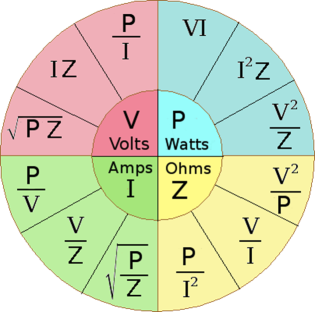
"This formula wheel shows common Ohm's Law and Watt's Law equations.
upload_2024-2-8_15-49-28-png.5345345

Let's calculate the voltage for 400W at 8 ohms, 800W at 4 ohms, 600W at 4 ohms, and 800W at 2 ohms using V =sq rt(PZ)

400W at 8 ohms
V = sq rt(400*8) = 56.57V800W at 4 ohms
V = sq rt(800*4) = 56.57V600W at 4 ohms
V = sq rt(600*4) = 48.99V800W at 2 ohms
V = sq rt(800*2) = 40V
Now let's calculate the current using I = sq rt(P/Z)

400W at 8 ohms
I = sq rt(400/8) = 7.07A 800W at 4 ohms
I = sq rt(800/4) = 14.14A600W at 4 ohms
I = sq rt(600/4) = 12.25A800W at 2 ohms
I = sq rt(800/2) = 20A
It may also be informative to consider (P = VI) so you can see the voltage and current side by side. In the following, we input the values of V and I that were calculated above.

400W at 8 ohms
P = 56.57*7.07 = ~400W800W at 4 ohms
P = 56.57*14.14 = ~800W600W at 4 ohms
P = 48.99*12.25 = ~600W800W at 2 ohms
P = 40*20 = 800W
FYI, I use ~ to mean an approximate value resulting from rounding errors.

Yah, what he said, ya got it now? Test next week.
 
  • Like
Reactions: bertthebassist
While this is all impressive - you really need to give a business answer to the question. It will involve more math unfortunately and more data points.

LOL! Typical condescending management response whenever corporate types are presented with technical information they either don’t understand or can’t be bothered trying to understand.
 
LOL! Typical condescending management response whenever corporate types are presented with technical information they either don’t understand or can’t be bothered trying to understand.
Well, the goal of managers is to increase sales and make profits, you can't blame them for that. If engineers give them technical explanations they don't understand, the end consumers won't understand the final benefit either.
 
  • Like
Reactions: ReidK and Bassdirty
Sone of the older Peavey amps were 2ohm, like 400 Series amps from the late seventies.

You beat me to it.
I never thought of Peaveys as being more complicated, therefore more costly. Back then Peaveys were looked down upon as uncool because they were cheaper. But before class D they,'ve always been thought of as robust and reliable.
Standard joke: after the Apocalypse all that will remain are roaches and Peavey amps. And maybe SM58s.
 
Perhaps some things for whatever reason just become standard, or a convention. For instance, P bass with tort and flats. Okay just a P bass.:bag: FSOs, made by many manufacturers. The aforementioned SM58 or 57. With all their discussed faults, 4x10s. Sansamp DIs. Plugging into the DI. "Carrots" and "fire the drummer" :bag:. Eigth notes in rock and roll. Pepto-Bismol, Kleenex, (everyone calls tissue that, but it's a brand name) Duracell. You get the idea. They become a known quantity, for better or worse, and manufacturers just follow that. No sense to re-invent the wheel if the one we're making is selling. Just a stray thought.
 
Last edited:
I have a Darkglass Microtubes 900 V-2 that doesn't like a 2ohm load It has a 4ohm/2ohm switch. I only tried it with the 2ohm load a couple times, because it smelled like it was about to go up in a cloud of smoke! It never seems to overheat at all with a 4ohm load. Has anyone else experienced this with these amps? It's a great little class D amp with a lot of features that I don't really use (2 distortion engines) and mostly these days I bring it along as a backup for my small venue fave (Ampeg PB-250) or my large venue and outdoor fave (PJB M-500).
 
My perception is it relates to both production cost and product optimization.

In general, solid state amps try to hold the voltage constant regardless of the impedance of the load. As the impedance is reduced, current and power increase. Current results in heat, so too much current means the output section of the amp will be damaged. So if a constant voltage amp is optimized for 2 ohms it will make less power at 4 ohms and 8 ohms.

Some solid state amp have an impedance switch. The associated circuitry adds to cost and complexity. These switches can do different things. For example the switch my reduce the operating voltage of the power supply or it may limit how much voltage the output section can develop. The end result is the amp is limited in a way that keeps it in a safe operating range..

Normally when an amp can hold the voltage constant, the power doubles when the impedance is cut in half.

The Mesa 800W Subways are rated 400W at 8 ohms, 800W at 4 ohms, and 800W at 2 ohms. So these amps hold the voltage constant when the impedance drops from 8 ohms to 4 ohms. But they do not hold the voltage constant at 2 ohms.

The 800W Subway amps have an impedance switch.
View attachment 5345343
If the load is under 4 ohms, the switch must be set to 2 ohms for safe operation. If the amp is operated into 2 ohms with the switch set to 4/8 ohms, the amp will either go into protect mode or incur damage.

You can also trick these amps into limiting themself to about 600W into 4 ohms by setting the switch to 2 ohms. This could be useful if your speaker can not handle the full power of the amp.

If you want to see some of the math read on...if not stop here:

This formula wheel shows common Ohm's Law and Watt's Law equations.
View attachment 5345345
Let's calculate the voltage for 400W at 8 ohms, 800W at 4 ohms, 600W at 4 ohms, and 800W at 2 ohms using V =sq rt(PZ)

400W at 8 ohms
V = sq rt(400*8) = 56.57V​
800W at 4 ohms
V = sq rt(800*4) = 56.57V​
600W at 4 ohms
V = sq rt(600*4) = 48.99V​
800W at 2 ohms
V = sq rt(800*2) = 40V
Now let's calculate the current using I = sq rt(P/Z)

400W at 8 ohms
I = sq rt(400/8) = 7.07A​
800W at 4 ohms
I = sq rt(800/4) = 14.14A​
600W at 4 ohms
I = sq rt(600/4) = 12.25A​
800W at 2 ohms
I = sq rt(800/2) = 20A​

It may also be informative to consider (P = VI) so you can see the voltage and current side by side. In the following, we input the values of V and I that were calculated above.

400W at 8 ohms
P = 56.57*7.07 = ~400W​
800W at 4 ohms
P = 56.57*14.14 = ~800W​
600W at 4 ohms
P = 48.99*12.25 = ~600W​
800W at 2 ohms
P = 40*20 = 800W​

FYI, I use ~ to mean an approximate value resulting from rounding errors.

I use my WD-800 at 2ohm powering my 8 ohm Eden D210-XST rated for 500 watts. The result is 300 watts of power and the combination is a very tight clean non harsh sounding cab. I can’t discern the missing dBs going from 400 watts to 300 watts.
 
Thx all for responding to my OP, good discussion and useful information. Deepens my appreciation for Mesa's efforts to give players the tools they need, even if more difficult to design/engineer.

Notice that no one asked the usual question - "What's the best impedance for metal?" Oops, guess that I just did........ And someone managed to slip in a reference to tort, so I guess this thread has run its course.
 
Well, the goal of managers is to increase sales and make profits, you can't blame them for that. If engineers give them technical explanations they don't understand, the end consumers won't understand the final benefit either.

Having straddled the managerial and technical worlds for most of my career I can assure you management has a much more diversified role to play in the success of a business beyond simply increasing sales and profits. Many companies, notably those that prioritize sales volume and profit over everything, celebrate their most successful year in sales and profits by going out of business within five years.

I also disagree that customers won’t understand something if the company’s management doesn’t.Managers usually like to think they’re the smartest people in the room. Customers, being consumers of the products or service, often have a far better understanding of the technology being peddled than company management teams do. And managerial egos often result in the companies they work for becoming willfully blind to the uncomfortable truth that it’s easier for an engineer to learn how to sell something and make money than it is for a businessman to learn technology and engineering. Because engineers and techs already know how to analyze things and “do the math.” ;)
 
Well, the goal of managers is to increase sales and make profits, you can't blame them for that. If engineers give them technical explanations they don't understand, the end consumers won't understand the final benefit either.
Management and the customer certainly benefit from the technical information that engineers develop and bring to the table. Good management teams know this and embrace it.
 
The less ohms the speakers are the higher amps are needed for the same power, this is what will produce higher losses in the speaker cables.

If you are running 2 ohm cabs your speaker cables should be approximately twice as heavy as for a 4 ohm cab.
I hope everyone who uses 2 ohm cabs have really thick speaker cables or they might overheat and melt, then the amp might go up in smoke as well.

Welders use low volts and high amps, that's why they need heavy cables.
Power lines are always high voltage so they can transmit massive amounts of power over thin cables.
 
My perception is it relates to both production cost and product optimization.
I suspect that there's a simpler reason: Amps are more powerful and speakers are more efficient now.

An Ampeg 810E* has a published sensitivity of 100dB/W/m at 4 Ohm.
The Mesa Boogie Subway 212 has a published sensitivity of 100.2dB/W/m at 4 Ohm.

Both have max RMS power handling of 800 watts, so both top out at around 132dB. The fridge weighs 137 lbs. The 212 weighs 53 lbs, and is roughly half the height and width of the fridge.

Purely in terms of being heard, it's not as necessary now as it once was to stack arrays of speakers or haul immense cabinets. Though if the need arises, there's also a much broader range of compact, efficient 8 Ohm cabs available now than there have ever been. There's arguably no point in trying to eke every last watt of a modern amp.

*(A modern product but it's based on Ampeg's 1970s-era speakers, and specs were easy to find.)
 
Last edited:
  • Like
Reactions: WRM and Wasnex
Even back in the day when amps and speakers were not as loud and I used stacks... I never had a use for 2 ohm. I have not seen or heard of anyone needing 2 ohm myself so I imagine it's so rare it's not offered anymore.
 
The less ohms the speakers are the higher amps are needed for the same power, this is what will produce higher losses in the speaker cables.

If you are running 2 ohm cabs your speaker cables should be approximately twice as heavy as for a 4 ohm cab.
I hope everyone who uses 2 ohm cabs have really thick speaker cables or they might overheat and melt, then the amp might go up in smoke as well.

Welders use low volts and high amps, that's why they need heavy cables.
Power lines are always high voltage so they can transmit massive amounts of power over thin cables.

in reality, claims of the need for “thick” speaker cables for 2 ohm operation are grossly exaggerated and misleading.

The length of the cable is an essential part of determining the losses in the cable. For a 6’ cable, even 14 gauge cable is plenty heavy for 2 ohm operation, and I have the math to show why.
 
Until I purchased a TT-800, the last time I owned a 2 ohm capable amp was an Acoustic 320 in the early 80's. The 320 was designed to mate with a 408 4x15 2 ohm cabinet.

The 408 didn't work out for me and the 320 gave up a lot of power at higher impedances, so I didn't keep them that long.

In a questionable marketing decision, Acoustic made both a 320 and B320 head and they were nothing alike. :roflmao:
 
Probably 1/3 or more of our Subway players require 2 ohm operation at least some of the time.

Not at all surprising. I suspect that the ability to operate at 2 ohms is one of the selling points for the Subway amps and thus tends to attract people who will actually use it in that application.
 
Just bought a 2ohm capable amp. I will not require 2ohms on a whole lot of gigs but I have the cabs and basically could only get to 750w of rated handling by 5.7ohms. ..that means my amp at 800w/4 is not going to be enough outside.
 
Probably 1/3 or more of our Subway players require 2 ohm operation at least some of the time.
I've been using two, 4 ohm cabs for many years now, thank God for the Shuttlemax 12.2. I used to get into arguments here about the wisdom of having them and how impractical they are.
 
Last edited:
I have a Darkglass Microtubes 900 V-2 that doesn't like a 2ohm load It has a 4ohm/2ohm switch. I only tried it with the 2ohm load a couple times, because it smelled like it was about to go up in a cloud of smoke! It never seems to overheat at all with a 4ohm load. Has anyone else experienced this with these amps? It's a great little class D amp with a lot of features that I don't really use (2 distortion engines) and mostly these days I bring it along as a backup for my small venue fave (Ampeg PB-250) or my large venue and outdoor fave (PJB M-500).


AFAIK the V1 were rated for 2 ohms but had problems with some cabs. I thought the V2 were rated for 2.67 ohms.
 
  • Like
Reactions: agedhorse