

Enjoy the benefits of a premium membership!
Upgrade Account
-
TalkBass has been independent since 1998. Add your voice.
Create a free account to reply to discussions, view embedded media, and browse with fewer display ads.
Join free Log in
Want zero display ads or expanded classifieds tools? Compare plans.
You are using an out of date browser. It may not display this or other websites correctly.
You should upgrade or use an alternative browser.
You should upgrade or use an alternative browser.
Questions on writing Arpeggios
- Thread starter Jasper199
- Start date
More options
Who Replied?

As an Amazon Associate, TalkBass may receive commissions from qualifying purchases made via links on this site.

Im one of those guys that likes to write stuff down because it helps me learn and remember quicker. I'm at the the point where I've got my scales written but now I'm on to Arpeggios, I'm have a problem with the notes.
Let's use a B minor7 for example
B C# D E F# G A (r) B
Now as far as I can see the notes to be used for a B minor7 Arpeggio are
1b 3 5b 7
B D F# A
Now the V should be flat or do I just play it sharp? I've found this in a lot of Arpeggios. So do I change to flats or keep them sharp.
Or am I totally wrong in what I'm doing
Thanks
Jasper199
Hello,
Lot of good and clear answers given.
I’d add one thing :
Le goal of arpeggios is not of of the scholar / university type, it’s of the animal / spontaneous one, it’s the kind of thing you must be able to play without thinking... at the fingers level.
Understanding is good, it’s even good well beyond the practice, it’s always good to understand what we do (we are not machines are we ?)
But in the arpeggio case, considering the bass is as a very simple and regular interface, the best tool to check is… the neck
Grab your instrument, grab a text like Jeff Berlin excellent (but not always easy to find) “A Comprehensive Chord Tone System For Mastering The Bass” (or Jerry Coker and al “Patterns for Jazz ins bass clef”).
You have a doubt about a Bm arpeggio ? The theory has an answer, a lot of books have an answer… but you neck has a easier one.
Luc

The real clues are in the key signatures...
Key signature for Bm has 2#, same as relative major, in this case D. So in Bm, all F and C are # by default.
@Mushroo is correct in that intervals are always reckoned by the number of letter names inclosed in the interval - a perfect 5th from B will always be notated as F#, never the enharmonic equivalent Gb. A chromatic b5 will have a natural accidental, a chromatic raised 4th might be seen notated E#(!), even though they sound the same. Remember accidentals are automatically cancelled at the end of the measure unless tied across bar lines.
Key signature for Bm has 2#, same as relative major, in this case D. So in Bm, all F and C are # by default.
@Mushroo is correct in that intervals are always reckoned by the number of letter names inclosed in the interval - a perfect 5th from B will always be notated as F#, never the enharmonic equivalent Gb. A chromatic b5 will have a natural accidental, a chromatic raised 4th might be seen notated E#(!), even though they sound the same. Remember accidentals are automatically cancelled at the end of the measure unless tied across bar lines.
Im one of those guys that likes to write stuff down because it helps me learn and remember quicker. I'm at the the point where I've got my scales written but now I'm on to Arpeggios, I'm have a problem with the notes.
Let's use a B minor7 for example
B C# D E F# G A (r) B
Now as far as I can see the notes to be used for a B minor7 Arpeggio are
1b 3 5b 7
B D F# A
Now the V should be flat or do I just play it sharp? I've found this in a lot of Arpeggios. So do I change to flats or keep them sharp.
Or am I totally wrong in what I'm doing
Thanks
Jasper199
You simply play what the formula dictates.
A minor 7 chord is made of the root, a flat third, perfect fifth, and a flat seven. That's the bare bones structure of a minor 7 chord.
The pattern is moveable and fixed, like a stencil. You can plug in any note you want to be the root.
Wow. This is really a great tool for me. Although I've been a lifelong wind instrument player, it's only been about two years since I took up the bass and had to really seriously pay attention to chords. Thank you for sharing this excellent resource!Check this web-site:
Musical Chords and Scales

I found when starting out on bass that remembering patterns worked best for me when it comes to scales and arpeggios. As long as you know the notes on the fret board so as to be able to hit the root note of a chord then there is no need to know every note for every chord. As time goes on you'll know where the major 3rd, minor 3rd, five, maj7, dom7 (b7) etc are in relation to the root.
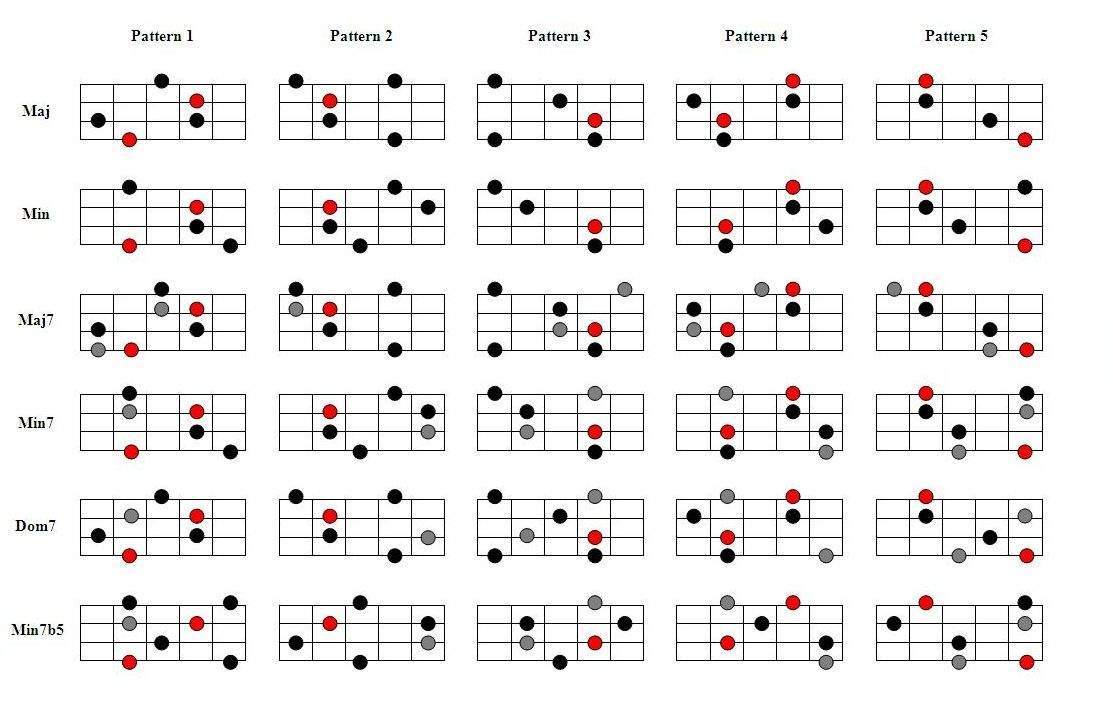
Thanks BAG, I do my best learning not only from hands on but also writing out what I need to know. I'll rewrite these patterns a few times.
I initially started on pattern one for root notes on the E string and pattern 4 for root notes on the A string. Once you know those you've got basically every chord possible at your fingertips. Pattern 2, 3 and 5 allows you to minimise position shifting and also using some of them as inversions once you're comfortable with the others.
Ok, this is what I have for m7b5 A-Z
A C Eb G
B D F A
C Eb Gb Bb
D F Ab C
E G Bb D
F Ab B Eb
G Bb Db F
How's it look?
Once again, let's visit that web-site from my posting - Musical Chords and Scales
and check all the available chords for your m7b5.
Looks good.Ok, this is what I have for m7b5 A-Z
A C Eb G
B D F A
C Eb Gb Bb
D F Ab C
E G Bb D
F Ab B Eb
G Bb Db F
How's it look?
Another way of understanding m7b5 chords is thinking of the arpeggio built on the 7th note in the major scale. For example, A is the 7th note in the Bb major scale, which has two flats, Bb and Eb. Your Am7b5 of A C Eb G fits right in. In root position on a staff, this fills up all the spaces in bass clef.
Once again, let's visit that web-site from my posting - Musical Chords and Scales
and check all the available chords for your m7b5.
View attachment 998335
Sorry, but this list is fundamentally flawed. Cm7b5 is C, Eb, Gb, Bb (D# in Cm would be an augmented 2nd, never a m3).
Likewise for Fm7b5, the 3rd is Ab, not G#, and the b5 is Cb not B as shown
For Gm7b5 the 3rd is Bb and the b5 is Db not C#.
I know this might seem pedantic to some but there it is...
Sorry, but this list is fundamentally flawed. Cm7b5 is C, Eb, Gb, Bb (D# in Cm would be an augmented 2nd, never a m3).
Likewise for Fm7b5, the 3rd is Ab, not G#, and the b5 is Cb not B as shown
For Gm7b5 the 3rd is Bb and the b5 is Db not C#.
I know this might seem pedantic to some but there it is...
Yes, you are correct.
I've decided to dig deeper into that web-site, and here is what I found out.
In the drop-down button menu, "Show notes / scales with root:", I've entered C (root), and in the Accidental drop-down button menu, I've entered, "Only show flat versions".
I think I got it correct this time.
Last edited:
But I've been known to be be wrong on several occasions according to my wife, lol
Yes.
Whousedtoplay, shouldn't Cmaj7+5 be C E G# B?
Yes. The problem was that I choose the "Show Only Flat Versions" button.
Here is what we get with "Show Flat and Sharp Versions".
In short about that excellent web-site.
The PITCHES are correct but finding the CORRECT notation requires some Music Theory knowledge.
So my arpeggios are correct?
A C Eb G
B D F A
C Eb Gb Bb
D F Ab C
E G Bb D
F Ab Cb Eb
G Bb Db F
Let's check with the web-site ("Show only Flat Versions"!)
I think you've passed the test.


