• TalkBass has been independent since 1998. Add your voice.
    Create a free account to reply to discussions, view embedded media, and browse with fewer display ads.
    Join freeLog in
    Want zero display ads or expanded classifieds tools? Compare plans.

Quilter Labs InterBass!

My Quilter BB800 with the Master set at 40w is LOUD. What are you all using for cabinets?

I've done blues jams with electric guitar and drums, using my 50w Quilter 101 Mini.

I betcha the 45w Interblock would cover the vast majority of coffeehouse gigs. Anything up to "guitar stacks and a rock drummer." (With the right cabinet, of course.)
 
This unit is $250.

It's a truly great preamp. The (loud) 45w amp section might just get you out of a scrape. I've done many "2 guitar and medium heavy hitting drummer" gigs where I've not set the BB800 louder than this goes.
The 24v power supply fits easily under my pedalboard alongside my TrueTone CS6 and the headroom from this probably goes a long way towards why it sounds so good.
For people saying what's the point of it, well, what's the point of a Noble or a Shiftline Olympic or a Lebass etc? Why did they have to put a pedal power supply in the Noble? If you definitely need an XLR out then spend 4 times as much on the Noble, or buy a DI box.
Maybe tomorrow I'll find the time to do a recording...
 
  • Like
Reactions: pcake
I totally get that not everything works for every player ... no problems.
but I'm having a hard time understanding how a 45w amp works for very many players at all.
IEM guys don't need any power, just a pre they like the sound of ... so the power amp on this box is overkill for them.
For players with good FOH support that need monitoring only ... 45w again seems kinda lightweight for stage monitoring.
The power amp in this unit likely drives the need for the largish 24v power supply ... which makes it less appealing as a pedal board device I would think.

As I said, I'm sure the preamp functions of this box sound just fine, but there are tons of preamps out there already so, again, I'm not quite getting what problem this box solves.

not trying to diss anything here either ... just trying to figure it out. If it works for you then great :thumbsup:
You must be very busy figuring out why 90% of new bass amp and pedal products are being released.
 
  • Like
Reactions: donahue
I'm not sure what it is about Pat's designs that inspire so many to question their uniqueness and at the same time say they offer nothing new to the crowded market.
I'd have been happy if this unit had no features at all, just 1/4" in and 1/4" out as long as what came out had that tone.
Perhaps that would have been easier to market actually.
 
I'm not sure what it is about Pat's designs that inspire so many to question their uniqueness and at the same time say they offer nothing new to the crowded market.
I'd have been happy if this unit had no features at all, just 1/4" in and 1/4" out as long as what came out had that tone.
Perhaps that would have been easier to market actually.
well, for my part, I guess the thing I don't understand the most is the 45w power amp. Another way to look at it is that if someone came on TB and asked if they could reasonably gig with any other 45w amp, there would be a significant number of people who would say no because, well, that's really not very much power for a gigging bass player. OTOH, there will certainly be a contingent of folks who are doing small/quiet gigs with Fender Rumble 40's, Ampeg PF20s and 50's etc. who would say otherwise .... but again, 45watts is a somewhat limiting factor for someone who gigs regularly in medium or large venues. Also, with 800-1200w full featured Class D powered amps on the market that weigh less than 8lbs, the even smaller format of the Interbass, while interesting, somehow does not seem super useful either given what else is available in other small/powerful amps.

On a related note, I have a guitarist friend who does a ton of gear reviews, who's go-to rig is a Fender Deluxe (so definitely a big tube fan). He tried out the Quilter guitar amp and was very impressed with all of its capabilities. For me that suggests that the Quilter stuff does sound good.

So look, FWIW, I am not dissing this new Quilter box and I don't doubt that Pat Quilter offers innovative stuff, the Interbass box just does not seem like it would be all that useful to many players given whats already in the market and what the Interbass features are.

If it works for you, that's great.

peace
 
It would just as redundant if it had 200w and dual speakons. I don't need one of those either. But it's really not hard to see how some people make use of them, specially when they review it on this very thread. I could make use of one I just don't need one. It's not rocket science.
 
  • Like
Reactions: kasbrey
well, for my part, I guess the thing I don't understand the most is the 45w power amp. Another way to look at it is that if someone came on TB and asked if they could reasonably gig with any other 45w amp, there would be a significant number of people who would say no because, well, that's really not very much power for a gigging bass player. OTOH, there will certainly be a contingent of folks who are doing small/quiet gigs with Fender Rumble 40's, Ampeg PF20s and 50's etc. who would say otherwise .... but again, 45watts is a somewhat limiting factor for someone who gigs regularly in medium or large venues. Also, with 800-1200w full featured Class D powered amps on the market that weigh less than 8lbs, the even smaller format of the Interbass, while interesting, somehow does not seem super useful either given what else is available in other small/powerful amps.

On a related note, I have a guitarist friend who does a ton of gear reviews, who's go-to rig is a Fender Deluxe (so definitely a big tube fan). He tried out the Quilter guitar amp and was very impressed with all of its capabilities. For me that suggests that the Quilter stuff does sound good.

So look, FWIW, I am not dissing this new Quilter box and I don't doubt that Pat Quilter offers innovative stuff, the Interbass box just does not seem like it would be all that useful to many players given whats already in the market and what the Interbass features are.

If it works for you, that's great.

peace
Well, the guitarist from my last band had an Electro Harmonix 44 Magnum which he kept in his pedal bag and had to use as a backup on a couple of occasions when his Mesa amp was having trouble. He later moved over to Quilter stuff (sounded great) and had a Micro Block 45 as a backup.
I have a BB800, which is quite transparent, so the Interbass appealed to me as a "character" preamp that would get me somewhere closer to the sound of my Markbass TTE801 which has 4 preamp tubes. The fact that the Interbass is also a capable backup amp (believe it or not) made sense given my guitarists experience. Great practice amp too.
As I mentioned before, the Interbass can go louder than my BB800 was set at during my last gig which was a fairly loud blues pub gig. I have no intention though of relying on it as my main gigging amp unless there is a failure with my BB800.
I fully understand that it might have redundant features for some but given how many preamps are described as being a swiss army knife when they don't even have a 45w amp built in!
 
well, for my part, I guess the thing I don't understand the most is the 45w power amp

I’ll refer to my early post.
This product was designed as a guitar amplifier. Not a bass solution.

As far as I can tell, Quilter changed the color, changed the EQ points to suit bass, and BOOM... they had a bass product they could sell.

When you think of it as a guitar amp, it’s just about perfect for gigging... 4 ohm speaker cab, pedal board, and guitar. That’s a slick 45w rig.

The 45w power amp was an already developed product by Quilter. So you put “bass” on it, and sell some units.

I did a gig, every single Wednesday for about two and a half years, and I used a combo that was an 8” speaker and a 60w amp (making 30w at 8 ohms). It was perfect.

I could see the Quilter working for that with a little 110 or 112 cab. Or a little home set up or something.

I don’t really have much use for it, but if some guys do, then cool for them. Lots of stuff on the market for just about every player out there.
 
  • Like
Reactions: Mushroo and pfschim
Seems like many here are bemoaning the particular feature set choices made By Quilter but haven't heard the actual box and the only reviewer who owns it - has heard it - loves it . If it's as good as he says - it'll find a home in the market despite the " potential drawbacks " - " missing features " and " different choices " made by Quilter . As the blind man said " we'll see " - Kelly
 
  • Like
Reactions: osv and Mushroo
Something about this little amp spoke to me, so I took a chance and picked one up. i was amazed at how loud it was. I realized that I never turn any of my big amps up anywhere near what they can really do, and this thing dimed can get as loud as or louder than they do at the lower settings which give me all the volume I've ever needed for band rehearsal or gigging. I play in a 80s alternative/New Wave cover band that plays mainly small to medium-sized bars and parties, and I figured I could probably gig with it.

So last week I took it to our gig, a private party at an art gallery space. Not a huge room, but a fair amount of volume to fill. Just to be safe, I put a "real" amp in the trunk, but I brought the Quilter in to set up. I ran it through my usual Bag End Q10X, which is an 8-ohm cab (so, 33 watts?), but a very efficient one (103dB). The Interbass got the job done with a little power to spare. We did not need to run the bass through the mains, and I could hear everything very clearly on stage all night. And, it sounded great. I was amazed.

I'm now on a quest for a lightweight and efficient 4-ohm cabinet to pair with it. (That Bag End is a great cabinet, but heavy.) I think with the right cab I could play just about anyplace I'm ever going to play with this thing. We have another private event this weekend in a bigger venue, so it will get more of a test. But I'm optimistic.

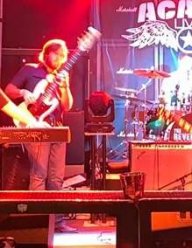
Gig pic from last weekend---Quilter amp not visible because it's so tiny.
 
Perhaps they included a modest power section for home practice or small gigs, and expect people to DI into a larger power amp for bigger needs.
Decades ago I used to play in pit orchestras for musicals and space was at a premium. This and little 10" monitor size cab (think Eden EX-110, Markbass, Genz Benz, whatever) could work nicely with your signal going to the main board for the house. Smaller and lighter is especially useful for folks using public transportation in downtown city venues (where many play musicals). Just a thought for those of you who might not use buses and trains to get to gigs and/or play in these small spaces in live theaters.
 
OMG, I brought it to my jazz trio gig last night. Effortless volume. Didn't have to push it. Bandmates commented on the really great tone. You know when you try a new bass and it brings out new musical ideas from you? I didn't think an amp would do that, but this one did. I just set everything flat, and boom! Genius little thing. The fact that it weighs less than a pound and has no fan is icing on the cake.
 
+1 on 45W power for small/mid/FOH gigs. The Quilter MicroBass 45 (same basic power section of Interbass) holds up very well/ if not excels in these conditions. ive been considering 'side-grading' over to the Interbass for the additional EQ stage.
 
I’ll refer to my early post.
This product was designed as a guitar amplifier. Not a bass solution.

As far as I can tell, Quilter changed the color, changed the EQ points to suit bass, and BOOM... they had a bass product they could sell.

I suppose it's easy to think this but if I recall, Quilter have implied that this is the adapted pre section from the BB802 with one less band of EQ but the all important vintage switch/cab sim added. After all the BB800 was the (adapted and uprated) power section of the QSC K series powered cab in an adapted guitar Block chassis.
I don't think Quilter are the kind of company to just superficially tweak a guitar product to meet a market.