• TalkBass has been independent since 1998. Add your voice.
    Create a free account to reply to discussions, view embedded media, and browse with fewer display ads.
    Join freeLog in
    Want zero display ads or expanded classifieds tools? Compare plans.

Ramps between pickups

Then do something with a different color than black. Match the wood, use clear plexi, cover with mirror...

Lots of things you can try. I've tried the ebony thing and matching the wood. Don't have one now, though.

Dan K.

I understand what they're for and why people like them.... I just think they're so unaesthetic. Big black blob in the middle of the bass. I think I'd prefer matching the wood of the ramp to the top wood. I personally don't need one but if I found a bass that I loved and it had one it wouldn't bother me....
 
Those things should be retractable. When down it's flush with the body. Would be pretty cool, just turn a knob or something to raise and lower it.

I'm having Scott Surine build me two basses with ramps counter-sunk into the body and covering the pickups as well, so they are totally retractable, and are cut out of the same piece of quilted maple from the top of the bass. Hit me up in Seven months, and I'll show you how it's done;)
 
Bump thread.

I play with a pick 90% of the time and don't "get" ramps.
Someone explain it to me?

I play fingerstyle 90% of the time and I don't "get" them either.

The idea that you play an upright over the fingerboard rather than over the bare spot further down sort of makes sense to me, but on 5,6,7, string basses which I now play almost exclusively I can't see the thumb rest thing. When I played 4s I did rest my thumb on the pickup. But with more strings you have to use your thumb for damping, so I'm not sure what I'd do with a ramp? And why a ramp rather then just s short rail for a thumbrest?
 
I play fingerstyle 90% of the time and I don't "get" them either.

The idea that you play an upright over the fingerboard rather than over the bare spot further down sort of makes sense to me, but on 5,6,7, string basses which I now play almost exclusively I can't see the thumb rest thing. When I played 4s I did rest my thumb on the pickup. But with more strings you have to use your thumb for damping, so I'm not sure what I'd do with a ramp? And why a ramp rather then just s short rail for a thumbrest?

Please read through the thread first if you're genuinely interested, ramps and thumb-rests serve separate different purposes. There's a lot of interesting information on them in the above posts.
 
what do you make yours from Norcaldog?I'm here in Novato too.So I could get supplies here

it's a piece of ABS plastic i picked up from Tap Plastics in San Rafael.

i'm running a set of Big Singles under my version of a ramp, i found that my right hand technique improved quite a bit when i raised the pickup up real close to the strings, & at lower vol home practice that worked. when plugged into my gig rig, not so much, pickups were way too hot, ( obviously )

so i picked up a piece of clear plexi, cut it to the correct dimension, used a bit of double stick tape & taped them in place & marked where the pickup screw holes are, ( mounting points ) & pulled it off & drilled & countersunk the heads.
it worked fine
so i got some black ABS, it comes in different thicknesses, so you can pick a thinner piece, & go flat across the pickups, or go thicker & sand in the radius of the bridge, your call. transfer the mounting points to the ABS, sand & radius the corners, & mount, ( you may need to source longer pickup screws )

& i wholeheartedly agree,,,, function over form

DSC01080_zps12940323.jpg

DSC01067_zps12221f8c.jpg

DSC01058_zps5ba22099.jpg

DSC01010_zpsee23ca03.jpg
 
One big benefit of ramps that most people don't think of (and this is especially true if you use a freestroke technique) is that the short consistent depth allows for a really fast recovery when plucking. For me it's akin to trying to do a drumroll on a reflective surface like a snare drum as opposed to doing a roll in mid-air. Not that I can do a drumroll though....:D

And yeah- you generally don't use a ramp like a thumbrest.
 
So from a technique standpoint, the idea is to limit how hard you can pluck the strings to gain consistency and control over the volume as you pluck? Seems like a legit idea, might try it on one of my basses some day.

In my case, no. I got the same governor type effect as playing over my pickups, which I set very close to the strings. I can pluck as hard as I want, I just can't pluck hard down into the fingerboard, I pluck more parallel with it.

Aesthetically speaking, I like that my ramps match my pickups. I've had ramps that matched my tops and I thing matte black looks better. Eye of the beholder.
 
This is my first bass with a ramp, which is removable because it's attached with two-sided tape. I've never removed it because I like it. When my bass was being built, the builder offered a magnetic solution, but I was too cheap to continue adding goodies.

ImageUploadedByTalkBass1377047286.031544.jpg ImageUploadedByTalkBass1377047308.797322.jpg

I love the heck outta this bass.
 
Please read through the thread first if you're genuinely interested, ramps and thumb-rests serve separate different purposes. There's a lot of interesting information on them in the above posts.

I've read this thread (and some of the referenced thread where they talked about playing an upright over the fignerboard rather than over the blank space), and I can see that a ramp is more than a thumbrest, but what I don't get is the idea that having that material under the strings makes you "faster"? Even playing over the fingerboard I don't recall going down so far as to touch the wood or that making any speed difference.

Is there some special "ramp playing technique" that I'm missing here?
 
It's really not going to make most people play faster, but it can possibly do so with the right circumstances. If you keep your ramp very close to the strings (2 or 3 credit card thicknesses, your fingers will usually bounce back up more quickly as they've finished their range of motion sooner. For most of us though, that speed difference is very small and isn't necessary- how often does a bassist get asked to play faster?

What that fast recovery can do though is give a more consistent attack. That helps a lot when doing a classical-esque plucking style. I can do it far better on a bass with a ramp than without. Similarly, I've tried plucking this way on guitars with wide string spacing and narrow spacing, and the narrow-spaced guitars are a lot easier as that tiny space between the strings does the same thing as a ramp in limiting your after-pluck depth.
 
I didn't like the tension my b string had over the neck or bridge pups so I made a makeshift ramp from a piece of scrap wood to be able to anchor at a spot where I could pluck comfortably and more consistently.

Doesn't match the bass AT ALL since when I made it I was out of black paint... but it works really well for me.
 
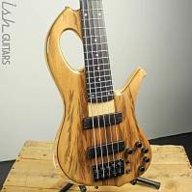
I can see how it would be beneficial. I like the feel of playing over the pickups and having something under my fingers, but I don't always want to play in those positions. I do like the look of ramps that were designed as part of the bass, like these:

[Invalid or Expired Link Removed]

734068_10151265069545927_622394115_n.jpg


img_6665.jpg