• TalkBass has been independent since 1998. Add your voice.
    Create a free account to reply to discussions, view embedded media, and browse with fewer display ads.
    Join freeLog in
    Want zero display ads or expanded classifieds tools? Compare plans.

Rattle Can Refinish Club

Are you spraying it while it is flat or hanging? For whatever reason, I have an easier time with spray paint when the body is flat and not hanging. Also, I don't wet sand during paint, I dry sand the paint until smooth every 2 or 3 coats.

A combination of flat and vertical. Kind of just depends what part of the body I'm spraying. Flat does seem easier to get an even coat but I'm also worried about spitting with the angle of the can I have to use for flat.

 
A combination of flat and vertical. Kind of just depends what part of the body I'm spraying. Flat does seem easier to get an even coat but I'm also worried about spitting with the angle of the can I have to use for flat.
,

I have never used the Stewmac nitro. I find that with any spray can, you have to find the right balance between the force of the aerosol forcing the paint to the surface and gravity allowing the paint to just fall to the surface. Unfortunately, every spray paint is different which is why you need to start with very light coats and work up to heavier coats.

I have never tried this trick, but they say that if you warm the spray can in warm water for a few minutes before you start, it will help with spitting. Of course in Tuscon, it probably never gets cold enough to worry about it. There is lots of good info on reranch.com, especially for nitro. Spend some time reading! There are also a ton of youtube videos, ferreting out the good from the bad is another story.

There are very few problems you are going to create for yourself that can't be fixed with sandpaper. The next thing I would do if I were you is to sand that thing smooth with about 600 grit. You shouldn't need to go higher than that during this part of the process, the next coats of paint should cover the scratches. Keep us updated!!!
 
  • Like
Reactions: BJMtz
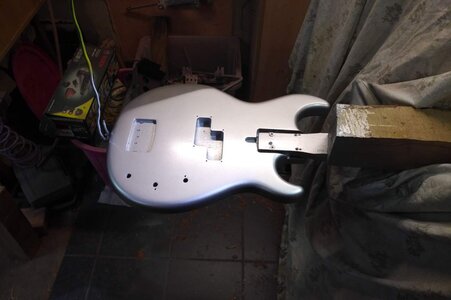
Well it was definitely my spray technique. I sanded and re-sprayed after watching a youtube video and the difference is very noticeable. The back looks awesome. The front has some uneven spots but only because the can was getting empty and started giving out towards the end. I'll re-sand the front while I wait for more paint.

I do warm the paint before I use it. It's what stewmac website recommends.

IMG_0021.jpg

IMG_0022.jpg
 
Hi all. So i have a Squier VM frettless jazz bass i want to paint. Im looking to do it myself on the cheap. Im pretty handy and have tools so i dont expect too much difficulty. Im looking here for advice, tips, important steps that might not be obvious.
My plan is to remove the hardware and neck. Scuff sand with 600 grit over the old finish, then clean, prime, sand, clean, paint, sand, clean, paint, clean, clear coat. Plan to mask at the nut and around edges of headstock and do a matching headstock.
Suggested brands of rattle cans?
20181201_190454.jpg
 
  • Like
Reactions: staurosjohn
Hi all. So i have a Squier VM frettless jazz bass i want to paint. Im looking to do it myself on the cheap. Im pretty handy and have tools so i dont expect too much difficulty. Im looking here for advice, tips, important steps that might not be obvious.
My plan is to remove the hardware and neck. Scuff sand with 600 grit over the old finish, then clean, prime, sand, clean, paint, sand, clean, paint, clean, clear coat. Plan to mask at the nut and around edges of headstock and do a matching headstock.
Suggested brands of rattle cans? View attachment 3254512

Yes take it all the way down to the body, you want everything off it before you start. I've done a couple and I've used the rattlecan lacquer from Guitar Reranch. I like their primer alot as well. I normaly use Minwax Clear Gloss Lacquer. I know others here have used different brands as well.
 
  • Like
Reactions: staurosjohn
Hi all. So i have a Squier VM frettless jazz bass i want to paint. Im looking to do it myself on the cheap. Im pretty handy and have tools so i dont expect too much difficulty. Im looking here for advice, tips, important steps that might not be obvious.
My plan is to remove the hardware and neck. Scuff sand with 600 grit over the old finish, then clean, prime, sand, clean, paint, sand, clean, paint, clean, clear coat. Plan to mask at the nut and around edges of headstock and do a matching headstock.
Suggested brands of rattle cans? View attachment 3254512

On mine that’s posted above I didn’t take all the way back to bare wood. I scuffed up the poly with 400 grit and then put my color coats on. I used no primer either, as a number of places I read and videos I watched said that poly acts as a sealer and primer.
I’m on the clear coats now and everything is looking good. I used stewmac lacquer and clear.
 
On mine that’s posted above I didn’t take all the way back to bare wood. I scuffed up the poly with 400 grit and then put my color coats on. I used no primer either, as a number of places I read and videos I watched said that poly acts as a sealer and primer.
I’m on the clear coats now and everything is looking good. I used stewmac lacquer and clear.

Like @tymbrewolf said, Pics or it didn't happen. :smug:
 
Don’t recall if I’ve posted this (here)... One of my first TB purchases was a Squier Mike Dirnt... body was damaged (was disclosed in sale)... repaired & refinished with Guitar ReRanch (Fender Sonic Blue)... added Fender ‘62 pu, custom 3-ply pg, Fender vintage bridge & cover, new wiring, pots & knobs, paisley CS neckplate & a Mike Dirnt Roadworn neck w/Hipshot Lollypop tuners... currently sporting GHS Pressurewounds!

53A11794-DCA1-49DC-907D-2A5CE901C4B1.jpeg
49270641-0839-4AC5-9BCD-AE12E8FE67C1.jpeg
8B5E15DB-F2B4-426A-9F4F-93C522C9AFD2.jpeg
89FA8215-7BC5-41FD-A412-F0478FC9557E.jpeg
EC0C1ED2-06EE-460B-A3AD-03B33EC98944.jpeg
 
Last edited:
i recently ordered a bass kit. I plan to paint it with a rustoleum spray on lacquer finish. i want the body to be the colored lacquer with a matching headstock, and do a spray on clear lacquer on the neck and colored headstock, which will seal in the waterslide i'm using.

is this product water based? I'm not seeing the information anywhere....
Invalid Link Removed

if all that sounds reasonable, what would be the recommended wood sealer to use before the lacquer application on the body?

any and all help is greatly appreciated. this guitar finishing business is complex.
 
i recently ordered a bass kit. I plan to paint it with a rustoleum spray on lacquer finish. i want the body to be the colored lacquer with a matching headstock, and do a spray on clear lacquer on the neck and colored headstock, which will seal in the waterslide i'm using.

is this product water based? I'm not seeing the information anywhere....
Invalid Link Removed

if all that sounds reasonable, what would be the recommended wood sealer to use before the lacquer application on the body?

any and all help is greatly appreciated. this guitar finishing business is complex.


I know it does not answer your question, but if you want to do lacquer, imho, the best rattlecan lacquer is from GuitarReranch. They have most of the original Fender colors, Gibson Colors and a couple of their own. I've done two using their primer (highly recommended) and paint and am about to do a third.
 
I got some sand through as I was wet sanding with 1000 grit. What's the best way to fix this? Since it's nitro can I spray black right over it then clear over that once it's dried?
View attachment 3272080
Edge sanding can be so frustrating. Just figure on spraying the black nitro and give yourself a few extra coats. Proceed with the clear coat. Sometimes if my base coat looks more textured than I like, I'll give it a little light sanding before the clear coat. The good thing about quality nitro products is the solvent and flattening of the finish once you figure out how much to spray in each coat. I miss those days, but won't do it again.
 
  • Like
Reactions: BJMtz
Don’t recall if I’ve posted this (here)... One of my first TB purchases was a Squier Mike Dirnt... body was damaged (was disclosed in sale)... repaired & refinished with Guitar ReRanch (Fender Sonic Blue)... added Fender ‘62 pu, custom 3-ply pg, Fender vintage bridge & cover, new wiring, pots & knobs, paisley CS neckplate & a Mike Dirnt Roadworn neck w/Hipshot Lollypop tuners... currently sporting GHS Pressurewounds!


Dang I LOVE that color.

I have a Gretsch G2220 I'd love to see in that color. The Gretsch is a nice little bass but the color options, IMO, are poor. Black (no), Sunburst (turd-burst to me) and the wine red that I have. All very dark and lacking character.

I painted the pickguard white and put white speed knobs on but that blue would rock this thing.

If you see the bass in my avatar, it is my Musicmaster that my son airbrushed for me when he was in high school. We went through tons of attempts to practice and learn the clear coat step but never got it right and eventually took it to an auto shop for clear. That guy got divorced and moved away and the other two shops around here don't want to clear something they didn't paint in case it doesn't come out.

I've watched tons of videos and read lots to figure out how to get that step right but it escapes me.
 
  • Like
Reactions: staurosjohn

Latest posts