• TalkBass has been independent since 1998. Add your voice.
    Create a free account to reply to discussions, view embedded media, and browse with fewer display ads.
    Join freeLog in
    Want zero display ads or expanded classifieds tools? Compare plans.

Real Differences In Heads Through 2x10?

Sounds to me like your amp and cab are perfectly fine, and you just need some effects pedals and/or lessons. :)

Perhaps a compressor pedal that also adds some tonal coloration, like the Diamond, might be just the ticket. And a good teacher can give you advice on how to attack the strings so your notes sound punchy and cut through the mix. When was your last lesson?

Also, what kind of bass are you playing, and what kind of strings? Maybe just a new set of strings will give you what you want.

Or he doesnt like the tone out of the Rumble. I hate the Rumble because of this.

OP - to answer your question...

Different heads will sound different. Ampeg sounds nothing like the Rumble. Mesa sounda different than both of those, as does the Mark.

The only solution is to try as many out as possible.

My Ric or Jazz plugged straight onto the Mesa D800 has plenty of grit when dialed in for that. No pedals needed.

 
I think my problem with my current rig, is that it lacks grit.

That's odd because when I owned a Rumble 500 head it never really sounded clean, there was always a bit of dirt in the sound.

As far as "concentrated punch", many cabs with tweeters are scooped in the mids, and that makes them less punchy to my ears. It's a seductive sound, I call it "the pillow", nice warm low end, smooth highs and no harshness at all. When I owned a Peavey 2-10, I disabled the crossover and suddenly the punchy mids were right there.
 
then the more I look, the more I think that an amp is an amp, and a pre amp is the only fix?

Why would you think that? If that was true, everyone would just play the same amp (or whatever wattage version was appropriate for their needs). The problem you're having is that most of these new cheap class D heads sound really generic and plain. That's not necessarily bad, but if you're looking for a particular sound, you probably won't find it without carefully selected outboard gear.

Cab is 400w at 4ohm, 350w at 8ohm.

You need to go back to the beginning, somewhere along the way your learning about this stuff went awry. Cabs HANDLE a certain amount of power at whatever wattage (RMS) they're rated at. And in the real world with bass, you can safely use about half of that. It's extremely rare to have a cab that has switchable impedance. They're usually guitar cabs, and they usually go between 4 and 16, because that is what you can feasibly do with wiring changes (ie switching from parallel to series or some combination, depending on the amount of drivers). Even then, the wattage rating stays the same because that's the thermal limit of the drivers. So you have these above specs wrong.

In a 2x10, are the settings on the amp more important than the amp itself?

What does this even mean? Are you trying to ask if power output makes more of a difference than for instance gain and tone settings? Wattage is just "how much". What you're asking is like "do the ingredients the restaurant uses and the recipe make more difference than the size of the plate they serve it on in how my food tastes"?

The "amp" part of an amp at least nominally is just there to make things louder. Sometimes there's extra engineering that goes in to either make it more clean/flat or more colored (usually towards a tubier sound). But this is generally more subtle and the preamp section (which is what your gain and tone controls on your amp are) is what is really going to shape your tone the most (after your bass, pedals, etc... are done with it, obviously).

For your needs, I would think something like a Genz Benz Shuttle or Shuttlemax (especially the Max as they have 2 blendable channels with independent tone controls) would be good. Or most of the SWR pro amps (ie not the "Working" series) that have tube pres. Or something like a GK 700RB and some variety of sansamp pedal.
 
  • Like
Reactions: theevilplankton
I've used a Fender 2x10 with a Peavey minimax and a lebass preamp for small places. Set was really loud and never had an issue with being heard. This is with a Sex Pistols tribute act, so not a low volume gig
 
OP, do you pick or play finger style? Where are you hitting the strings - closer to the neck, the bridge? And I would have to agree with one response - if you're looking for true grit and grind, the Geddy kind, anything in the Rumble series is not the way to go - its just not the nature of the beast.
 
Grit is something I can’t help you with. I’ve spent the last 50 odd years trying to eradicate any signs of distortion from my signal chain. Back in the day using low powered tube amps, to get any sort of a decent volume, distortion was a fact of life for a bass player. Now players are trying to emulate what they hear from way back then! :D
You're exactly right BassmanPaul! Back in the 60's if you wanted to get loud, you just dealt with the distortion. At college in '68-'69, I ran into some guitar players that had Fender Champ amps (bottom of Fender line back in the late 60's) that they put a 10" JBL speaker into. They originally used these little 15-watt amps for recording but also played small to medium clubs with them. The whole idea was that they could push them easily into a screaming overdrive sound without being so loud that they blew everyone out of the building. And the JBL speaker handed the overdrive distortion just fine. Worked great for guitars but sure didn't want that with my bass amp.

In fact, when it traded in my '66 Fender Bassman for my Standel amp, one of the deciding factors was that I could hit my low E on it at crazy loud volume (literally shook the basses on the wall) with zero distortion. I've been after clear, full, articulate sound in bass gear ever since, which is why I play an Eden amp through my DNS410. I also want to keep any signs of distortion out of my signal chain.
 
I’ve spent the last 50 odd years trying to eradicate any signs of distortion from my signal chain. Back in the day using low powered tube amps, to get any sort of a decent volume, distortion was a fact of life for a bass player. Now players are trying to emulate what they hear from way back then!

As far as just simply emulating the tones of yore, I'll both agree and disagree with that statement, because I feel like there's more to the picture than just bassists wanting to sound old-timey. ;)

I spent a large part of my bass career chasing a super clean sound - because, just like you said, distortion was a byproduct of outdated, obsolete, and inferior gear of the past! In modern times we have the ability to actually be loud and clean and so should take advantage of it! Progress!!

Then I started to dive more and more into recording, and began appreciating how various levels of distortion (among other seasonings) can completely change the way bass sits in a mix, even if the distortion isn't really all that audible. Guess what gear is just naturally good at getting that type of tone? Well, turns out that that's the calling card of the more desirable vintage amps.

Sure, there's lots of truly inferior vintage gear that's been all but forgotten, and rightfully so, so I'm not saying that all vintage gear was good, but classic gear that's still appreciated today usually IMO has that classic designation for more reason than just because it's "vintage", and vintage is hip. :)

I say this as a guy whose most vintage piece of gear is circa 2000, but I have a good appreciation for classic tones for their function as opposed to any sort of nostalgia, and have no qualms with using modern means to get to the same ends.

Stepping down from my soap box in 3... 2... 1...
 
Last edited:
  • Like
Reactions: BassmanPaul
As far as just simply emulating the tones of yore, I'll both agree and disagree with that statement, because I feel like there's more to the picture than just bassists wanting to sound old-timey. ;)

I spent a large part of my bass career chasing a super clean sound - because, just like you said, distortion was a byproduct of outdated, obsolete inferior gear of the past! In modern times we have the ability to actually be loud and clean and so should take advantage of it! Progress!!

Then I started to dive more and more into recording, and began appreciating how various levels of distortion can completely change the way bass sits in a mix, even if the distortion isn't really all that audible. Guess what gear is just naturally good at getting that type of tone? Well, turns out that that's the calling card of the more desirable vintage amps.

Sure, there is lots of inferior vintage gear that's been all but forgotten, and rightfully so, so I'm not saying that all vintage gear was good, but classic gear that's still appreciated today usually IMO has that classic designation for more reason than just because it's "vintage", and vintage is hip. :)

I say this as a guy whose most vintage piece of gear is circa 2000, but I have a good appreciation for classic tones for their function as opposed to any sort of nostalgia, and have no qualms with using modern means to get to the same ends.

Stepping down from my soap box in 3... 2... 1...

I hate to disagree with you Kro, and agree on most of your post. HOWEVER, 2000 isn't vintage...1960 is vintage, back when 215 cabs ruled the roost.;):thumbsup:
 
I hate to disagree with you Kro, and agree on most of your post. HOWEVER, 2000 isn't vintage...1960 is vintage, back when 215 cabs ruled the roost.;):thumbsup:

Ha! Well, that was kinda my point... ;)

I don't consider myself to be a particularly backwards looking bass player when it comes to tone, but some benefits of what one would consider a "vintage tone" are IMO undeniable when it comes to sitting in certain mixes.
 
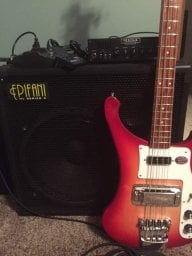
Playing a US Geddy with D'addario NYXL strings.

Great bass (my dream bass for some time), but I was just wanting to add a bit more Geddy grind without a pre amp.....then the more I look, the more I think that an amp is an amp, and a pre amp is the only fix?

Gain staging is where its at.
Your head has gain, drive and level controls, all three of which are used when the OD switch is engaged. You should be able to find a setting on the OD channel that gives you clean at normal levels but grows a beard when you dig in a bit...
 
  • Like
Reactions: Rip Van Dan
Ha! Well, that was kinda my point... ;)

I don't consider myself to be a particularly backwards looking bass player when it comes to tone, but some benefits of what one would consider a "vintage tone" are IMO undeniable when it comes to sitting in certain mixes.
I must have misunderstood. I'll agree that vintage tone can sometimes sit in a mix better than modern tone.
 
I'm using the same cab as you are. When shopping for heads I found the offerings from MB to be very clean and transparent. Doesn't sound like what you're looking for. I did have a Rumble prior to it and like you found the OD useless for the minimal time I called upon it. Mine was a combo and was a muddy mess but, that was more a function of the cab. For me, the GB Streamliner 900 was the perfect solution. The gain offered plenty of dirt although thats not how I use it. I use it just to color the sound a bit. Of your two choices, I'd go with the Tech21
 
  • Like
Reactions: theevilplankton
I'm using the same cab as you are. When shopping for heads I found the offerings from MB to be very clean and transparent. Doesn't sound like what you're looking for. I did have a Rumble prior to it and like you found the OD useless for the minimal time I called upon it. Mine was a combo and was a muddy mess but, that was more a function of the cab. For me, the GB Streamliner 900 was the perfect solution. The gain offered plenty of dirt although thats not how I use it. I use it just to color the sound a bit. Of your two choices, I'd go with the Tech21
I love my Streamliners. For OP, a 600 Watt SL might do him just as well. You might be interested in this if you want a bit more grind: Ran my Streamliner at 16 ohms tonight -- a revelation