
Enjoy the benefits of a premium membership!
Upgrade Account
-
TalkBass has been independent since 1998. Add your voice.
Create a free account to reply to discussions, view embedded media, and browse with fewer display ads.
Join free Log in
Want zero display ads or expanded classifieds tools? Compare plans.
You are using an out of date browser. It may not display this or other websites correctly.
You should upgrade or use an alternative browser.
You should upgrade or use an alternative browser.
Double Bass Recommendations of Free Jazz
- Thread starter StuFordBass
- Start date
More options
Who Replied?
I was just saying there is a paradox at the heart of Free Jazz :
If it is based on tunes,licks and borrowing from other artists - then really it is no different from any other Jazz, which has all these elements.
But as it gets towards totally free improvisation, with no reference to anything else - then how is it even Jazz?
If it is based on tunes,licks and borrowing from other artists - then really it is no different from any other Jazz, which has all these elements.
But as it gets towards totally free improvisation, with no reference to anything else - then how is it even Jazz?

You can most certainly be influenced by a history of music, and play within it's idiom without imitating someone. Also, if you think jazz is based on licks, I don't know even know what to do with that.
As for a recommendation for free jazz, I feel like if you just listen to the history of the music it makes a lot of sense within the context it came from. Check out the early free improv sides by Lennie Tristano, the early free improv stuff from West Coasters Shelley Manne and Jimmy Giuffre. Then move to the early Ornette, Cecil, Steve Lacy, then late Coltrane, Ayler, and the mid-late-60's ESP stuff. After that, check out the early AACM stuff and the early European Free Improvisers. Historical context is everything when it comes to "understanding" a music, but some stuff may just stick out as "Good" or "Bad" to you, and that's what you want. The music should speak for itself, but knowing what came before something often helps to ground understanding of it. Like anything, there's some really amazing music, a bunch of okay music, and some crap. But that's the case with any music...
Bass players to check out: Henry Grimes, Reggie Workman, Charlie Haden, Malachi Favors, Barre Phillips, Barry Guy, William Parker, (early acoustic) Steve Swallow, and a million other people.
As for a recommendation for free jazz, I feel like if you just listen to the history of the music it makes a lot of sense within the context it came from. Check out the early free improv sides by Lennie Tristano, the early free improv stuff from West Coasters Shelley Manne and Jimmy Giuffre. Then move to the early Ornette, Cecil, Steve Lacy, then late Coltrane, Ayler, and the mid-late-60's ESP stuff. After that, check out the early AACM stuff and the early European Free Improvisers. Historical context is everything when it comes to "understanding" a music, but some stuff may just stick out as "Good" or "Bad" to you, and that's what you want. The music should speak for itself, but knowing what came before something often helps to ground understanding of it. Like anything, there's some really amazing music, a bunch of okay music, and some crap. But that's the case with any music...
Bass players to check out: Henry Grimes, Reggie Workman, Charlie Haden, Malachi Favors, Barre Phillips, Barry Guy, William Parker, (early acoustic) Steve Swallow, and a million other people.
I was just saying there is a paradox at the heart of Free Jazz :
If it is based on tunes,licks and borrowing from other artists - then really it is no different from any other Jazz, which has all these elements.
But as it gets towards totally free improvisation, with no reference to anything else - then how is it even Jazz?
The English love paradoxes but there is none. Free Jazz is music from the jazz tradition free of tunes, chords and strict time. When it becomes totally free the jazz is dropped saving us from your dreaded paradox.
Maybe trying so hard to force a literal interpretation and the related paradox is a version of British humour? Can I come to your free jazz candlelight supper?
free of tunes, chords and strict time.
So, if as you say, it is missing all those things, what makes it Jazz, as such..?

The words "flogging" and "dead horse" come to mind.
Yes, but it does seem to confuse some people.
The words "flogging" and "dead horse" come to mind.
Hi there - we might have met?
I was in Cardiff for the Jazz Summerschool in August at the Royal Welsh College of Music and Drama - Paul Gardiner has taught on that course in the past and this Summer I was with a friend of hers' - Lee Goodall.
We also seem to have similar gear - I have a Stentor although mine's an Elysia and I use a Clarus as well - with EA cabs.
and as someone above already mentioned Peter Kowald,
may I add a YTvideo here:
there
that I watch from time to time,
to remember a musician with an enormous grande human quality.
you may also want to look out for a recording that was done for FMP:
"When the sun is out you don't see the stars"
Peter Kowald, Werner Lüdi, Saiko Namchylak and Butch Morris play things that are not exactly music, but that what is the reason behind it.
may I add a YTvideo here:
there
that I watch from time to time,
to remember a musician with an enormous grande human quality.
you may also want to look out for a recording that was done for FMP:
"When the sun is out you don't see the stars"
Peter Kowald, Werner Lüdi, Saiko Namchylak and Butch Morris play things that are not exactly music, but that what is the reason behind it.
"When the sun is out you don't see stars" is my favorite album of the CD age. I got to work with him on two albums and four concerts. A great man.
As for what makes it free jazz it is that the musicians are abstracting elements of that tradition - line, swing, energy and harmonic movement. Obviously, lines get blurred - see Parker/Guy/Lytton, Cecil's Feel trio, Schlippenbach trio, etc. Free Jazz tends keep traditional roles - if not at all times. Rhythm section is still a thing. It is also about intention - when you play a free jazz gig, you are working toward the stated goal of creating the energy and forward momentum.
As for what makes it free jazz it is that the musicians are abstracting elements of that tradition - line, swing, energy and harmonic movement. Obviously, lines get blurred - see Parker/Guy/Lytton, Cecil's Feel trio, Schlippenbach trio, etc. Free Jazz tends keep traditional roles - if not at all times. Rhythm section is still a thing. It is also about intention - when you play a free jazz gig, you are working toward the stated goal of creating the energy and forward momentum.
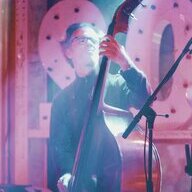
I love Gary Peacock's playing. Those old Improvising Artists records with Paul Bley are great. Turning Point and Virtuosi come to mind. Spiritual Unity by Albert Ayler was already mentioned. More recently Not Two, Not One with Bley and Paul Motion, and In the Evenings Out There with Bley, Tony Oxley (a severely underrated master), and John Surman. All this is coming from a, self described, ECM junkie, so take it for what it's worth.
The words "flogging" and "dead horse" come to mind.

Peacock is amazing. I love the ECM stuff but I wouldn't call it free jazz.I love Gary Peacock's playing. Those old Improvising Artists records with Paul Bley are great. Turning Point and Virtuosi come to mind. Spiritual Unity by Albert Ayler was already mentioned. More recently Not Two, Not One with Bley and Paul Motion, and In the Evenings Out There with Bley, Tony Oxley (a severely underrated master), and John Surman. All this is coming from a, self described, ECM junkie, so take it for what it's worth.
Honestly, a lot of so called free jazz players (mostly horn players) don't have the technic to play anything else. Call them artists if you like.
The original Ornette Free Jazz is a very fun recording to listen too but you must read the CD notes (by Gunther Schullar I think?) He explains a lot of what is actually going on in the performance. For example Freddie Hubbard was not comfortable in the group soloing with no chords situation and you can hear it on close listening. Also the two basses (Lafaro and Haden) stay out of each others way by staying in different registers .I'm involved in a new project that is doing some free jazz pieces and I'm relatively unfamiliar with the style. I'm familiar with Ornette's Free Jazz, and I've really been listening to The Shape of Jazz to Come a lot lately. Does anyone have some recommendations of free jazz recordings to check out to get a good idea of what to do on bass?
Honestly, a lot of so called free jazz players (mostly horn players) don't have the technic to play anything else. Call them artists if you like.
This is a fairly uninformed and ignorant thing to say. Like any genre, free jazz has it's duds but saxophonists like Evan Parker, Urs Leimgruber, Bhob Rainey and John Butcher just tower over saxophonists in other genres technically.
Players like, uh, John Coltrane, Steve freaking Lacy, John Tchicai, Paul Dunmall, Willem Brueker, Dudu Pukwana, Jimmy Lyons, Roscoe Mitchell, Joe McPhee, etc, are/were certainly technical masters.
Brötzmann played Dixieland, and while his technique may be specialized, NOBODY has the technique to do what he still does.
I am going to say that all of these saxophonists musics are likely more worthwhile than Bobsax's!
One of the great reasons to work in free music of all kinds is there is a place for every sound your instrument can make, so while it is possible for a person with limited technical resources (sometimes by choice) to contribute, the music is more satisfying the more control you have over your instrument.
For example, a large part of my vocabulary lies on the other side of legit classical technique.
This is a fairly uninformed and ignorant thing to say. Like any genre, free jazz has it's duds but saxophonists like Evan Parker, Urs Leimgruber, Bhob Rainey and John Butcher just tower over saxophonists in other genres technically.
Players like, uh, John Coltrane, Steve freaking Lacy, John Tchicai, Paul Dunmall, Willem Brueker, Dudu Pukwana, Jimmy Lyons, Roscoe Mitchell, Joe McPhee, etc, are/were certainly technical masters.
Brötzmann played Dixieland, and while his technique may be specialized, NOBODY has the technique to do what he still does.
I am going to say that all of these saxophonists musics are likely more worthwhile than Bobsax's!
One of the great reasons to work in free music of all kinds is there is a place for every sound your instrument can make, so while it is possible for a person with limited technical resources (sometimes by choice) to contribute, the music is more satisfying the more control you have over your instrument.
For example, a large part of my vocabulary lies on the other side of legit classical technique.
I just listened to as much as I could stand of your trio in San Diego
Do you have any recordings that show you and your friends know how to play?
I don't want to be too harsh but what I heard was BS .

- Apr 19, 2004
- 808
- 42
- 48
- Disclosures
- Endorsing Artist: Conklin Guitars (Basses)
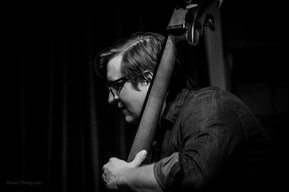
I just listened to as much as I could stand of your trio in San Diego
Do you have any recordings that show you and your friends know how to play?
I don't want to be too harsh but what I heard was BS .
The simple fact that Damon and his "friends" play music all over the globe is the obvious example that they know how to play!! It is also obvious that bobsax doesn't get it...much like most people do not get bebop. It's the same thing. If we take the time to listen...we might learn something.
What I love about this music is that you are really under the microscope. The most basic (and most important!) musical skills are magnified. Rhythm! It makes or breaks it.
Another beautiful thing is hearing innovation rather then imitation ...which is one thing that the popularity of jazz schools (education wise) since the late 60's has unfortunately suppressed. I'm talking about the working jazz musician, no names as they say. Not the Brad Mehldau's, Wayne Kranz's. Of course there are countless plus' to a formal jazz education and I'm not dismissing that ...but an unintended consequence is the individuality that "jazz" had (from being passed down as an aural art) got lost when textbooks arrived.
Free music still has that same process of learning... just like our heroes learned bebop, etc....which I find absolutely liberating!
I just listened to as much as I could stand of your trio in San Diego
Do you have any recordings that show you and your friends know how to play?
I don't want to be too harsh but what I heard was BS .
Turning it into some kind of stupid contest isn't the best answer - you can go ahead and join the rest of the people who hate this music - that music was certainly not made for dullards to be able to "stand".
Still, You could post a video of yourself playing any 5 minute segment of what Mr. Fuchs (a German master who plays sopranino saxophone, bass & contrabass clarinets
: Invalid Link Removed) is playing that video, or what I was playing or of you playing any of these "easy" examples:
Evan Parker:
Nobody is asking you to like the music, and thinking it is B.S. is fine, but it is pure ignorance to pretend it takes no technique to play well.

I think anonymous bashing is cowardly and has no place on the forum...
Certainly is, but it is a nice opportunity to dis-spell the notion that any musician involved in free music can't play.
Have I met free players that can't play? For sure.
Ironically, in my experience I have seen/heard/met WAY more straight ahead jazz bassists that I don't feel have a good grasp on the instrument's fundamentals. The other huge irony with the straight jazz "so and so can't play" is that out of all the free bass players who became well known free players in the 50s and 60s the straight ahead community accepted the bassist with worst technique with open arms! I am not talking about content, but nobody can argue that Charlie Haden is a great technical bass player.
For me, my interests are free music and the double bass. So certain music that doesn't interest me that has incredible bass playing will have something for me. Where certain (even famous) straight bassists with no real technique have nothing for me.
By the same token, a mediocre bassist with some good ideas in free music has an interest for me provided the ideas are there.
There are also a lot of young players doing boring freebop albums - mostly in Chicago and Brooklyn who can't actually play bebop.
I do not feel legit jazz chops should be a prerequisite to play free - unless your music sounds like jazz!
So yes, not being able to play well is problem in free music but no more than in any other genre.
In the end, in free music you are ALLOWED to play, for bass players this is incredible. The instrument has so many sound resources, it can take on so many roles and be orchestrated so many ways. While I am certainly interested in the traditional roles of the instrument, it is also great to find new spaces for it.
In the end, in free music you are ALLOWED to play, for bass players this is incredible. The instrument has so many sound resources, it can take on so many roles and be orchestrated so many ways. While I am certainly interested in the traditional roles of the instrument, it is also great to find new spaces for it.[/QUOTE]
+1million!
+1million!
Latest posts
-

-

-
 The Official Gallien Krueger 400RB picture thread/fanclub
- Latest: frank cucinotta
-

