
Enjoy the benefits of a premium membership!
Upgrade Account
-
TalkBass has been independent since 1998. Add your voice.
Create a free account to reply to discussions, view embedded media, and browse with fewer display ads.
Join free Log in
Want zero display ads or expanded classifieds tools? Compare plans.
You are using an out of date browser. It may not display this or other websites correctly.
You should upgrade or use an alternative browser.
You should upgrade or use an alternative browser.
Remote Band Practicing
- Thread starter ragetoca
- Start date
More options
Who Replied?

They do, and that is why I mentioned drummers needing to stick to the script and not get dragged back by trying to accomodate too much.Orchestras have a conductor to help overcome this.

Smooth_bass88
vaxx!
- Oct 31, 2006
- 12,122
- 16,793
- Disclosures
- have been on nationally released albums, charting on the Billboard 200


The minimum it could be is the speed of light… so minimum would be 16ms.I see. LA to New Jersey is like 3000 miles so it is a probably a thing of physics vs internet speed

In these cases, everyone has to just do their homework, take good notes, have a solid bandleader and be as professional as possible. I’ve done this many many times and if everyone is “on it”, there are no problems.
We have a new album to learn, we dont play often enough (live), so we are looking for options

A quick check with the speed of light being about 300.000 km/s means every 300 km causes 1 ms delay, so 3.000 miles would be about 16 ms. But that would be if you had a single direct link, like one single long piece of optical fiber or a line-of-sight wireless channel. Going through the Internet means passing through many nodes, each of which adds its own delay. Unless someone already figured out how to build quantum-entanglement based receivers, I think it's very tough to go below tens of ms in the bestest case.I see. LA to New Jersey is like 3000 miles so it is a probably a thing of physics vs internet speed
i have had pretty good results with Jamkazam, especially when using a metronome or drum machine (usually provided by the host, or person with best internet service). and the speed/latency improves signinficantly on off-peak hours. we usually go without video to clean up the signal. they have made many improvements recently, specifically regarding the connectivity and sound quality....ethernet connection required though...

And that’s one way. So the time it takes for your signal to reach the other coast and then for their reaction to come back to you, you’ve got a minimum of 32 ms. Plus whatever latency is induced by any routers, compression, firewalls, etc. I’ve seen demos where very specialized network routes and hardware have been set up over long distances to make real time interaction better, and those are impressive, but well beyond the reach of us mere mortals.The minimum it could be is the speed of light… so minimum would be 16ms.
Smooth_bass88
vaxx!
- Oct 31, 2006
- 12,122
- 16,793
- Disclosures
- have been on nationally released albums, charting on the Billboard 200
when is the gig? Maybe arrange a couple rehearsals the day before and then run the set at soundcheck.We have a new album to learn, we dont play often enough (live), so we are looking for options
I used to do tech support for a company that did this sort of thing in real time on dedicated direct dialed digital phone lines (low bandwidth, but very low latency, pre internet) and it was possible-ish with very fast compression algorithms (the enhanced apt-X that is in the Bluetooth spec came in at 1.4 ms). For small distances, it was possible, as distance increased so did latency. Most of what we did was program in one direction and talk back in the other so it didn't matter much. When timing was mission critical, we used time code on one channel and program on the other.
Once we're talking about transporting over the internet, latency becomes too high to effectively jam in a tight fashion.
I have had better luck with things like reaper's ninjam that embraced the delay rather than tried to fight it.
Ah - ISDN. What's old is new again

Near Chicago I can get < 10ms in about a 3 state area IF everyone is on the same ISP - e.g. ATT or Comcast. Not cheap. Not always predictable.
Make threads at home, mix anywhere, rinse and repeat. Just not in real time so much.

The latency will be noticeable. It will be more than 10ms. Adam Neely did a video on this
Correct. Also keep in mind in between any two points on the internet, or any internet-worked set of networks there is minimum floor for latency even if you have no other traffic to compete with. There will always be cumulative serialization delay even at line rate.Agreed, the state of the internet as it is, prevents real time collaboration. BUT, you might want to explore trying an audio only connection, maybe that will have less latency.
I'm a network engineer at my day job.
July 18th but we fly in from different cities.when is the gig? Maybe arrange a couple rehearsals the day before and then run the set at soundcheck.
I run a Jamulus server for our band. Haven't tried it yet but our initial tests were sort of ok. Bottom line is the speed of light limits you. So you'll never get better than 2.7 milliseconds. Then add in all the computers and processing. If you can get as good as 30 ms, you're doing really well.

I'm working on short set for an upcoming one time gig, and one of the guys suggested using Jamulus, I've never used but am game. We are only about 30 miles apart, but due to conflicting schedules it may be a solution. I was going to install it but my studio only has WiFi and apparently that's an issue. I have direct network access from my home office, but don't have a standalone USB interface (and I hate to buy one for a test). I do have a Behringer USB mixer that I can configure with my PC (X2222USB). The USB output is stereo, but it's a mixer so I'm thinking it should work. I do have a Tascam 16x08 interface, rack mounted in the studio, seems like a lot of work for a test...
Any thoughts on the configuring the USB mixer with Jamulus?
Any thoughts on the configuring the USB mixer with Jamulus?

Brandon Shea
Commercial User
Are you on Windows? Assuming there's an ASIO driver for your mixer, it should be totally fine for this purpose.I'm working on short set for an upcoming one time gig, and one of the guys suggested using Jamulus, I've never used but am game. We are only about 30 miles apart, but due to conflicting schedules it may be a solution. I was going to install it but my studio only has WiFi and apparently that's an issue. I have direct network access from my home office, but don't have a standalone USB interface (and I hate to buy one for a test). I do have a Behringer USB mixer that I can configure with my PC (X2222USB). The USB output is stereo, but it's a mixer so I'm thinking it should work. I do have a Tascam 16x08 interface, rack mounted in the studio, seems like a lot of work for a test...
Any thoughts on the configuring the USB mixer with Jamulus?
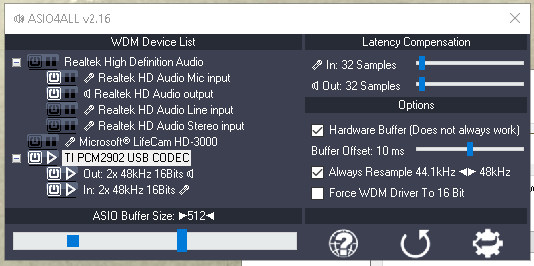
Yesterday I did some basic testing, installing Jamulus with the ASIO4ALL driver. I was able to get it working on Win10, using my camera mic and system speakers. I played around a bit with a Tascam DR40x (handheld recorder) as an interface which also worked, but was a limited using the built in mics. Will give the Behringer USB mixer a try this evening, fingers crossed. If Jamulus works out OK, I may look around for a small USB mixer for my office. I really need to get off my butt and run a cable out to the studio  .
.
Thanks
.Thanks
The Behringer USB mixer works like champ with the ASIO4All driver... Did a couple of tests with folks that were online, seems like a pretty cool platform. We'll see how it all works with a practice tonight, I'm in Maryland and connecting with groups in NY, NJ, and Boston were returning 11-12 msec connection times, music sounded pretty clear... The hardware buffer seems to be working, we'll see how it goes.
Appreciate the input, Cheers
Appreciate the input, Cheers
Update, first Jamulus session...
Jamulus session went pretty good, low latency, and we had a drummer drop in which was a nice addition. I actually set up my Tascam DR unit to record the session. It worked pretty well except I connected it to the Tape Out which for some reason did not pick up the session coming in from Jamulus via the USB. Must be one of those Behringer quirks... anyway great success, and a cool new tool to use. I can connect the DR unit to the main outs, and that should resolve the issue.
Cheers
Jamulus session went pretty good, low latency, and we had a drummer drop in which was a nice addition. I actually set up my Tascam DR unit to record the session. It worked pretty well except I connected it to the Tape Out which for some reason did not pick up the session coming in from Jamulus via the USB. Must be one of those Behringer quirks... anyway great success, and a cool new tool to use. I can connect the DR unit to the main outs, and that should resolve the issue.
Cheers
Did a little research, and it is a Behringer Mixer quirk, if you select the 2TR/USB to Main button it bypasses the Tape Out circuit. So your only output is coming from the board channels. The crazy part is that you can hear the USB input through the headphones, so it looks like the solution is to use the main out. I could use the control room output, but then the line volume would be controlled by the Headphone\Cntrl Room pot. With the technical hiccups worked out we're going to give it another try tonight. Here's a video on that Behringer "quirk". I wonder is Mackie has the same issue? If this Jamulus thing works out I may look around for a smaller 4 XLR port USB mixer (similar to the one in the video), this full size mixer takes up a lot of room.


