

Enjoy the benefits of a premium membership!
Upgrade Account
-
TalkBass has been independent since 1998. Add your voice.
Create a free account to reply to discussions, view embedded media, and browse with fewer display ads.
Join free Log in
Want zero display ads or expanded classifieds tools? Compare plans.
You are using an out of date browser. It may not display this or other websites correctly.
You should upgrade or use an alternative browser.
You should upgrade or use an alternative browser.
Removed the Blend pot from my J
- Thread starter John Webb
- Start date
More options
Who Replied?
Sorry - I was responding to Mushroo.
Thanks for the information on the other tapers. I haven't seen M/N myself, but it is probably something designed for this specific purpose.
Do you know who is the manufacturer of the M/N pots? I would like to look at the technical data.
Thanks for the information on the other tapers. I haven't seen M/N myself, but it is probably something designed for this specific purpose.
Do you know who is the manufacturer of the M/N pots? I would like to look at the technical data.

two separate 250k volume pots = 1 500k vol pot + 1 500k blend pot...absolutely a fact.
if you use 250k vol pot + 1 250k blend pot, however, the loading on the pickup will be increased and you may be able to hear it ("may" being the operative word, here)
if you use 250k vol pot + 1 250k blend pot, however, the loading on the pickup will be increased and you may be able to hear it ("may" being the operative word, here)
I don't think that this is exactly correct. The 2 volume pots are in parallel - each is independent for each pup- the resistance does not add.
However, you are essentially correct - the sound will be changed if you use a volume + blend pot instead of 2 volume pots.
I'll look at what is happening with the volume and blend pots and do some calculations.
However, you are essentially correct - the sound will be changed if you use a volume + blend pot instead of 2 volume pots.
I'll look at what is happening with the volume and blend pots and do some calculations.
I don't think that this is exactly correct. The 2 volume pots are in parallel - each is independent for each pup- the resistance does not add.
Even though each control is associated with a pickup, you still have the value of each pot connected to ground. So if you have 2 volumes, and each is 250K, that is the same as having a 125K resistor connected from the hot to ground. Parallel resistance is halved, series resistance is added.
125,000 Ohms seems low, until you realize most pickups are anywhere from 6K to 12K on average, and as an example two 8K pickups in parallel, is 4K.
But the pots do alter the tone of the pickup, lowering the resonant peak and rolling off some top end.
I had an old Hayman guitar once with two humbuckers, and it sounded really dark. Then I looked inside and saw they used 100K pots!
So I changed them to 500K and it sounded like a new guitar.
Sorry - I was responding to Mushroo.
Thanks for the information on the other tapers. I haven't seen M/N myself, but it is probably something designed for this specific purpose.
Do you know who is the manufacturer of the M/N pots? I would like to look at the technical data.
I know Alpha makes some, you can find them here:
Dual Blend/Balance Pot With Center Detent
They have the 500K in A/C taper, and the 250K in M/N.
You can try here also: http://www.potentiometers.com/
I don't think that this is exactly correct. The 2 volume pots are in parallel - each is independent for each pup- the resistance does not add.
However, you are essentially correct - the sound will be changed if you use a volume + blend pot instead of 2 volume pots.
I'll look at what is happening with the volume and blend pots and do some calculations.
no, sorry, I am correct...trust me...with the volume wide open and the balance in the centre, they're just shunt resistors...and whether you have resisors in parallel or one 1/2 value resistor, it's electronically the same.
Thank You, David.
By the way, I discussed this with my engineer tonight, and he recommends using a single 500K linear pot for blend, wired with one input on each end, and the wiper to the output. He ways that the loss is negligible because the input impedance on the amp is so high. This is how Gibson does it.
pilbarabass - Thanks for responding - Maybe I am not clear on your meaning for "two separate 250k volume pots = 1 500k vol pot + 1 500k blend pot". The 2 x 250K pots are in parallel to ground. When they are wide open, both pups see 125K to ground. THEN the signal goes to the balance pot that is say, 500K dual, in the center it is another 250K to ground, so the total impedance would be around 100K or so. This is a serious low impedance to the signal. Perhaps this is why my engineer uses the wiring as above, so that it doesn't shunt any more of the signal.
Anyway, the point is still correct - there will be a sound difference. This is why they developed active electronics, yes?
How much difference? would be an interesting experiment. We need some electronics teacher to assign this as a class project and run experiments!
By the way, I discussed this with my engineer tonight, and he recommends using a single 500K linear pot for blend, wired with one input on each end, and the wiper to the output. He ways that the loss is negligible because the input impedance on the amp is so high. This is how Gibson does it.
pilbarabass - Thanks for responding - Maybe I am not clear on your meaning for "two separate 250k volume pots = 1 500k vol pot + 1 500k blend pot". The 2 x 250K pots are in parallel to ground. When they are wide open, both pups see 125K to ground. THEN the signal goes to the balance pot that is say, 500K dual, in the center it is another 250K to ground, so the total impedance would be around 100K or so. This is a serious low impedance to the signal. Perhaps this is why my engineer uses the wiring as above, so that it doesn't shunt any more of the signal.
Anyway, the point is still correct - there will be a sound difference. This is why they developed active electronics, yes?
How much difference? would be an interesting experiment. We need some electronics teacher to assign this as a class project and run experiments!

I changed my lakland USA jazz from blend w/ active to passive vol/vol and the difference in sound is huge compared to what that bass sounded like before (even in passive mode). I'm getting a lot more upper midrange (1-3k zone) now, and thus more snarl and growl. With the blend it sounded smoother and softer. It is not subtle. Some people would surely prefer the blend sound, but for rock V/V is the way to go. For me.
My '86 Ibanez Roadstar II came with a Blend/V/T setup and since I replaced the pups, I've been considering switchin' that to V/V/T. I'm gonna try wiring in 500K pots all the way down the line to see if I can get what I'm lookin' for sound-wise. If that doesn't do it... sounds like the V/V/T setup might. Thanks.
Try using a 500K LINEAR "B" taper pot for balance - one pickup at each end and the center to the output. That can help the sound a lot over a dual balance pot. Be sure it is not an audio taper.
Also, my engineer recommends a 47pF (very small) cap on the volume pot from input to the center. This will also help keep the upper mids.
Also, my engineer recommends a 47pF (very small) cap on the volume pot from input to the center. This will also help keep the upper mids.
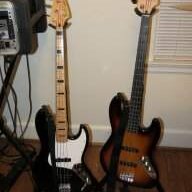
I've wondered about this exact setup myself. In fact, I think it was discussed on one of the myriad threads on blend pots, but shot down by someone because of all the complex interaction between the pots and pickups.
There are different blend pots. Some are audio taper, and reverse audio taper. Some are marked A/C and M/N.
I like M/N myself. It gets the level more-or-less all the way on in the middle. M/N seems to be what I've seen with Bartolini and Fender setups.
Stew-mac blend pots are really stereo volume controls with A taper on both sections, although they seem to work fine, when I checked them on a meter they did not read the same when in the middle detent.
EMG and Basslines seem to use linear taper pots, and they work well also.
 So that's why I never liked the blend in my EMG loaded bass.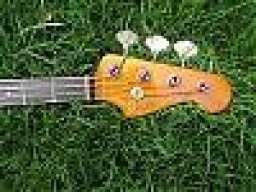
Scanning thru this I don't think anyone has completely hit the nail on the head. The difference in most blend setups is that they are a pair of 500K pots. Blending with 500K pots is different than 250K pots. You do not get the same frequency response from the pickup being cut. There is not equivalent place on a 500K pot attenuation that has the same frequency response as a 250K attenuation.
The reason many will use a 500K blend is because the two pots look like a 250K load when everything is wide open. With everything wide open, a 250K volume and a 500K blend will load the pickups exactly the same as a 250K V V setup. But as stated above, the 500K blend does not blend the same at all. It is more like a switch (on or off).
You could go with a 250K blend pot which is a pair of 250K pots. However, you would be loading down the pickups more in all positions (three 250Ks in parallel vs two). Theoretically this should be a lot closer to 250K V V. If you put a no load pot on the volume, you theoretically could get the 250K V V blending with a 250K blend pot with the volume wide open.
See post 56 below for some frequency curves of different configurations. I simulate a 500K volume with a 250K blend and show that it is very close to 250K V V:
http://www.talkbass.com/forum/showthread.php?t=256769&page=3
Dave
The reason many will use a 500K blend is because the two pots look like a 250K load when everything is wide open. With everything wide open, a 250K volume and a 500K blend will load the pickups exactly the same as a 250K V V setup. But as stated above, the 500K blend does not blend the same at all. It is more like a switch (on or off).
You could go with a 250K blend pot which is a pair of 250K pots. However, you would be loading down the pickups more in all positions (three 250Ks in parallel vs two). Theoretically this should be a lot closer to 250K V V. If you put a no load pot on the volume, you theoretically could get the 250K V V blending with a 250K blend pot with the volume wide open.
See post 56 below for some frequency curves of different configurations. I simulate a 500K volume with a 250K blend and show that it is very close to 250K V V:
http://www.talkbass.com/forum/showthread.php?t=256769&page=3
Dave

- Feb 16, 2008
- 21,240
- 23,636
- Disclosures
- John K Custom Basses
In my 60's cover band i have to constantly tweak the volume from song to song, so it's impossible to adjust the two volumes the same amount quickly, so i really need a master volume. I tried a volume pedal, but not only was it uncontrollable to adjust in super fine increments, it also changed my tone. I've also tried a blend pot (dual 250K) with a center detent and didn't like what it did to the tone and output. And since i always use one or the other pickup, or both (full up ) I decided to go with a three way rotary switch so it doesn't detract from the bass' stock appearance. here's some pics of the way that i wired it:


Hi David, are you saying that you personally recommend a blend pot that is 50%/50% in the center position, or are you just saying that you've encountered them in your travels? If you do use a 50/50 blend pot, what in your opinion is the advantage over 100/100?
I just found a good one. AllParts sells a 500K blend with the MN taper. It's perfect in every way. At the center you have around 500K to ground, and only about 100 Ohms to hot. So it's exactly like having two 500K volumes on full.
You have to wire it up the correct way though... if you do it backwards it wont work right.
I just converted one of my basses from two 500K volumes to this blend, and it sounds exactly the same. I did A/B recordings to make sure.

You have to wire it this way. If you swap the output and ground connections it wont work right.
You have a good reason to have misconceptions.. many blend pots don't work as they should.
I was very excited to find that one in a local guitar shop. I had stopped using blends after I switched from EMG's because I couldn't find one that worked right.
That one works as it should.
I was very excited to find that one in a local guitar shop. I had stopped using blends after I switched from EMG's because I couldn't find one that worked right.
That one works as it should.
let me see if a get this
if i have more pots going trough my signal, more loss of bright and output? even at minimal leves?
that could be the reason that i see many bassist take out the tone control? i have even seen a bass with no volume or tone control and it sounded awesome(and that bass was a cheap peavey)
if i have more pots going trough my signal, more loss of bright and output? even at minimal leves?
that could be the reason that i see many bassist take out the tone control? i have even seen a bass with no volume or tone control and it sounded awesome(and that bass was a cheap peavey)


