• TalkBass has been independent since 1998. Add your voice.
    Create a free account to reply to discussions, view embedded media, and browse with fewer display ads.
    Join freeLog in
    Want zero display ads or expanded classifieds tools? Compare plans.

Replacing new strings question.

Make sure that you crimp the cut end of the string at least 90 degrees so the core does not migrate up the outer wrappings.
Establish a witness point when you are tuning the new strings.
As we have seen too many times in TB threads, please make sure you wrap the strings around the tuning post correctly, the string should be wrapped so the lowest point of the string on the tuning post should be the part that goes to the nut.
 
  • Like
Reactions: Afc70
I read something about twisting and making the strings sound dead. Can someone tell me more about that. (hence my question)

(sorry for my bad English)

Yeah, once you've got the string wound on the tuner peg a bit, run it between your fingers down the length of the string to push the twists out at the ball end. A bit like getting twists out of a lead, but not.

It matters more if you do the first few winds by winding the string around the tuning peg by hand (rather than turning the key)....that definitely creates twists.
 
Last edited:
  • Like
Reactions: JPK_DK
We like our jokes around here but overall: it sounds like you don't have to go XL scale to get the job done with your strings of choice; thru-body is, in my humble opinion, LESS of a hassle than most thru-bridge configurations (string length recalculation aside); that's a sweet bass; and string twist is always a hazard, but you start to learn to "read" a string after a few times doing the restring job.

One thing I DO like about thru-bridge config is being able to pull on the string in the direction of the bridge, then see it twist a bit in the direction of de-twisting once it's loose from the bridge anchoring position. That's harder with string-thru, but with practice, you can have a hand on the string as you start to wind it to feel if it wants to twist, or with the right cut, you can even have it slack enough to twist itself into place in a thru-body bass as you start winding the tuner.

I like the stability of setting the witness point in a thru-body setup, as then, you can do the whole feel-out-the-twist thing based on that even as you're first dropping the far end of the string into the tuner's mineshaft.

You won't be the 2 thousandth, nor the 2 millionth bassist to twist a string if it happens sometime, but be sensitive to them and don't rush it.
 
I did it. It sounds good, every string has a good sustain. I like the sound of new strings on this bass, especially in passive mode.
Thank you all so much for all the help and advice!

upload_2022-7-23_13-58-56.jpeg
 
Does anyone have any good advice on replacing strings on a 5 string trough body bass? Thanks in advance.
Change one string at a time to keep tension on the neck. I always cut the string about 3" longer than the distance to the tuner. My second suggestion can change by bass model but with normal tuners I like to wrap 3 times around the tuner. In reality I check the diameter of the posts multiply that by Pie then multiply by 3 and that is my extra length. I have a longhorn with very small tuners on that bass I don't do as many wraps.
 
  • Like
Reactions: Just go for it
OP, I see that a couple people have responded to your puzzlement about the "twisted string" question. Maybe I can add a little info.

First, it actually is something you want to be clued about, and something to be avoided when you restring. IME, if there's a pent up torsion (meaning, tendency to rotate) in the string, when it's up to pitch the string tends to sound dull or lacking in overtones. If you like the sound of dead strings, fine--but if you don't, you want to avoid that. IOW, the twisted string problem affects the tone, not AFAIK the mechanical strength of the string.

If you seat the ball end then cut the string to length and wind it up to pitch with the tuning peg, you'll tend to get some amount of twist in it. With a top loader bridge it's pretty easy to avoid. Just leave about an inch extra at the bridge end (figure the length the winding is overlapped) then start working the tuner. As the string starts to pull the ball end into its seat at the bridge, pause and just rotate the string between your fingers somewhere around the middle of the fretboard. IME, you'll often find that releases a bit of the dreaded twist.

Not so easy with a string-through bass--and all my basses are top-loaders--but if I were you I'd do the same thing: start winding the tuner with the ball end hanging out of the ferrule by about an inch, and when it starts to pull into position just check in the speaking length of the string if you can relieve any twist it's developed. With a string-through, I figure you'd want to do that with both hands, one in the speaking length and the other on the ball end itself. Try that and see if you can't sense that there's a bit of twist in it. Relieve it as best you can, and tune to pitch.

Hope that helps.
 
OP, I see that a couple people have responded to your puzzlement about the "twisted string" question. Maybe I can add a little info.

First, it actually is something you want to be clued about, and something to be avoided when you restring. IME, if there's a pent up torsion (meaning, tendency to rotate) in the string, when it's up to pitch the string tends to sound dull or lacking in overtones. If you like the sound of dead strings, fine--but if you don't, you want to avoid that. IOW, the twisted string problem affects the tone, not AFAIK the mechanical strength of the string.

If you seat the ball end then cut the string to length and wind it up to pitch with the tuning peg, you'll tend to get some amount of twist in it. With a top loader bridge it's pretty easy to avoid. Just leave about an inch extra at the bridge end (figure the length the winding is overlapped) then start working the tuner. As the string starts to pull the ball end into its seat at the bridge, pause and just rotate the string between your fingers somewhere around the middle of the fretboard. IME, you'll often find that releases a bit of the dreaded twist.

Not so easy with a string-through bass--and all my basses are top-loaders--but if I were you I'd do the same thing: start winding the tuner with the ball end hanging out of the ferrule by about an inch, and when it starts to pull into position just check in the speaking length of the string if you can relieve any twist it's developed. With a string-through, I figure you'd want to do that with both hands, one in the speaking length and the other on the ball end itself. Try that and see if you can't sense that there's a bit of twist in it. Relieve it as best you can, and tune to pitch.

Hope that helps.
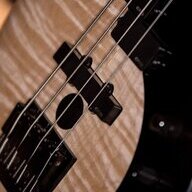
Thank you for this, useful info. Not just for me I guess.
 
  • Like
Reactions: Ewo
Since I evolved from skinny 6 strings to 4 string bass. I start with the heavier one's to install 1st, work my way to the lighter ones and only tension them a full step down to desired tuning. With 6 strings I treat the bass & treble sides as their own sub groups for tuning. EAD as a set of 3 for the bass side, GBE as the treble side. With the 4 string bass, it's EA for bass side, DG for treble side. For a 5 string, EAD for bass side, GB for the treble. I guess one could perceive the EA as the bass side pair, with the DGB as the treble side. If one does drop tuning , I don't think it would really matter though.

With 9's & lighter as older strings on a 6 string and I don't want the heavier strings slack for tension. That 9 has a tendency to break before the others. With the Bass guitar, never had a broken 45, so it may not be that vital for mature string set. Once my tuning is about where it should be, I go back and balance the whole set to dead on in tune, because they are all to just cents flat of dead on in tune tension. I guess that would be the fine tuning of micro adjustment at the end.

String preference, the olde version of my bass came with 45-65-80-100's, the newer version 45=65-85-105. I stayed with the EXL170S 45-100's because I don't want to deal with the nut slots possibly being to tight for 85 & 105 strings. Path of least resistance was D'Addario or Ernie Ball brand round wounds. The D'Addario was on sale recently, so they won the $ 4 price war. I've never used Ernie Ball for any of my 6 strings. Have either stayed with D'Addario (Strats), Gibson (LP), Musicians Gear (Tele) & PRS (Strats). The Jackson Bass is D'Addario.

As for scale length specific strings, match as close as you can. D'Addario short scale the taper starts at 32 inches, where as medium & longer scale strings the taper of the strings start at a longer length. Coincidentally, the E1 string peg wraps at 32 inches from ball end in the string hole of the bridge to the inside of the tuning peg on my bass guitar. Since there is a couple of winds the tapered end of the string is wrapped for all of the tuning pegs & is uniformly flat to & thru the nut slots => where they accommodate the ball immediately after the saddles. Assuming & since mine is 28.6 scale, anything 30+ scale is also going to wind a tapered string end.
 
  • Like
Reactions: Just go for it

Latest posts