• TalkBass has been independent since 1998. Add your voice.
    Create a free account to reply to discussions, view embedded media, and browse with fewer display ads.
    Join freeLog in
    Want zero display ads or expanded classifieds tools? Compare plans.

Double Bass Resetting bridge after accident

Chris Fitzgerald

Student of Life
Staff member
Administrator
Gold Supporting Member
Oct 19, 2000
27,582
38,515
Louisville, KY
www.chrisfitzgeraldmusic.com
Last week, my office bass was knocked over by an intruder in my office. The bridge came off, but the post didn't drop:
Office%20bass.jpg


There was some cosmetic damage to the top, but since it's the ply it seems to have survived without any major structural damage that I can see. With the help of a friend, I was able to get the bridge back up and the bass plays..... but it sounds weird. I have made several adjustments re: bridge position with the notches, etc. but it still feels and sound weird. Looking at it today, I noticed that the space on the adjusters seems a little wider on the outside than on the inside, and I wonder if maybe my adjusters are turned around inside out (pics below). Can any luthier types take a look and tell me what you think? Thanks!
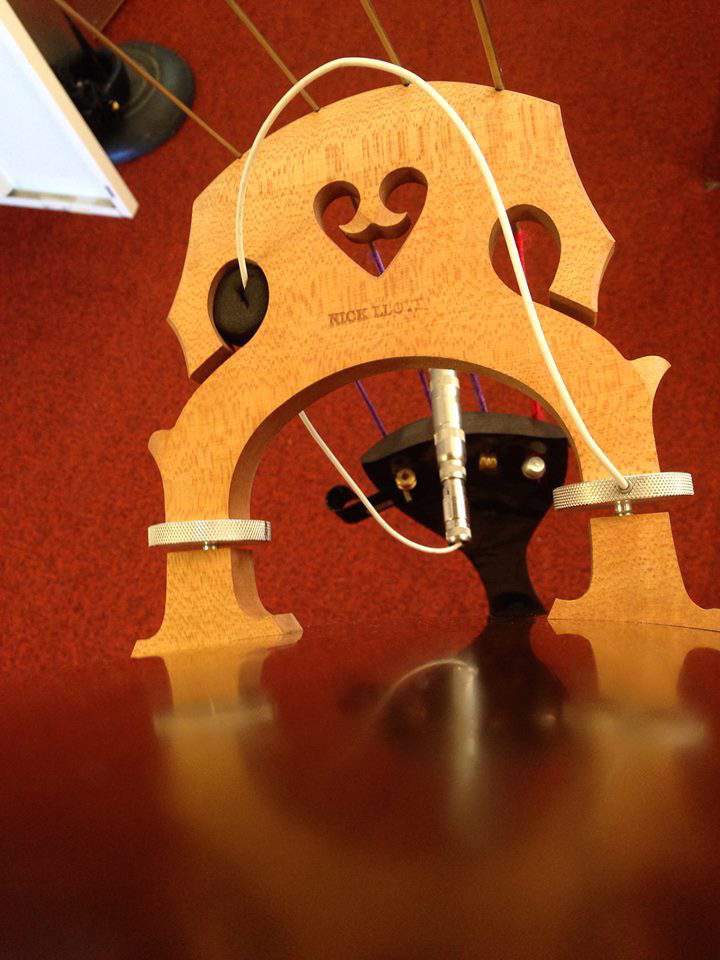
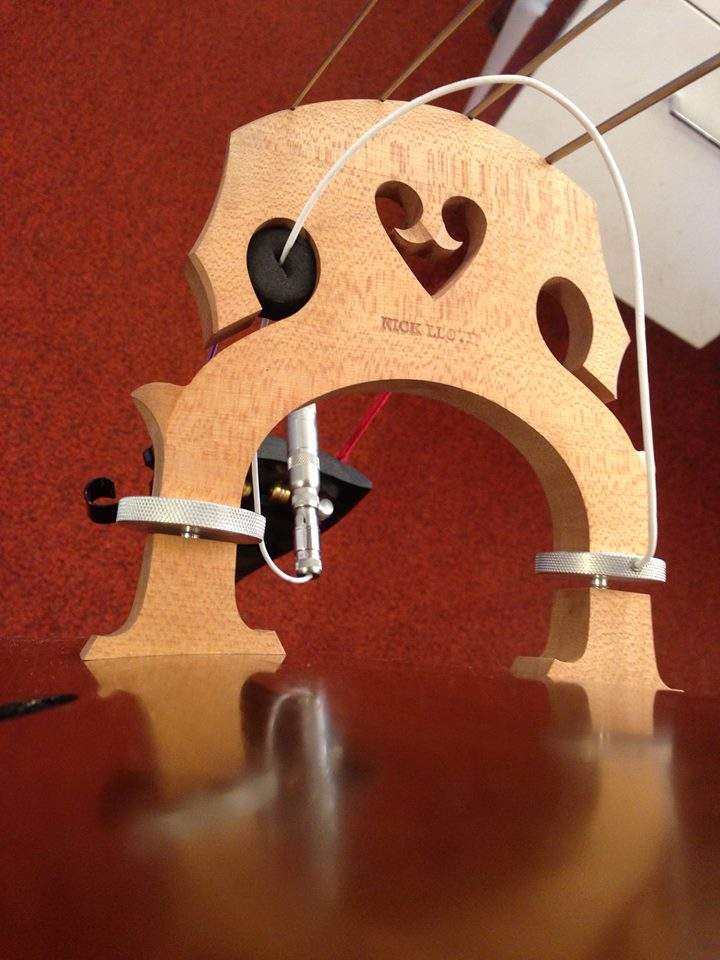
Bridge 1.jpg

Bridge 2.jpg
 
Last edited:
Is it possible that the feet are reversed? Some luthiers mark them. If not then it might be hard to tell which is which, unless you try them both ways. Also, even if the sound-post didn't fall, it still might have moved. You need to check that.

It's possible since both feet came off. The way I put it back was kind of a crapshoot, for sure! Sidney King (my colleague in the classical string department here at the U) said he thought the soundpost looked about right.

It looks like the adjuster on the E side may be one turn higher than its' brother. Maybe take them both all the way down and work from there?

Glad this came up. I've been told by a well respected luthier that it's best to keep the adjusters within a turn of each other, but that it's not necessary to have them exactly the same; having that one turn of leeway gives the player the option of adjusting the height of the G or E string to their liking. I wold be happy to hear dissenting opinions, but have been operating on this principle. :)


Edit: Pickup was on the E side, and the foot stayed with the pickup. What I don't know is whether the feet are turned inside-out or not, or how one would tell.
 
Edit: Pickup was on the E side, and the foot stayed with the pickup. What I don't know is whether the feet are turned inside-out or not, or how one would tell.
If you turn one of the feet around, you'll see that its impossible to get them backwards.

I think your soundpost moved when the bass fell. If it hit hard enough to dislodge the bridge from underneath your strings, it moved. Maybe not much but you should get it looked at by your local pro pronto.

I know its 'only' plywood, but if the post rotated a little it will be digging the angled ends of the post into the wood of the top and back.

Good luck, Chris.
 
I agree with Jake. The post probably moved. Another factor which might be nit-picky concerns the effect raising one adjuster more than the other has on relative position of the bridge. ??? Ideally, the feet should be equidistant from the F holes. With the adjuster heights equal, the bridge should look centered when sighting down the fingerboard. For example, a bridge could be closer to the bass side F hole and raising the E side will move the top and strings toward the G side, which might fool you into thinking the bridge is centered when it's not. Granted, a few mm might not affect tone but it changes the position of the bridge to bass bar and soundpost. Get it checked.
 
Thanks for the input. I will get it up to Cincy when time permits. I know Sid has done a few soundpost settings in his time and he seemed to think it was in the right place, but he didn't get in there with a mirror, either. What I was noticing today was that the space between the adjuster and the bridge foot was a little different on the inside of the foot than on the outside. At first, I also noticed that the space was different from the front to back as well, with more space on the tailpiece side of the bridge than on the neck side. I was able to correct this by straightening up the bridge. I hope it's OK to play in the meantime... it sounds better since I straightened the bridge, anyway. I still feel like these little micro adjustments are part voodoo!
 
Last edited:
I think the adjusters are fine, although the one on the bass foot is harder than hell to turn. I should have put graphite on that one while I had the chance, since every time I try to turn it now it always tries to turn the bridge foot with it. D'oh!

The whole episode brings me back to the notion of how much I'd love to see a new adjustable bridge design that allowed for more individual string height adjustment on the part of the player, or at the very least, that allowed for basic G-side/E-side balance correction. As a pizz player, that amount of space between the G and the board is absolutely crucial to the balance of the instrument. Too low, and you can't get a sound that's in balance with the rest of the bass. Too high, and playing tempos is difficult. Same for the E and growl. I love the look of those crazy adjusters that sit on ball joints somebody posted in a new bass thread recently, although as a Full Circle user I couldn't use them.
 
Here it be...

Hi all,

After a very nice trip through France and Germany I came home with my new Michael Bornhak double bass (http://www.bornhak.de/). Michael is a very talented luthier who worked for Andreas Wilfer until he set his shop in Waldkirch, a beautiful town in the south of Germany, in the middle of The Black Forest.

I was looking for a bass with pizzicato playing in mind but that could also work well under the bow and this one does it, even with Spirocore Mittels. I love everything on this bass: woods, tone, volume, playability, fit, finish, attention to detail,... When I visited Michael to see and try the bass he was very friendly and he even went home and left me alone in his shop with the bass so I could play it for as long as I wanted without distractions.

I love an old bass as much as the next guy around here but provided the quality of the instruments compared being equal, buying from a living, working luthier was a plus for me as a way to support such an art, so this was my choice: my 2014 Michael Bornhak double bass:

go to this link for the full gallery slide show:
http://s97.photobucket.com/user/frandiaz/embed/slideshow/Gear/Michael Bornhak double bass

Some selected shots:

that's the bass changing hands:
MichaelBornhakampFran02_zps81146bf8.jpg


full shot:
MichaelBornhakDB_full_zps5b26be41.jpg


the beautiful scroll:
MichaelBornhakDB_headstock03_zps7569f725.jpg


the French inspired neck botton:
MichaelBornhakDB_neckjoint03_zps4ae4bbe7.jpg


Michael even carved the bridge and adjusters from scratch:
MichaelBornhakDB_bridge_wheeldetail1_zps8f7874a9.jpg


MichaelBornhakDB_bridge_wheeldetail2_zps74194cdd.jpg


You can hear some sound samplers that Michael recorded here:
[Invalid or Expired Link Removed]
 

Latest posts