
Enjoy the benefits of a premium membership!
Upgrade Account
-
TalkBass has been independent since 1998. Add your voice.
Create a free account to reply to discussions, view embedded media, and browse with fewer display ads.
Join free Log in
Want zero display ads or expanded classifieds tools? Compare plans.
You are using an out of date browser. It may not display this or other websites correctly.
You should upgrade or use an alternative browser.
You should upgrade or use an alternative browser.
Double Bass Resetting bridge after accident
- Thread starter Chris Fitzgerald
- Start date
More options
Who Replied?

Still haven't had time to get up to Cincy, and not likely to have a break any time soon. I'm thinking of taking the bridge off again because the feet turn every time I try to turn the adjusters. I've got a tube of graphite and I can just lube the daylights out of the adjuster threads and also the top of the bridge leg that the other side of wheel touches. But as regards the bridge feet moving when the wheel is turned, I've noticed that this happens on some basses but not others. I can't help but wonder why that might be? I also honestly can't remember if this bass was one of those basses before this mess happened or not.

Jake deVilliers
Commercial User
- May 24, 2006
- 6,349
- 607
- Disclosures
- Owner of The Bass Spa, String Repairman at Long & McQuade Vancouver
The feet spin more easily on basses with flatter/smoother/newer tops.Still haven't had time to get up to Cincy, and not likely to have a break any time soon. I'm thinking of taking the bridge off again because the feet turn every time I try to turn the adjusters. I've got a tube of graphite and I can just lube the daylights out of the adjuster threads and also the top of the bridge leg that the other side of wheel touches. But as regards the bridge feet moving when the wheel is turned, I've noticed that this happens on some basses but not others. I can't help but wonder why that might be? I also honestly can't remember if this bass was one of those basses before this mess happened or not.
Use canning wax to lube the threads and friction surfaces and rub some blackboard chalk onto the bottom of the feet for grip.
Try not to drop the soundpost!
Th
Thanks, Jake... will try! Canning wax? Is that the stuff that looks like a white candle with no wick?
The feet spin more easily on basses with flatter/smoother/newer tops.
Use canning wax to lube the threads and friction surfaces and rub some blackboard chalk onto the bottom of the feet for grip.
Try not to drop the soundpost!
Thanks, Jake... will try! Canning wax? Is that the stuff that looks like a white candle with no wick?
Jake deVilliers
Commercial User
- May 24, 2006
- 6,349
- 607
- Disclosures
- Owner of The Bass Spa, String Repairman at Long & McQuade Vancouver
Geez, DURRL, I thought you'd have a canning setup in your summer kitchen!Th
Thanks, Jake... will try! Canning wax? Is that the stuff that looks like a white candle with no wick?

I guess regular candles would work but please - non-scented.
One thing I can't see in the photos is the bridge side view. Make sure the back side (towards the tailpiece) is perpendicular to the top. you can use a piece of paper as a square or just look at the bridge relative to the rib joint and it should be parallel (that's the backside of the bridge)
Geez, DURRL, I thought you'd have a canning setup in your summer kitchen!
I guess regular candles would work but please - non-scented.
My grandma had a canning setup, but I was pretty young when I was around that scene. But seriously, the wax is better than/will outlast the graphite? That's interesting. Not questioning at all - this stuff is what you do for a living - it just seems counterintuitive. So, will go with the wax and chalk!
If the feet have fallen from the main bridge part, you might have put them on the wrong side. At least something to check. I wrote something in the lower surface of each foot (like E and G, treble and bass, etc.) to avoid mixup in the future.
When I have to tune down all strings to change or remove the bridge, I put the bass on it's back on a carpet or bed so the soundpost does not fall (hopefully).
When I have to tune down all strings to change or remove the bridge, I put the bass on it's back on a carpet or bed so the soundpost does not fall (hopefully).
I worried about that at first, but since the adjusters are threads down, and since I know which side the Full Circle goes on, I figure even I couldn't have screwed that one up! 

At the hardware store look for paraffin wax. It comes in bars about half the size of a pack of cigarettes 4 or so bars to a box. Handy to have around for sticky drawers and the like. Wet snow ski wax works too....it's basically straight paraffin.Thanks, Jake... will try! Canning wax? Is that the stuff that looks like a white candle with no wick?
Jake deVilliers
Commercial User
- May 24, 2006
- 6,349
- 607
- Disclosures
- Owner of The Bass Spa, String Repairman at Long & McQuade Vancouver
Wax has been used for hundreds of years to ease wooden drawers, lubricate table saw tables and fences, etc.My grandma had a canning setup, but I was pretty young when I was around that scene. But seriously, the wax is better than/will outlast the graphite? That's interesting. Not questioning at all - this stuff is what you do for a living - it just seems counterintuitive. So, will go with the wax and chalk!
I really like it when you can adjust a DB bridge at full tension - and I use paraffin wax.
I really like it when you can adjust a DB bridge at full tension - and I use paraffin wax.
Me too - that's all I need to hear!
Just played a rehearsal today on this bass, and afterwards as i was adjusting the bridge one turn lower, I heard a quiet crack. The bass has a n open seam in the treble C bout between the side and back. I can't tell, but it may be between laminations, of it may be only a line if finish sticking up. Here's a pic:
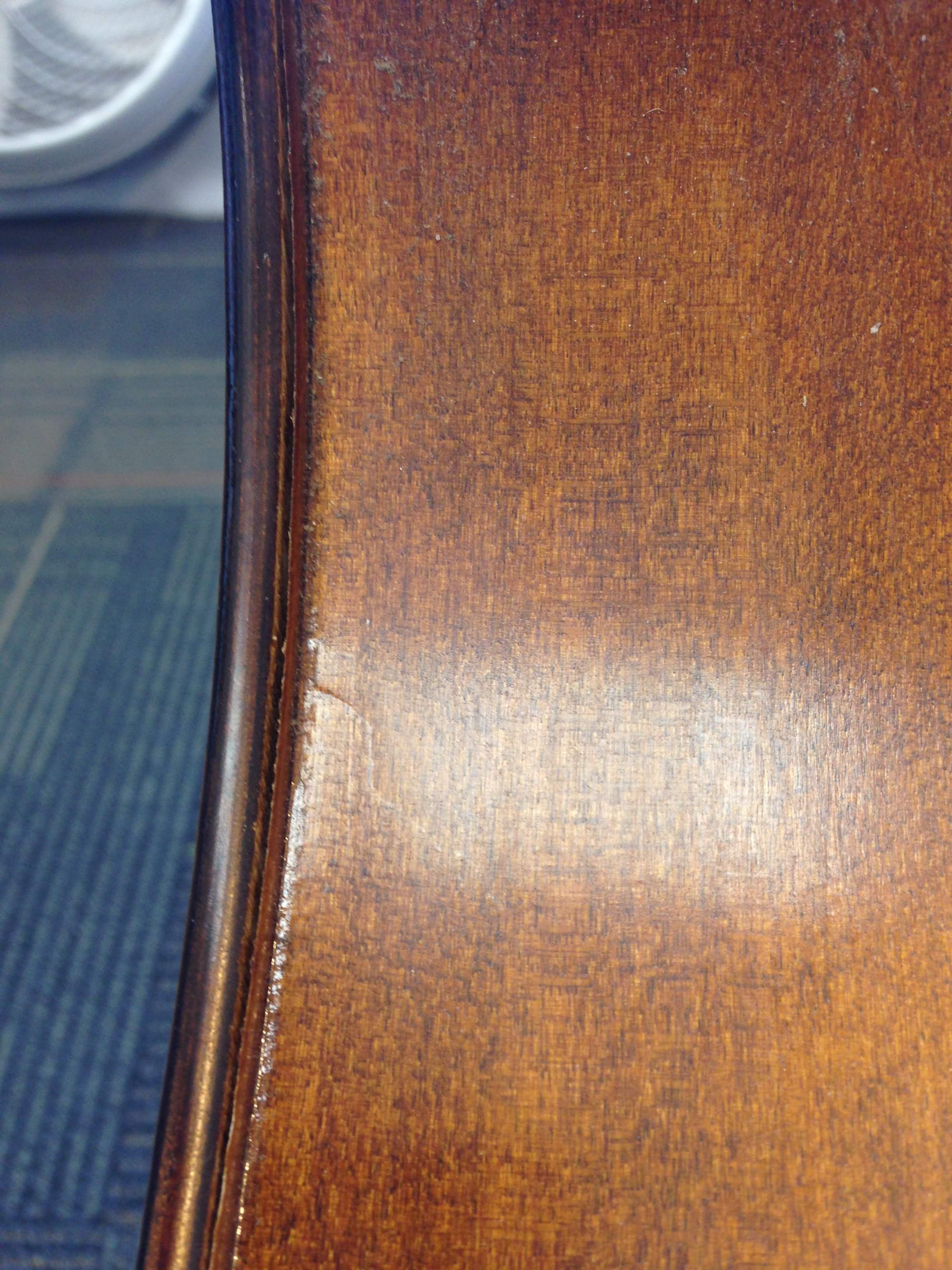
John Goldsby is supposed borrow this bass to play this week. A couple of questions: Is this a simple clamp and glue repair? If so, will the strings need to come off (they're dominants)? Last, since there's no way I can get to a luthier before Sunday, is there any danger in letting John use the bass these next two weeks like this?
John Goldsby is supposed borrow this bass to play this week. A couple of questions: Is this a simple clamp and glue repair? If so, will the strings need to come off (they're dominants)? Last, since there's no way I can get to a luthier before Sunday, is there any danger in letting John use the bass these next two weeks like this?

It looks to me like a simple glue and clamp job, but I'm no luthier. If the bass is used without the glue job being done, it likely will buzz. If it is used without the glue job, you could lose chips of finish or wood.
I *think* that is a lam separation, not finish. I see no need to remove the strings for the repair.
I *think* that is a lam separation, not finish. I see no need to remove the strings for the repair.
Jake deVilliers
Commercial User
- May 24, 2006
- 6,349
- 607
- Disclosures
- Owner of The Bass Spa, String Repairman at Long & McQuade Vancouver
Thanks, gents. Since I have neither glue nor clamps, I just stuck a business card in the crack to stop the rattle and will take it to a local guy who does school instruments when the camps are over. Here's hoping it stays together until then!

John Goldsby
Supporting Member
- Mar 4, 2003
- 1,172
- 2,160
- Disclosures
- Bassist @ WDR Big Band Cologne, Discover Double Bass, Conservatorium Maastricht, NL
Thanks, gents. Since I have neither glue nor clamps, I just stuck a business card in the crack to stop the rattle and will take it to a local guy who does school instruments when the camps are over. Here's hoping it stays together until then!
The question is: Whose business card is in the seam now? I guess that's one way to get gigs
Feel free to leave yours - that would actually be kinda cool.
A good alternative to throwing them through the f-holes. But opening a seam to be able to do that might not make the bass player happy...The question is: Whose business card is in the seam now? I guess that's one way to get gigs


