• TalkBass has been independent since 1998. Add your voice.
    Create a free account to reply to discussions, view embedded media, and browse with fewer display ads.
    Join freeLog in
    Want zero display ads or expanded classifieds tools? Compare plans.

RESOLVED New Bass Build has no Lows

I've been wondering this myself. I almost never play unplugged, so it's a little hard for me to decide if it does or not. I A/B'd it last night with my fattest sounding bass unplugged. It definitely sounded thinner? But I don't THINK it sounded like it should have as little low end as it does.

Would a 500k volume pot make a bass sound thin? In some of my reading I turned this up as a possibility for what I did wrong. I'm not sure whether I put a 250k or a 500k volume pot in the bass or not.
I didn't read down after this but, yes 500k pot can make single coil pickups sound thin.
 
Is this a multi-pickup bass? If so, the pickups might be wired out of phase (opposite polarity). This would create a big low frequency drop when both pickups are used together. One way to tell this is that if you solo each pickup, the bass response should get better.

This is exactly hat I was thinking. Out of phase pups will kill virtually all of your low end and a good portion of your mid range also. I’d be curious as to how your pups are physicaly set up. Could you post a pic? Better yet show us your wiring.
 
Keee-rist, that's a heavy body! I have entire basses that are lighter than that. It's possible that that heavy chunk of wood is the culprit, as it's so dense it doesn't vibrate, therefore you just get string vibrations with no interference. Kind of like a Steinberger stick.

Does it have super-long sustain with no dead spots? If so, I'm thinking the issue is that dense body with the stiff quartersawn neck.
Plus the heavy decoupling string vibration from the wood, bridge. The thinner the bridge, the more interaction with the wood, for better or worse. The heaver the bridge, the less string vibration gets to the wood. The tone stops at the bridge. IMHO...
 
Last edited:
  • Like
Reactions: bdplaid
why assume they dont think to do it. if you dont want to have to adjust eq on the amp every time you change basses then you look at all the other options so that you either dont have to change any settings or just hit a pedal on or off to get what you want and get what you want instantly. i know for me on stage i dont want to have to touch my amp, ive got other things to do up there. besides, we know how much sound guys like it when you mess with your amp after sound checking ;)
What's wrong with turning ONE knob on the amp?
We turn knobs on everything else all the time!
What are they there for if not to use?
 
Sarcasm?
8 lbs is not heavy!
13-14lbs is.

Have a look at average body weights on Warmoth. Most are around 5lbs, 6lbs on the heavy side and 4lbs on the light side (unless you are talking short scale, ultralight bodies, etc). 8lbs for just a body is insane (at least for a 4 string) and also have entire basses that are lighter than that body.
 
  • Like
Reactions: bdplaid
An 8LB BODY is heavy. Most of my builds have been half of that. You won't see many above the 5lb range on Warmoth's site. The neck and other junk add about 4 - 5 lbs to an instrument's weight. That's where the average 9 lb bass comes from. His bass will be around 12 or 13 lbs assembled.

Have a look at average body weights on Warmoth. Most are around 5lbs, 6lbs on the heavy side and 4lbs on the light side (unless you are talking short scale, ultralight bodies, etc). 8lbs for just a body is insane (at least for a 4 string) and also have entire basses that are lighter than that body.
OK.A body separate from the neck and everything else.
So you're referring to a parts bass.
Many of us just buy the whole bass assembled.
That's why I defer to the whole bass weight.

Plus the fact that some basses are neck through.
There is no separate body weight.
 
It might be worth our time to consider a few of the basics of troubleshooting methodology. In reading the thread, I'm seeing the following things considered(in no particular order):

1. Type of body wood used
2. Neck wood(quartersawn vs. flat)
3. The combination of pickups from different manufacturers
4. Weak battery
5. Wiring issues(pickups out of phase, mis-wired capacitor, etc.)
6. Component out of spec.(Resistor, etc not within specified tolerance)
7. EQ at the amp
8. The type of bridge used, and it's transmission of audio information to the body
9. Use of possibly-inappropriate values for pots
10. Bad ground connection
11. Use of specific components(Stellartone, pickups, etc.) lending this specific character to the tone(with the assumption that no anomalies exist).
12. Pickup to string distance
13. Type of string used(already addressed by changing strings)

Along the way, we have chosen to troubleshoot the tone on a different instrument(If I understand correctly that the example in the video is NOT the bass in question).

A quick look at the list above will indicate which of these items can be tested with relative ease, as opposed to more complicated changes. It is my suggestion that you eliminate the possible causes in that order, by taking the "low-hanging fruit" first, then advancing to more complicated tests.

If you have not done so, I would strongly suggest(because I, like others, believe the answer lies in the electronics) that you photograph the control cavity, then use the photo to help you draw a schematic diagram of the electronics(if you have not already done so). This could be very helpful in determining the cause of your woe, and some measure of documentation would be very useful to anyone on the thread who is trying to help. I'd also suggest limiting the conversation to your bass only, as other similar-sounding examples may sound that way for reasons that are completely different from the conditions surrounding your build.

Best of luck in getting this the way you want it to sound. I'll continue to watch, as I am curious to learn the eventual answer.
 
OK.A body separate from the neck and everything else.
So you're referring to a parts bass.
Many of us just buy the whole bass assembled.
That's why I defer to the whole bass weight.

Plus the fact that some basses are neck through.
There is no separate body weight.

There really should be no confusion, the title of the thread mentions a "bass build" and the OP did include this:
Pretty traditional setup.

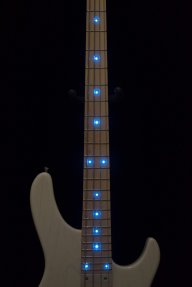
Neck = Quartersawn maple/rosewood (roasted maple). I finished the maple with Tru Oil and the rosewood with lemon oil.
Body = 8lb Alder P-Bass shape with a side jack.
Electronics = passive P/J (aguilar P/ Kloppmann J). Blend knob, Stellartone Bass 10 tone knob, Kill Button, Output.
Hardware = Hipshot Tuners (with D-tuner), Babicz Full Contact Bridge, anodized aluminum pickguard.

That's about everything I can think of.
 
  • Like
Reactions: bdplaid
OK.A body separate from the neck and everything else.
So you're referring to a parts bass.
Many of us just buy the whole bass assembled.
That's why I defer to the whole bass weight.

Plus the fact that some basses are neck through.
There is no separate body weight.

None of us have weighed it, or seen it, we can only go by the OP's words, which listed the body separately and said 8lbs.
 
  • Like
Reactions: Watchootognbout
Hey guys!

So I just finished this build I've been doing for months and month and everything turned out spectacularly, except for one really weird problem. The bass doesn't really seem to have any lows and it's the brightest bass I've ever played.

At first I blamed the strings, I had put brand new D'Addario NYXLs on it. But I swapped them out for 1+ year-old TI flats and it still sounds super aggressive and angry. The pickups are really high-quality vintage sounding pups that people usually use to get more classic tones.

Every other aspect of the bass is amazing and it feels/plays like heaven. I just can't seem to figure out where my thump is! I've played hundreds of basses over the years and this one has got to be the most aggressive, least bassy bass that I've played yet.

I'm open to the idea that I did something wrong. Let me know what you think.

I owned ONE Zon, and it was exactly as you describe. I've never owned a bass before or since that was like it. Perhaps there was something wrong with it, but it was certainly disappointing. I sold it quickly. Hope your situation works out.
 
My suggestion: hook each pickup, one at a time, directly to the jack and test.
THIS ^ THIS ^ AND THIS ^
I was reading through to see if someone else suggested this.
It's the only way to really tell if the pickups are doing what you expect.

If both sound OK individually, then wire them both directly to the Jack without any of the other components.
If it still sounds right, note the wiring because you have them wired in phase.
If together, they sounds thin, you have them out of phase.

Different brands of pickups can have different wiring color schemes.
Check with each manufacturer to see that you have the correct schemes for each.

Also magnets put in differently can change phase.
I dropped a pickup once and the magnets came off, when I finally got them put back on in a position where it worked properly by itself, but it was out of phase with the other. I had to reverse the wiring to make up for the phase difference.
 
There's a builder forum video on YouTube with Roger Sadowsky and Michael Tobias... At one point both of them mention that when constructing and assembling an instrument, they finish it, tune it to pitch, then walk away for a few days. Both of them mention that it can take time for the instrument to settle into its sound.
Yeah. No. Miswired basses don't settle in.
Walk away for wood parts to settle in and perhaps there will be subtle tone changes as the bass acclimates to it's finished assembled form and environment. But it won't make wrong sound right.