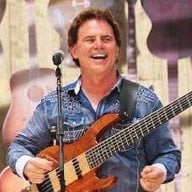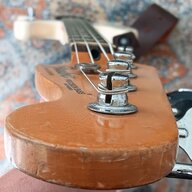
I recently purchased a used Reverend Thundergun bass. Prior to buying it I did some research but could not find very many reviews online. So I thought I'd add one. Warning: I have never tried to write an instrument review before.
A little background... I'm in my mid-50's and have been playing bass since I was 14. Over the course of those 40 years I've owned dozens of basses, from Fender (P, J and Jag) and Gibson (T-bird, Grabber, SG) to Ibanez and Alembic and Modulus and Pedulla and Status and Tobias and Wal, etc., etc. My primary bass these days is an Ernie Ball Music Man Stingray. I also have a Rob Allen fretless. I play Americana, Classic Rock, Blues, R&B and Jam-band music. I like my bass to be bassy. James Jamerson and Pino Palladino are my guys. I use flatwounds, roll off the high end completely, roll on the low-end, and boost the mids. One of the things I like about Stingrays is that it feels natural for me to anchor my thumb on that big pickup near the bridge while plucking with my fingers (I only pick occasionally, if the song calls for it).
Recently the battery housing crapped out on the Stingray at rehearsal a day before a gig. Suddenly no sound. Dead in the water. That's the second time this has happened to me. The first time a little soldering fixed it. This time it was beyond repair. I was able to get the entire housing replaced in time for the gig by a local repair shop (thanks Mike Lull!), but the experience spooked me. So I decided I need a backup bass for the Stingray, that I could have on-hand at gigs. For a backup, I wanted a well-made bass with passive electronics, that could hopefully approximate the sound of my Stingray live but also add a little variety that I could leverage when recording. I also didn't want to spend a lot of money.
I love the look of Reverend's Mercalli and Thundergun basses (though it would be nice to see more finish options available). I'm a sucker for korina and especially dig the natural finish on the Thundergun. I live in a big city but could only find one Reverend bass in a store to try out and it was a Dub King. So I tried it and was impressed. Very well built and solid feeling and fun to play and I liked the sound of the pickups (as best I could tell with roundwounds). I didn't care much for the look of the Dub King though and didn't want to go short scale or spend that much dough on a new bass that would just be a backup instrument. But soon after an opportunity arose to get a used Thundergun (which has the same pickup configuration as the Dub King), so I took a chance and bought it online without being able to play it first.
My first impression upon receiving the Thundergun was that it is a beautiful and well-made instrument. Solid, good components, smooth pots, beefy bridge, flawless finish. I immediately put some flats on it, tweaked the action a bit and plugged it in. Dead silent--no hums. A good sign.
I initially played it at home though a Phil Jones BigHead headphone amp and Audio Technica M40 headphones. Then I took it to band practice and played through a Demeter 400D amp and Epifani UL3 2x10 cabinet. Here are my impressions of the sound (and I'm realizing as I write this how difficult it is to meaningfully describe instrument sounds with words).
First off, the bridge pickup sounds a bit like my Music Man, but has more midrange definition. It is tight, aggressive and ballsy. Unlike a Jazz bass bridge pickup it is not thin or nasally. This pickup would really cut through and assert itself in a band situation and would be perfect for jazz fusion (does anyone still play jazz fusion?), soloing, etc. It really brings out funky, articulate playing.
Rolling over to the neck pickup produced a warm, full, punchy, low-midrangy, growly sound reminiscent of a P-bass but without that woody, hollow, scooped characteristic that I don't care for in P-basses (and J basses). The neck pickup made me want to go all John Paul Jones and start to Ramble On. In a band setting it undergirds the mix with a tone that's rich and muscular and well-defined. Perfect for the type of music I play.
Playing live with the band, it was fun to go back and forth between the two pickups depending on which best suited a particular song. However, I found the pickup blend/pan knob to be nearly useless. It's a neat idea, but either a pickup selector switch or, better yet, a vvt knob configuration would have worked better IMHO. Even when playing alone through headphones, I could not get enough of a blend of the two pickups to make any noticeable differences in the sound. Maybe the gradations would be more discernable with roundwounds. And worse, the middle position (both pickups) caused it to sound weak and muffled (perhaps out of phase?). Maybe the pot is bad? Or is this what it's supposed to do? I would have preferred that the blend in the middle be both pickups full on. Instead it seems like the weakest signal of each pickup combined. I'll have to go back and play that Dub King at the store to see if it does the same thing.
So, for me the usable pickup selection options are full-on bridge pickup or full-on neck pickup, not blends of both. That's a lot of loss of potential tone shaping, but I'm a "set it and forget it" kind of guy so it doesn't bother me. When dialed to either full bridge or full neck pickup, the sound is focused and assertive. The sustain is fantastic. The volume level is even between pickups (except for that center blended "both pickups" dead zone where everything phases out) and is even across strings. The fourth fret on the G string (B note) has a bit of a dead spot, and requires a little more attack to match other notes. This is not an unusual occurrance on a bass--fairly common on Fenders--and I don't mind little personality quirks like that, as long as they're not too prevalent.
The neck feels super-fast. It is easier to play than my Stingray, or a Precision. I don't know what the dimensions are, but it really does remind me of a Thunderbird neck. My fingers seems to move around with less effort.
Comfort-wise, the Thundergun is a winner. It is lighter than my Stingray. There is no neck dive. I like the absence of a belly-cut on the back of the body (never liked those and wish Ernie Ball hadn't added them to the Stingrays). I hold my basses fairly high and the Thundergun feels good pressed against my chest. The body is resonant. It hangs a bit different on me than a P or J or my Stingray does--mostly I think because there is no belly cut--but once I got used to where it naturally wanted to go I was good with it.
I installed black Schaller straplocks. I think I'll replace all 3 knobs with black metal knobs. It would be cool to do a black bridge and black tuners too. Maybe someday when Reverend makes my signature model I'll specify those cosmetic touches. ;^)
The Thundergun really does capture the best of several classic basses while also establishing its own unique personality. It's got a little bit of Stingray without the heft (or dependence on batteries) and with more tonal variety; a bit of Fender Jazz but with more balls; a bit of Precision but with more fullness; a bit of Thunderbird without the neck dive and unwieldy body shape. So far everyone who sees it--bass players and non-bass players alike--has oohed and ahhed at how cool it looks. It's too bad there aren't more Reverend basses in shops for folks to try out.
My Thundergun is a keeper and will give the (much more expensive) Stingray a run for its money. It will not be relegated to the originally intended status of mere backup, but will instead get played a lot, live and in the studio.
I find that many bass review/demonstration videos on YouTube are of limited use because the bass is not recorded well. So I made a recording of the Thundergun through a Zoom R24 digital recorder--just noodling around. There are no effects and the EQ is set flat. The tone control on the bass is rolled off entirely, until the 03:04 mark.
Dropbox - Reverend.WAV
Played with fingers:
00:00 - 00:33 - Bridge pickup
00:33 - 00:40 - Slowly panning to middle (both pickups)
00:40 - 01:00 - Middle (both pickups)
01:00 - 01:10 - Slowly panning to Neck pickup
01:10 - 02:00 - Neck pickup
Played with pick:
02:00 - 02:25 - Neck pickup
02:25 - 02:32 - Panning to middle (both pickups)
02:32 - 02:37 - Middle (both pickups)
02:37 - 02:46 - Panning to Bridge pickup
02:46 - 03:04 - Bridge pickup
Played with fingers & treble control turned up full:
03:04 - 03:14 - Slowly turning up treble control
03:14 - 03:50 - Bridge pickup w/ treble turned up
03:50 - 04:00 - Panning to Neck pickup
04:00 - 04:42 - Neck pickup w/ treble turned up
Last edited: