• TalkBass has been independent since 1998. Add your voice.
    Create a free account to reply to discussions, view embedded media, and browse with fewer display ads.
    Join freeLog in
    Want zero display ads or expanded classifieds tools? Compare plans.

Rick 4003 Truss/Neck repair

Update: The truss rod nut on the low E side is absolutely refusing to budge. I can maybe turn it a hair in either direction but after that it stays stuck.

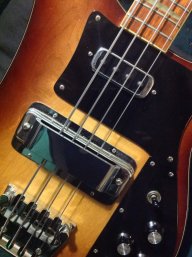
Although I am a little bit confused as to which direction to turn it. The manual states underbow = clockwise and overbow = counter-clockwise. However I am not sure what they mean by under/over? My neck looks like this:
There are a million people asking the same question online and I am still confused as to which way to turn it.
View attachment 3400463

The high G side truss rod nut moves freely in either direction.
The Rickenbacker manual uses the under bow and over bow terms opposite to how I expect them. You have too much neck relief which they describe as under bow and needing clockwise turn. You may need someone too push the neck straight while you tighten it clockwise per their manual. Definitely loosen the strings for the procedure. Someone with the right tools might do this with clamps.
Screenshot_2019-04-29-00-07-09~2.png
 
Last edited:
Also, I would bet the G string nut turns so easily because it is loose and doing nothing while the E string one is tightened. I would guess that is also why it shows more in the pickup cavity. The G string side is straight and the E string side is curved.
 
So do you believe that flatting the neck out by hand/with clamps would allow me to tighten the E-string side much easier? Because right now I don't think I'll be able to, even with a good amount of force.
 
I've seen a number of ways to do it. Dan Erlwine has a video with clamps on a Fender neck. There is a video of someone clamping the Rickenbacker body to a table, then pushing on the headstock. I've seen people use a buddy to hold it while tightening.

The trick is, the truss rod doesn't move the neck. The truss rod holds the neck. Manually straightening the neck should make it easier to loosen the truss rod. Loosening it should cause no harm.

Having the strings tuned to pitch means you are starting out with a lot of force to fight against. Loosen them. You might end up having to over correct to compensate for the strings when you tune.

Also, both truss rods should have around the same tightness on the nuts. The fact that the one can move in every direction without any tension means that it is doing no work. Only the E truss rod seems to be trying to hold the neck.

I would start by manually straightening with the strings loose, and loosening the truss rod so I could grease the threads. Then I would straighten it and tighten the truss rods until both felt snug and held the neck straight.

You might have to repeat a couple of times.
 
What others were saying is the truss rod can just be pulled out of the neck and replaced if it is truly broken. I've not done it on a Rickenbacker. I've seen it done on a Fodera and I've done it on a Warwick. It is a simple procedure. But the first step would be loosening the nut.
 
What you are describing is what I thought was the case for the pre-'84 truss rods, not the modern dual truss rod neck. It was going to be the next thing I tried but I couldn't gather whether or not it was for the 84 necks only - so I came here to ask. If I can use that method here I'll give it a go
 
What you are describing is what I thought was the case for the pre-'84 truss rods, not the modern dual truss rod neck. It was going to be the next thing I tried but I couldn't gather whether or not it was for the 84 necks only - so I came here to ask. If I can use that method here I'll give it a go
The manual from Rickenbacker is convoluted a little. First they describe one way of doing the truss rod. Then say if you have an old instrument, you should do something else. Then it says to do that for all instruments, even implying non Rickenbacker ones.

Screenshot_2019-04-29-00-59-24~2.png

It really would seem to be helpful. The nut needs to move. Straightening the neck manually will take the compression off the nut reducing the friction to let it loosen.

I think if you have to make a small adjustment on a neck, you can get away with a small turn and no manual assistance. If you have a bigger change, the truss rod really wasn't designed for that.

Give it a watch.
 
Last edited:
  • Like
Reactions: JPDsma
Awesome - this is great! Yeah...the owners manual is poorly written, hence my confusion. I'll give that a try buy I'd like to see what @Jeff Scott has to say first - he apparently has experienced the exact same symptoms...
 
The Rickenbacker manual uses the under bow and over bow terms opposite to how I expect them. You have too much neck relief which they describe as under bow and needing clockwise turn. You may need someone too push the neck straight while you tighten it clockwise per their manual. Definitely loosen the strings for the procedure. Someone with the right tools might do this with clamps.
View attachment 3400644
The stuff about instruments other than the Ric having limited range of adjustment is pure and utter garbage. Many instruments have much better control over the neck adjustments than Rickenbacker does. So don't get misled by this manipulative bit of advertising copy.
 
Thanks for that better angle of the headstock. So, there are a few extra thread protruding on the E side vs. the G side, but not overly excessively so. The key thing is how far the heel end of the rod has pulled into the neck.

Is your bass from 1984?
Can you pull the pickguard and photograph the nuts on that end? If you are careful you shouldn't even need to loosen the strings, but use a towel, or whatever to protect the finish as you slide the pickguard out from under the strings (or loosen them if you prefer, to make it easier to do so). Regardless, given how much relief you have, you need to either clamp the neck of have someone help you so that you can relieve pressure on the rods. As mentioned above, the rods are not designed to do that much work, they are primarily for holding the neck in place once adjusted.

The wood at the heel end of the neck may be a bit soft, and this can be dealt with my saturating it with CA glue to harden and strengthen the wood there, but you will need to remove the rods first before doing this. What kind of truss rod tool do you use?
 
I haven't tried to remove the nut entirely yet. I can do that when I am home. Is there anything I should be wary of? I dont wanna cause too much tension on the other truss rod and break it or something
 
It won't over stress the other rod, but for educational purposes, I'd totally loosen the strings and remove both nuts and leave the bass for a day or two to see what the neck does when relaxed (no tension on it at all).

After that, we can talk about pulling the rods out. It really is pretty simple to do. I have read of the rods rotating and putting pressure on the wrong side of the neck (they are pre-curved a bit before sliding them into their channels).
 
Last edited:
UPDATE:

Okay so after being unable to make any progress myself I took it to a local tech that was recommended to me.

He messes around with it a bit and after about 5 minutes he realizes that the G-side truss rod is just...broken. The top nut for the rod just kind of fell out of place. We then mess with the bottom of the rod and push/pull it in and out of the neck to see what happens...pushing it in a bit actually made the neck straight as an arrow so for right now we're leaving it at that. I'll get a replacement rod (where can I purchase one?) and swap it out when I can.

If any of this sounds incredibly upsetting or dangerous let me know - otherwise thanks for all the help guys!
 
The rods are designed for user/field replacement, so you're good to go when you get the new rod (from RIC, presumably). I had to replace one on my '04 4004Cii, no big deal. :cool: At least, it was easily replaceable; try doing that on a Fender or most any other instrument. ;)
 
I'll get a replacement rod (where can I purchase one?) and swap it out when I can.

Spindrift in New London is a Ric dealer and several years ago was great about getting me small parts from Ric, at a discount from list price, and without Ric's absurd shipping fees. I will offer the caveats that this was 2015, the salesman I was dealing with is no longer there (it still has the same owner, though), and I had purchased a 4003 from them around the same time. I don't know if any of that will make any difference at all, but they're still good people.
 

Latest posts