• TalkBass has been independent since 1998. Add your voice.
    Create a free account to reply to discussions, view embedded media, and browse with fewer display ads.
    Join freeLog in
    Want zero display ads or expanded classifieds tools? Compare plans.

Rickenbacker Weirdness

MrBKerth

The Gypsy Bravado
Apr 20, 2013
726
210
Texas
scumpopband.wixsite.com
Hello all,
looking at getting a Rickenbacker 4001/4003 and was finally able to play one this weekend. I don't have experience with Rickenbackers and this one had some quirks that seemed quite problematic.

It's a vintage Ric 4001 and the bridge pickup only works on one of the outputs. When plugged into the output closest to the bottom strap button, all 3 pickup selector positions generated sound (bridge position was extremely weak and almost entirely treble but the others sounded great). When I moved to the output farthest from the bottom strap button, soloing the bridge pickup produced no output. I've registered with the Ric Resource Forum, and I'm waiting for approval/activation, but I figured I'd ask you guys and gals. The seller had mentioned that it was not uncommon to use a Y split instrument cable or a stereo box of some sort for the old ric's, but I'm unfamiliar with that as well.

Does any of this sound correct/common?
 
The other output jack does require a Ric-O-Sound box for stereo output, at least on my modern 4003. That part sounds normal. The standard output jack (where you heard the signal) handles both pickups and it sounds like there may be an issue with the pickup, the pot, wiring, etc.

I enjoy my new Ric and recently discovered the need for the extra Ric-O-Sound box...I expected to run another cord to a different amp but no. And it's not really stereo, it splits the neck and bridge signals to run to different amps -- no idea why that cannot be achieved like I thought it would be. In any case, that sounds correct/normal.

If Jeff Scott sees this thread, he'll know everything about the 4001. There are several experts around, stand by.
 
The other output jack does require a Ric-O-Sound box for stereo output, at least on my modern 4003. That part sounds normal. The standard output jack (where you heard the signal) handles both pickups and it sounds like there may be an issue with the pickup, the pot, wiring, etc.

I enjoy my new Ric and recently discovered the need for the extra Ric-O-Sound box...I expected to run another cord to a different amp but no. And it's not really stereo, it splits the neck and bridge signals to run to different amps -- no idea why that cannot be achieved like I thought it would be. In any case, that sounds correct/normal.

If Jeff Scott sees this thread, he'll know everything about the 4001. There are several experts around, stand by.
That's very reassuring because even though it's a 70's model with rounds on it, the neck appears to be in good condition with very low action. Minimal bridge lift as well. By the sounds of it, I may need to replace the bridge pickup or have the gremlins chased out of it, but that can assuredly be done. Loved the sound I got out of the normal channel.
 
That's very reassuring because even though it's a 70's model with rounds on it, the neck appears to be in good condition with very low action. Minimal bridge lift as well. By the sounds of it, I may need to replace the bridge pickup or have the gremlins chased out of it, but that can assuredly be done. Loved the sound I got out of the normal channel.

I suspect it'd be a minor repair. It really is all treble, I'd think even more on a 4001 before they changed the tone on the 4003. At some point they created the push/pull tone pot to get both 'modern' (more bass) and the 'vintage' all trebly tones on the 4003. Another possibility is pickup height is too low...when I removed the pickup cover on mine (requires disassembly and redoing the pickup height) I noticed how much height affects the the overall output.
 
I had minimal output from the neck pickup on my '83. Turned out to be dead and the only reason I was getting any output from it at all was inductance. I had mine rewound by Tom Brantley; he comes highly recommended, and that's what I'd recommend over replacement, because modern pickups are wound hotter than the '70s pickups.

The trebly tone of the bridge pickup is due to a bass cut capacitor that many people snip to make the output deeper. The modern push-pull switch simply switches the capacitor in or out of the circuit and is very easy to retrofit to an older bass. I added one to my '83.

The Ric-O-Sound is simply a stereo jack that routes the neck and bridge pickups out separately, presumably to separate amps, and one can be straight sound while the other has effects, or whatever you wish. You don't need a Ric-O-Sound box, you can use a stereo splitter cable with a stereo plug at one end that splits to two mono cables. (The reason you only got one pickup when you plugged into that jack was because it was a mono cable into a stereo jack.) I found a cable that runs stereo for several feet before splitting into two mono cables; to my kind it was better than the more easily found splitter that splits right by the jack because then you've got the weight of two cables right there, and it's more cumbersome.

You also want to read this, because with an older Ric, you want to understand how the truss rods work before you ever go near them; they're not like normal truss rods. If you have a tech do the work, it's worth making sure they're familiar, too: Invalid Link Removed
 
Hello all,
looking at getting a Rickenbacker 4001/4003 and was finally able to play one this weekend. I don't have experience with Rickenbackers and this one had some quirks that seemed quite problematic.

It's a vintage Ric 4001 and the bridge pickup only works on one of the outputs. When plugged into the output closest to the bottom strap button, all 3 pickup selector positions generated sound (bridge position was extremely weak and almost entirely treble but the others sounded great). When I moved to the output farthest from the bottom strap button, soloing the bridge pickup produced no output. I've registered with the Ric Resource Forum, and I'm waiting for approval/activation, but I figured I'd ask you guys and gals. The seller had mentioned that it was not uncommon to use a Y split instrument cable or a stereo box of some sort for the old ric's, but I'm unfamiliar with that as well.

Does any of this sound correct/common?
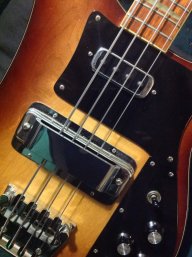
The further from the strap button output jack is a stereo jack, and you need a stereo cable to make it work right.

The closer output jack is mono.

It sounds like the one you were playing does not have the capacitor that cuts low frequencies from the bridge pickup bypassed. Many people bypassed this cap. Modern Rickenbackers have a push/pull pot to either bypass it or engage it.
 
The 4001 has a capacitor on the bridge pickup ( a .0047 cap) that removes the lower frequencies . You can bypass the cap with a piece of wire and get the full response of the pickup . It's easy to do . I did the bypass on my 4001 the day I got it . You should also read up on adjusting the old spring style truss rods . You must tension the neck before you attempt to tighten them . You can damage the neck if you do not tension them first . Older Rics are quite different from other basses , but once you understand the differences you will be fine ...
 
If it's a bad pup, consider a Classic Amplification replacement, better construction, lead dress, and shielding than OEM. He can custom wind them for classic 4001 tone or more modern 4003. Good luck with it, love the thinner neck profile on the old 4001's.
[Invalid or Expired Link Removed]
 
Hello all,
looking at getting a Rickenbacker 4001/4003 and was finally able to play one this weekend. I don't have experience with Rickenbackers and this one had some quirks that seemed quite problematic.

It's a vintage Ric 4001 and the bridge pickup only works on one of the outputs. When plugged into the output closest to the bottom strap button, all 3 pickup selector positions generated sound (bridge position was extremely weak and almost entirely treble but the others sounded great). When I moved to the output farthest from the bottom strap button, soloing the bridge pickup produced no output. I've registered with the Ric Resource Forum, and I'm waiting for approval/activation, but I figured I'd ask you guys and gals. The seller had mentioned that it was not uncommon to use a Y split instrument cable or a stereo box of some sort for the old ric's, but I'm unfamiliar with that as well.

Does any of this sound correct/common?

The Rick has a mono (nearer the strap button) and a stereo output jack: the mono jack works like the output jack of all normal passive basses. The stereo jack separates the pickup outputs, with one pickup on the tip and the other on the ring (of a stereo jack-plug): you need a stereo cable going into a Y-splitter to use this effectively, then you can run your pickups to 2 separate amps or two different channels of one amp. If you plug a (normal) mono cable into the stereo socket, you short out one pickup and get just the other pickup output. Most of us just use the normal output. There doesn't seem to be an issue with your 4001 on that score, anyway - it's working correctly.
 
Nice try. Stereo has a specific meaning, You're just being A.R. To prove a point.

Aren't both circuits in fact used for audio? Or is the output of one of the pickups sending MIDI data?

And weren't you doing the same?

T R S connectors can be, and are most commonly used for stereo, which is what most people think of when they see these connectors. Most non-technical people may err technically in calling it a stereo connector, when it is used for so much more.

Stereo is just a special case of two channel audio. It can also be used as you pointed out, as a two channel audio connector in which neither channel of audio is related. Then it is also commonly used for analog balanced audio, where it takes both the tip and ring connectors to carry only one channel of audio. And then it can be used on a guitar/bass for that matter, to carry both audio and carry the ground circuit to turn on the active circuitry if mated with the common instrument Tip/Sleve 1/4" plug. Where you pointed out that someone technically restricted the use of this connector only for stereo audio, I likewise pointed out that there were, technically, other uses beyond those described so far.

1/4" T.R.S. is the proper technical description. Calling it a stereo plug is the most common non-technical description. Everyone knew what the other person was talking about. They however did not claim technicality. Certainly many other connector types can carry stereo or other two channel audio and do the other things. The physical connector itself has little or no bearing on the type of signal it might carry. You can technically do a stereo connection using a three prong A.C. plug. It is not technically correct to call that connector a stereo plug. The non-technical folks get cut a lot of slack around here in my mind.
You can't hate me for finding more technically innovative uses for the TRS, so you will only have to hate me for being even more A.R. And perhaps also for coming to the defense of our otherwise oppressed, non-technical friends. ;)

EDIT: Wait! What? Ohhhh, that A.R.! I thought it meant Aways Right. :facepalm:
I'm never always right... and I can prove it!
 
Last edited:
  • Like
Reactions: Sartori
And weren't you doing the same?

T R S connectors can be, and are most commonly used for stereo, which is what most people think of when they see these connectors. Most non-technical people may err technically in calling it a stereo connector, when it is used for so much more.

Stereo is just a special case of two channel audio. It can also be used as you pointed out, as a two channel audio connector in which neither channel of audio is related. Then it is also commonly used for analog balanced audio, where it takes both the tip and ring connectors to carry only one channel of audio. And then it can be used on a guitar/bass for that matter, to carry both audio and carry the ground circuit to turn on the active circuitry if mated with the common instrument Tip/Sleve 1/4" plug. Where you pointed out that someone technically restricted the use of this connector only for stereo audio, I likewise pointed out that there were, technically, other uses beyond those described so far.

1/4" T.R.S. is the proper technical description. Calling it a stereo plug is the most common non-technical description. Everyone knew what the other person was talking about. They however did not claim technicality. Certainly many other connector types can carry stereo or other two channel audio and do the other things. The physical connector itself has little or no bearing on the type of signal it might carry. You can technically do a stereo connection using a three prong A.C. plug. It is not technically correct to call that connector a stereo plug. The non-technical folks get cut a lot of slack around here in my mind.
You can't hate me for finding more technically innovative uses for the TRS, so you will only have to hate me for being even more A.R. And perhaps also for coming to the defense of our otherwise oppressed, non-technical friends. ;)
I don't hate anybody. I understand what you are saying. I wasn't the one who invented the word stereo and instilled it with a specific meaning. As musicians we should probably know what a stereo soundfield is regardless of our technical acumen.

For the record, even Rickenbacker calls it a stereo jack. Nobody is perfect. And by that, I am not referring to a recently banned member forum.
 
I don't hate anybody. I understand what you are saying. I wasn't the one who invented the word stereo and instilled it with a specific meaning. As musicians we should probably know what a stereo soundfield is regardless of our technical acumen.

For the record, even Rickenbacker calls it a stereo jack. Nobody is perfect. And by that, I am not referring to a recently banned member forum.

Gotcha!

Any one who conjures up the spirit, willingly or otherwise, of the one of whom we shall not speak, is aces in my book.
image.jpeg
 
  • Like
Reactions: DigitalMan